Where Warm Tones Meet Natural Color
Brown occupies an unusual position among the colors a collector might seek. In several species it represents the untreated state of the material rather than an induced one, an inversion that turns the usual logic of enhancement on its head.
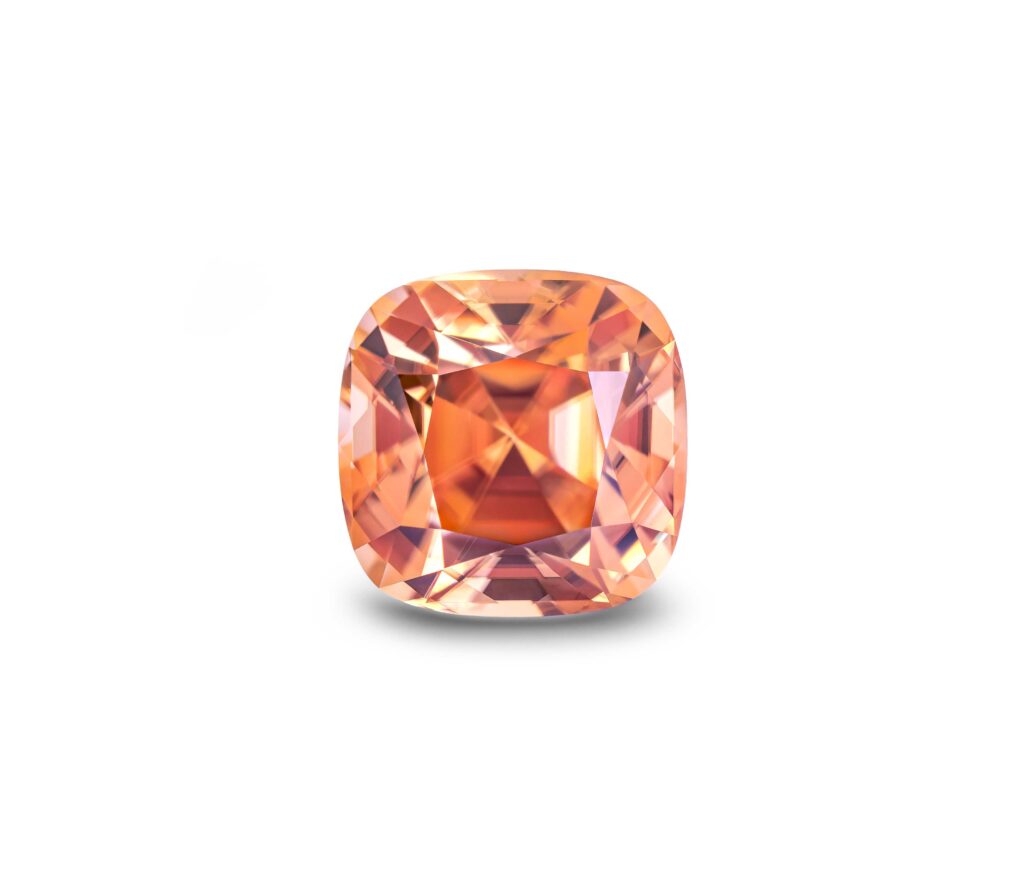
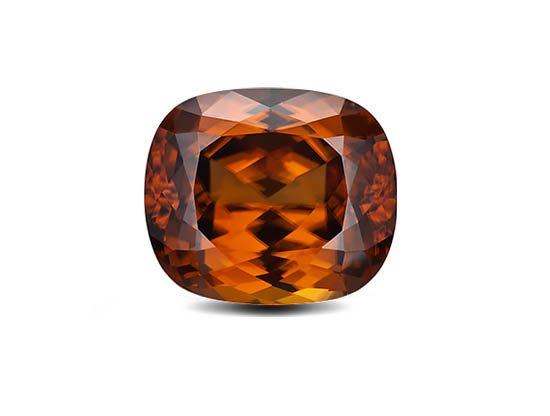
Natural zircon is the clearest illustration. Much commercial blue zircon owes its color to heat treatment, yet warm whiskey-brown and cognac specimens are prized precisely for retaining their original, unenhanced saturation, so here brown signals what has not been done to a stone. That documentary honesty sits at the heart of the color’s appeal to serious collectors, and it explains why natural-color standing, more than depth of tone alone, defines the tier a brown stone belongs to.
Identification and Natural-Color Standing
The mechanisms behind warm body color differ from one material to the next. In zircon, brown saturation combines with a refractive index approaching diamond to yield fire and brilliance that surprise collectors familiar only with commercial material. Among garnets, the pyrope-spessartite hybrids of the Malaya group carry peachy, cinnamon, and brown-modified tones arising from the interplay of iron and manganese, hues that shift perceptibly under different light sources.
Because brown reads as tonal depth rather than pure hue, cutting decisions carry unusual weight. Step cuts reveal the color as a coherent whole through continuous transparent planes, while brilliant faceting animates it into warm flashes.
Correct identification is therefore the first discipline in this color, since similar warm tones appear across zircon, garnet, and other materials that differ entirely in composition and value. Spectroscopic analysis and inclusion study distinguish one species from another and, critically, establish whether color is natural, the determination on which value in this category turns.
Collector Context for Stones in Brown Tones
Selection standards for brown gemstones draw on the gemological expertise developed by Eduard Grygorian, IGI Colored Stones Grader, with particular attention to accurate variety confirmation and the treated-versus-untreated distinction. Where the certificate accompanies the stone, documentation from GIA or specialist gemological laboratories confirms natural origin, species, and treatment status; for a color whose standing rests so heavily on unenhanced condition, that record is the foundation rather than a formality.
Stones of this color reward informed acquisition, offering optical substance and genuine natural-color credentials at a point of entry more accessible than the vivid categories. Large specimens with strong warm saturation and eye-clean clarity (free of inclusions visible to the unaided eye) grow scarce as size increases, and stones combining size, natural color, and precision cutting occupy a narrow segment of what reaches the collector market in any given period.
Acquired in loose form, these gemstones remain independently gradable, suitable for bespoke commissions, and unmodified in condition, qualities that underpin long-term resale value within a category where finite supply sustains lasting demand for rare natural gemstones. Grygorian Gallery offers private consultations on the gemological characteristics, identification, and natural-color standing that define collector-grade stones in brown tones, from its gallery at the Palais de la Scala in Monaco.