When Scale Intensifies Every Decision
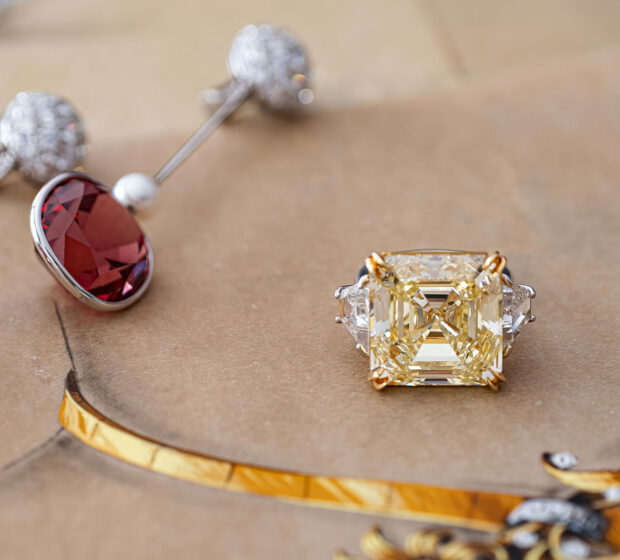
The cufflink’s design constraints are among the most demanding in fine jewelry. Face diameter — typically 12 to 20 mm — leaves little room for compositional complexity, which means every element present must earn its place precisely. A stone that reads as a minor accent in a ring becomes the entire visual argument in a cufflink face; an enamel that might serve as background elsewhere becomes the primary surface.
Enamel techniques expand the design vocabulary considerably. Plique-à-jour — translucent enamel without a metal backing — produces a stained-glass quality that no other surface treatment approaches. Champlevé fills recessed cells in the metal with opaque color, creating precise geometric fields. Guilloché applies a machine-engraved pattern beneath translucent enamel, adding optical depth to what reads as a flat surface. In unique fine jewelry and custom design jewelry of this kind, these are not decorative options — they represent fundamentally different ways of using color and light within the constraints of the format.
Closure mechanics are as consequential as the face design. Bullet-back fittings suit heavier faces where security matters most; whale-tail closures offer easier fastening for daily wear; chain-link connections allow the face to move and catch light differently as the wearer moves. Fixed-post formats read more formal and architectural. The closure is chosen for the weight and character of the face it serves — in high-end custom cufflinks at this level, that decision is made last but matters as much as any other.
The Standard That Miniature Scale Demands
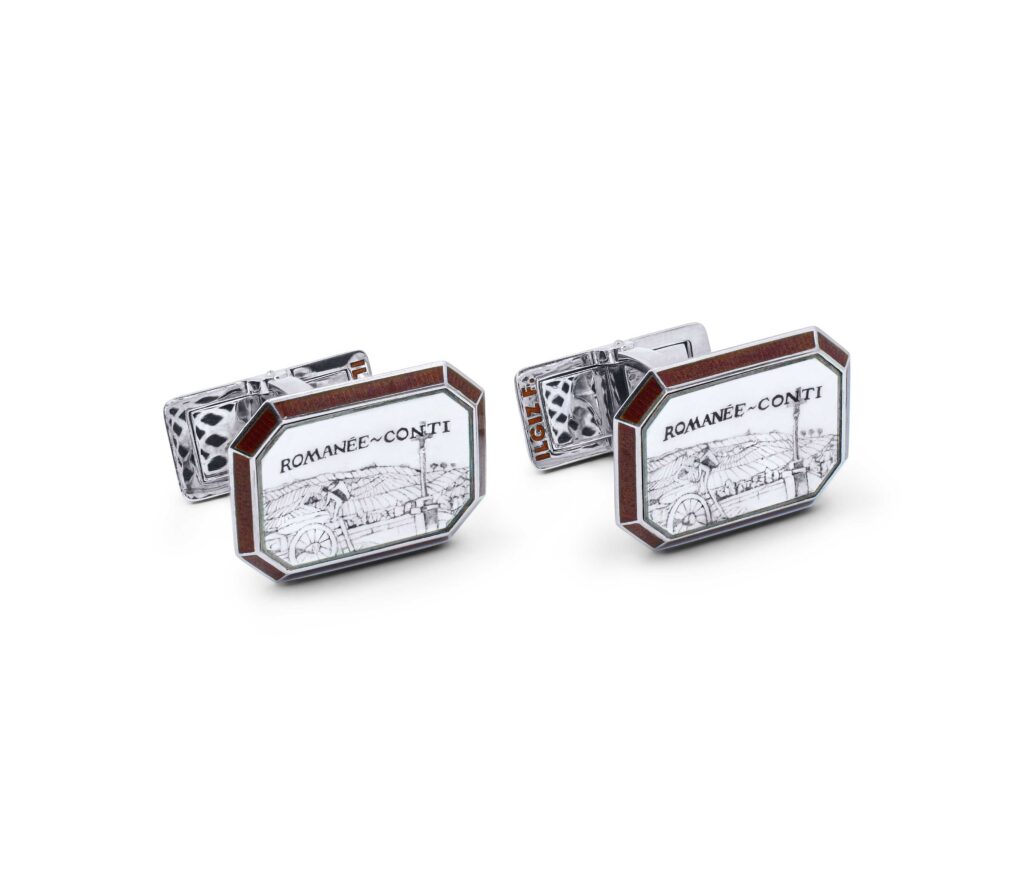
Designing cufflinks for high-end custom jewelry requires the same gemological and compositional rigour as any larger format — concentrated into a surface where there is no room for approximation. Eduard Grygorian’s background at Chaumet and Boucheron, combined with the Romanée-Conti & Monaco collaboration with master enamelist Ilgiz Fazulzyanov, defines a standard that treats the cufflink format as haute joaillerie in miniature rather than an accessory category.
Each piece reflects that standard concretely. Stone selection prioritizes face-up color and optical character at the scale the format demands — a stone that performs at 15 mm requires different cutting geometry than one chosen for a ring center. Where enamel is introduced, the technique is chosen for what it contributes to the composition: grand-feu enamel for chromatic depth and permanence, plique-à-jour where translucency is the design argument. This is bespoke luxury jewelry where the miniature scale intensifies rather than relaxes the demands placed on every decision.
Grygorian Gallery’s custom-made cufflinks carry a maker’s mark and leave our Monaco atelier as exclusive objects — each face a resolved compositional argument at the scale where precision is most unforgiving.
The Collector’s Case for Exceptional Cufflinks
Fine cufflinks anchored by exceptional stones or museum-quality enamel represent a consistently undervalued category in the collector jewelry market — objects whose material and craft content places them alongside far larger pieces, in a format that travels, stores, and wears with exceptional practicality. Cufflinks by recognized enamel masters and featuring certified colored stones have achieved serious auction results precisely because the collector base that understands their value remains selective.
Each piece is available as shown: stone or enamel selection, face design, and closure architecture already resolved. Acquiring luxury custom cufflinks of this calibre means securing both an exceptional object and one whose craft content is immediately apparent to anyone who understands the format. For collectors with a specific stone, enamel technique, or design brief in mind, bespoke cufflinks by Grygorian Gallery are available by private consultation — a made-to-order path for those who approach the format seriously. Worldwide insured shipping is available to collectors globally.