



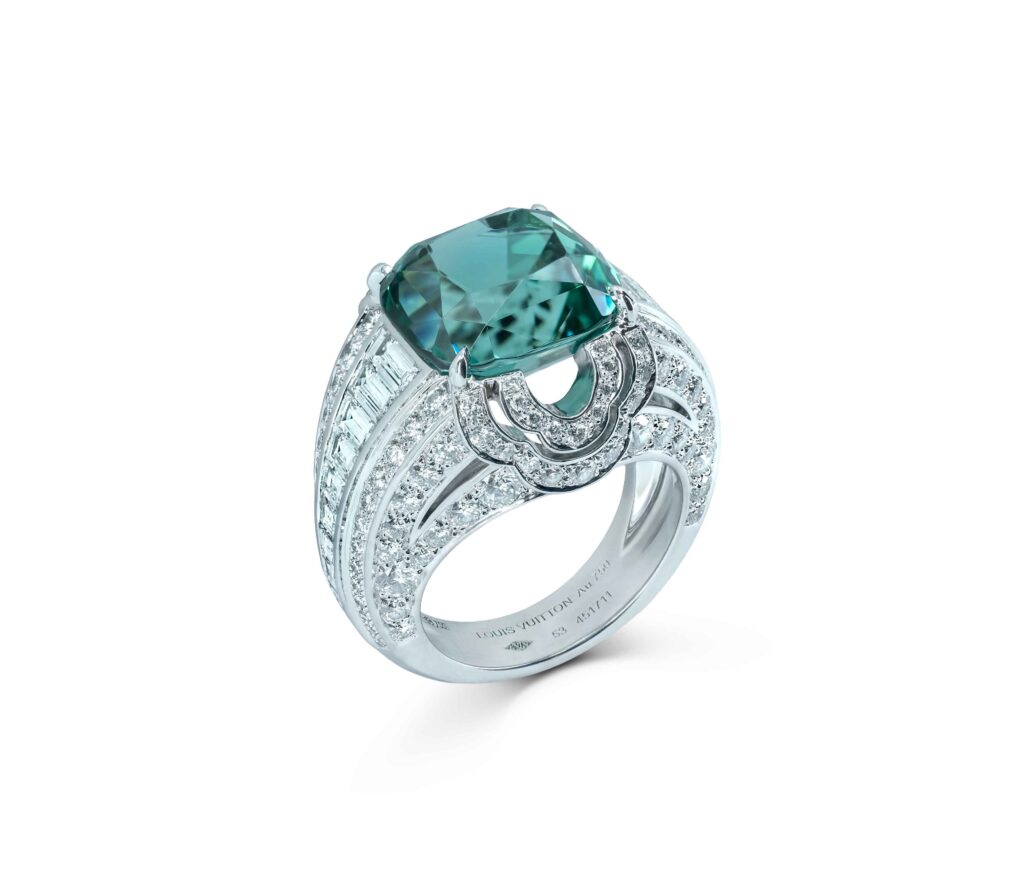

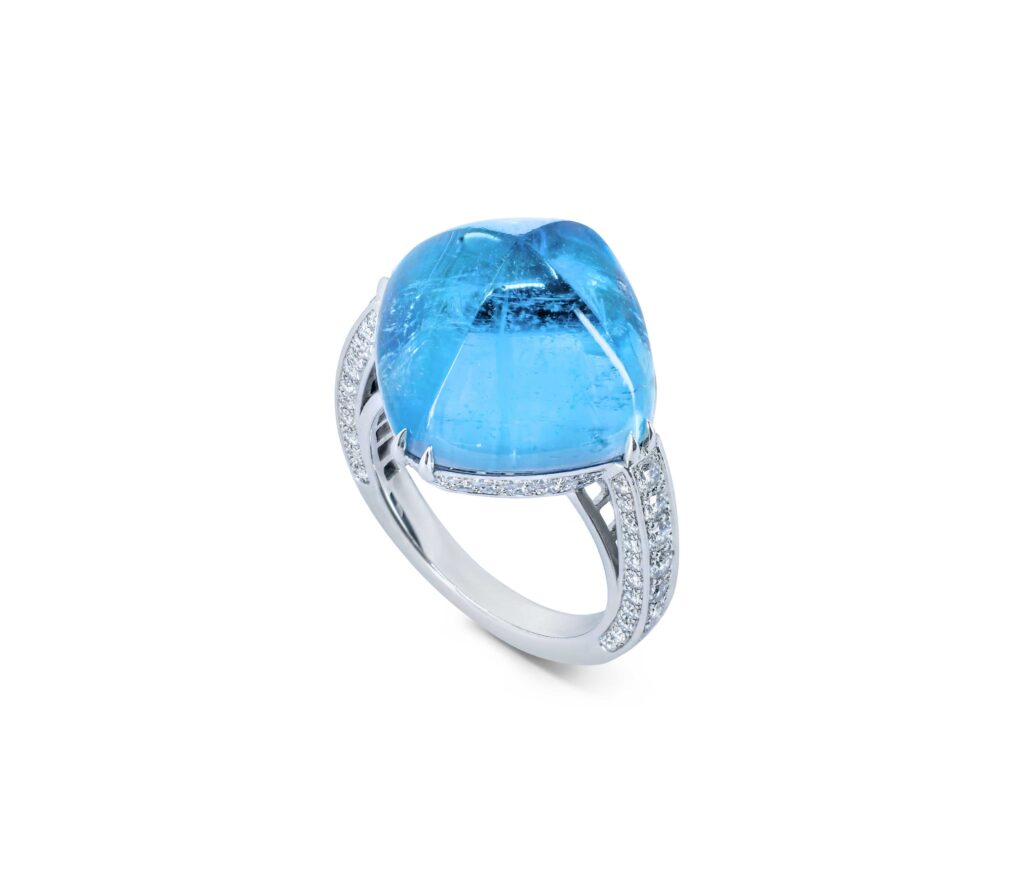
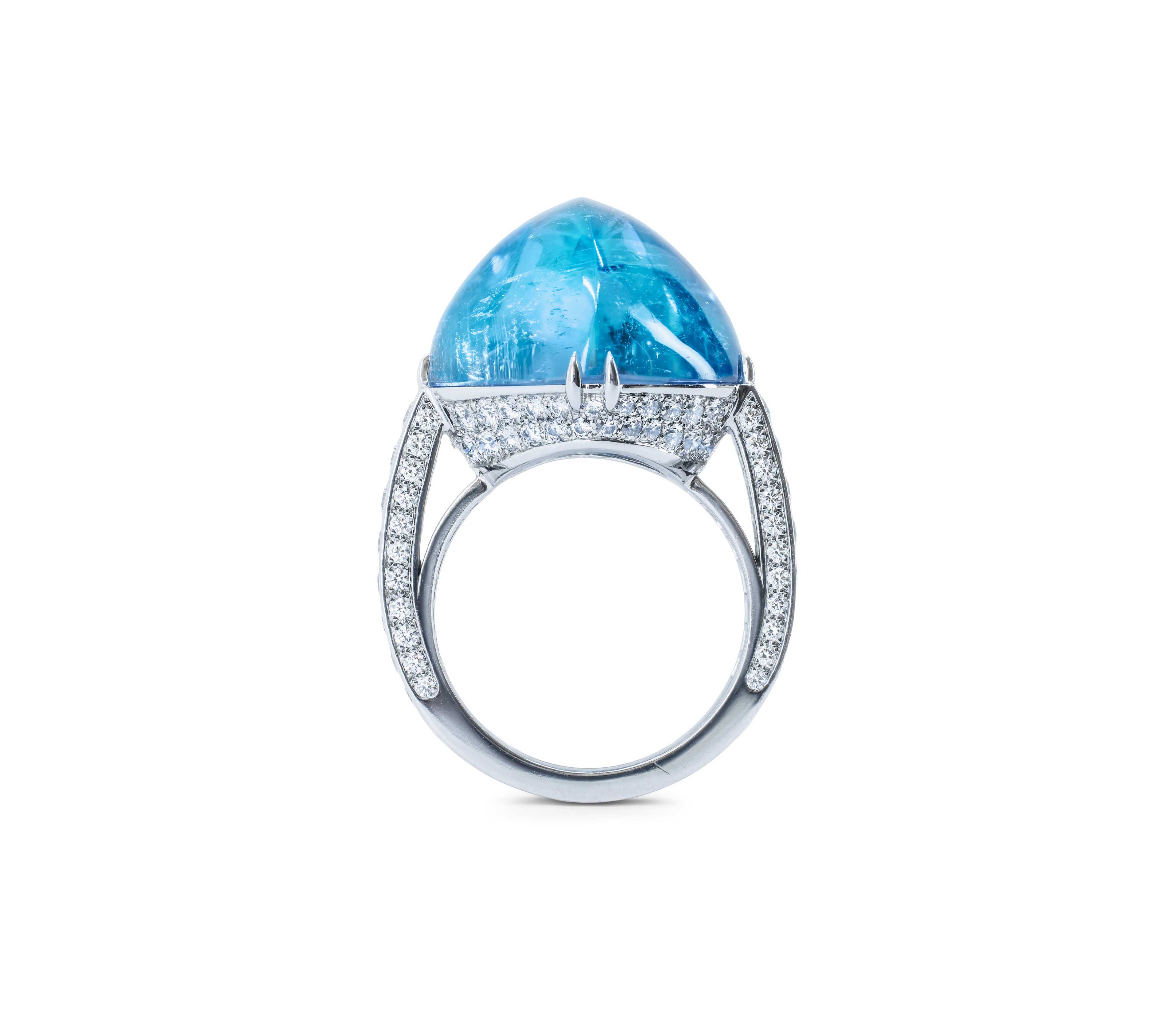



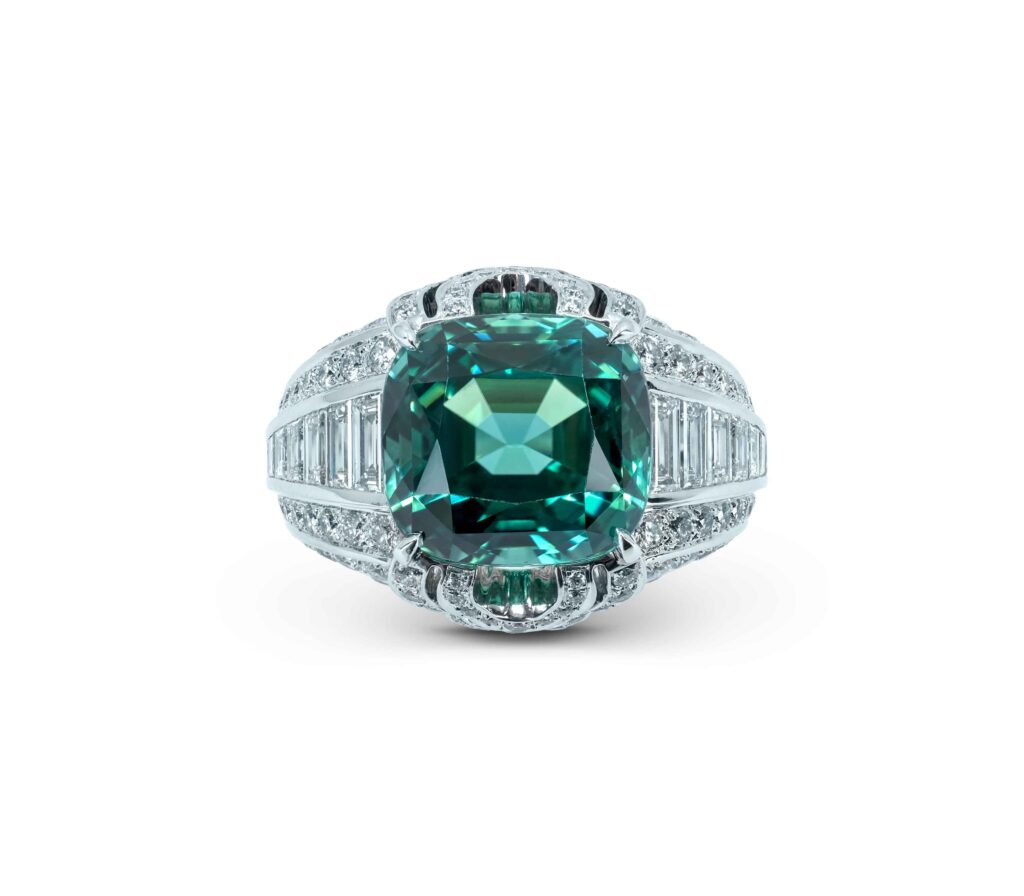
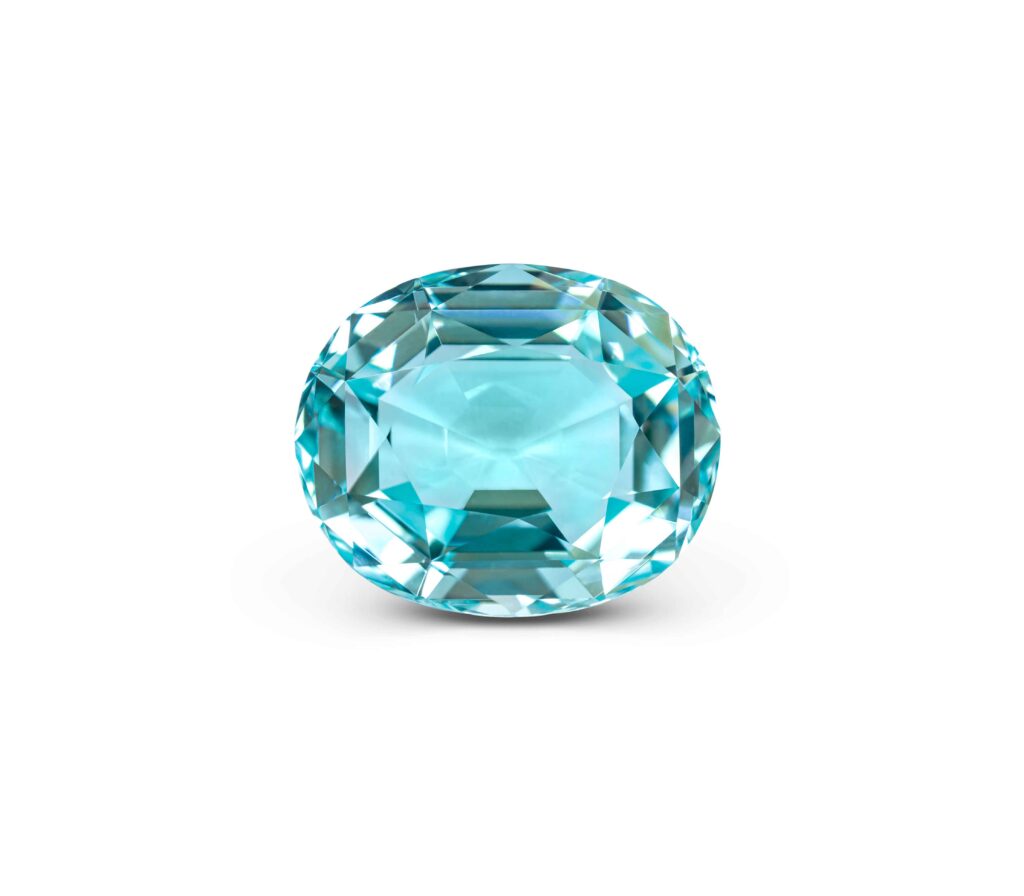
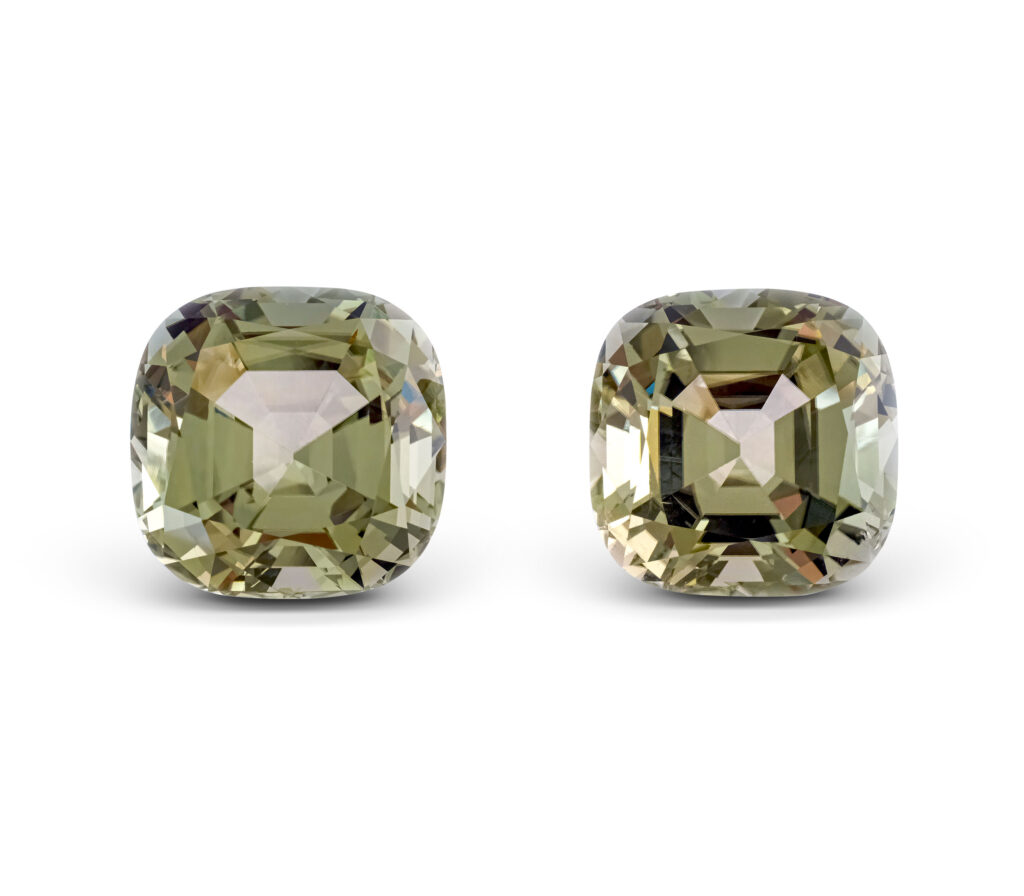
When Paraíba tourmaline first surfaced on the market in 1989, it belonged to no existing order of value. A copper-bearing gem that appears to glow from within with a cool, electric light, it was like nothing else among coloured stones. Today it outprices diamonds of comparable size, and the salerooms of New York, Geneva and Hong Kong post results that would have seemed impossible a decade ago. What follows are the jewels that set the defining records — and why those records have held.
The Record Set in a Single Evening
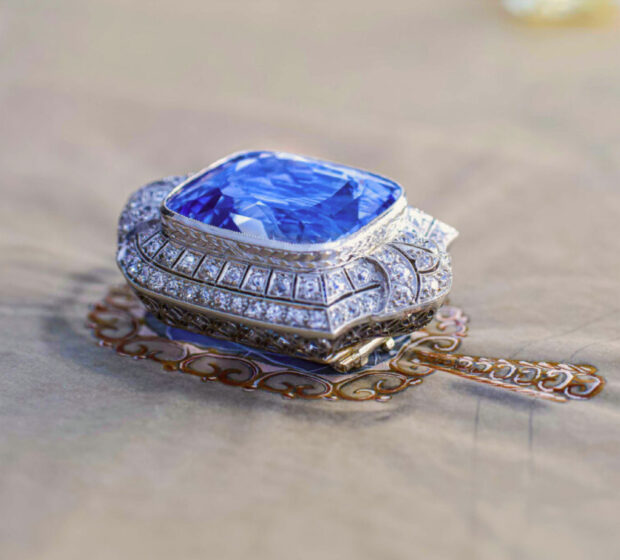
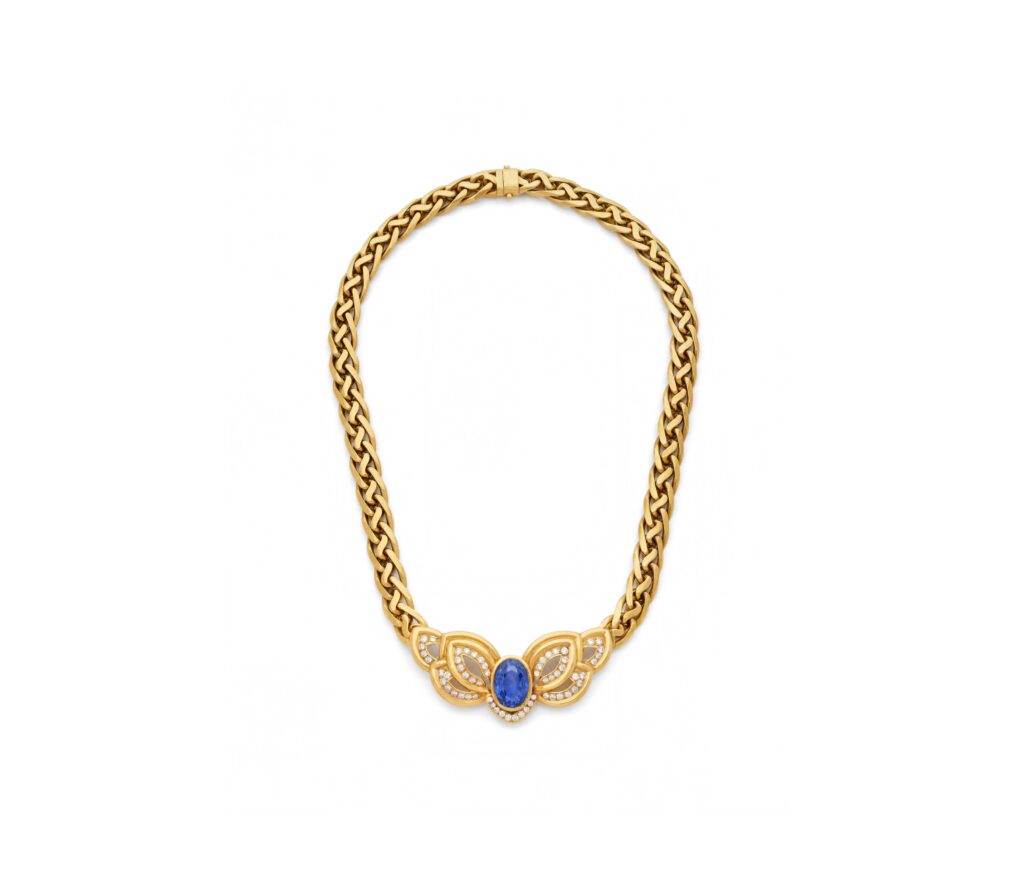
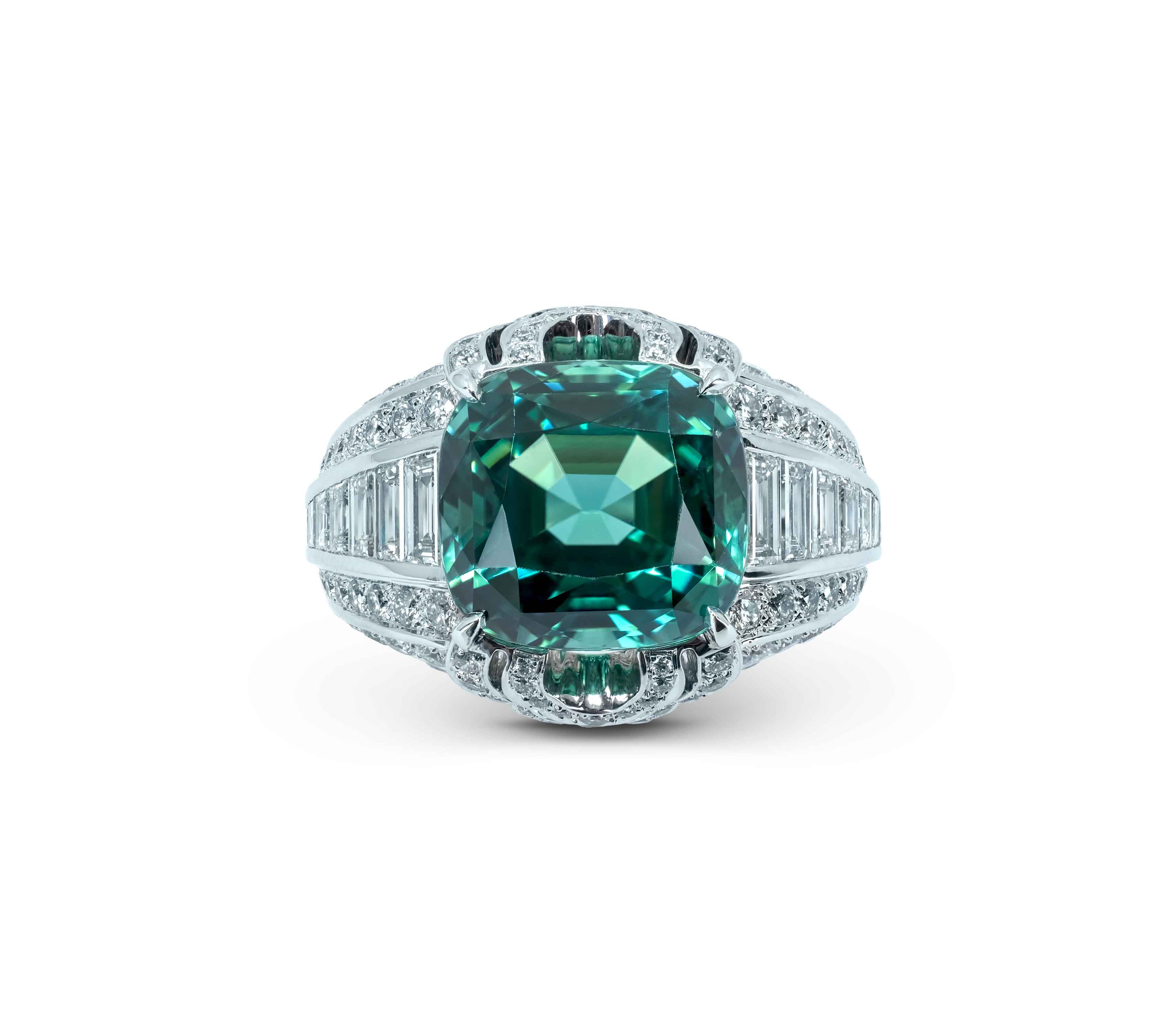
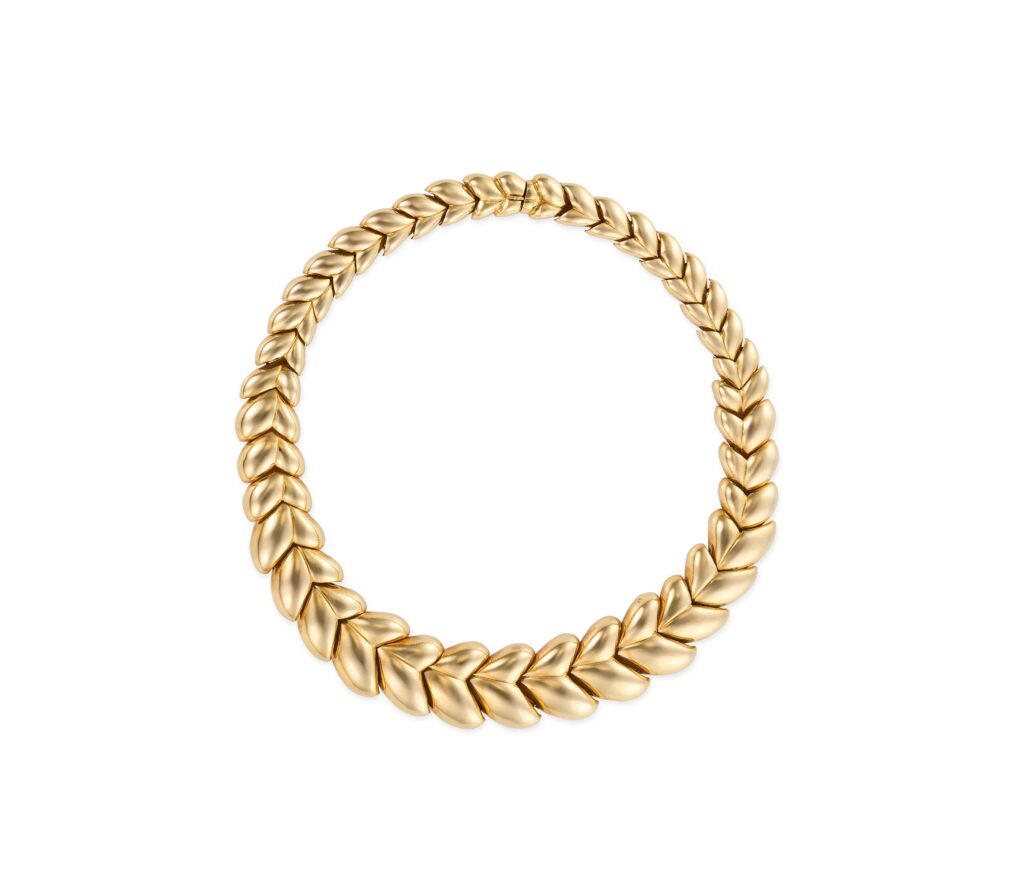
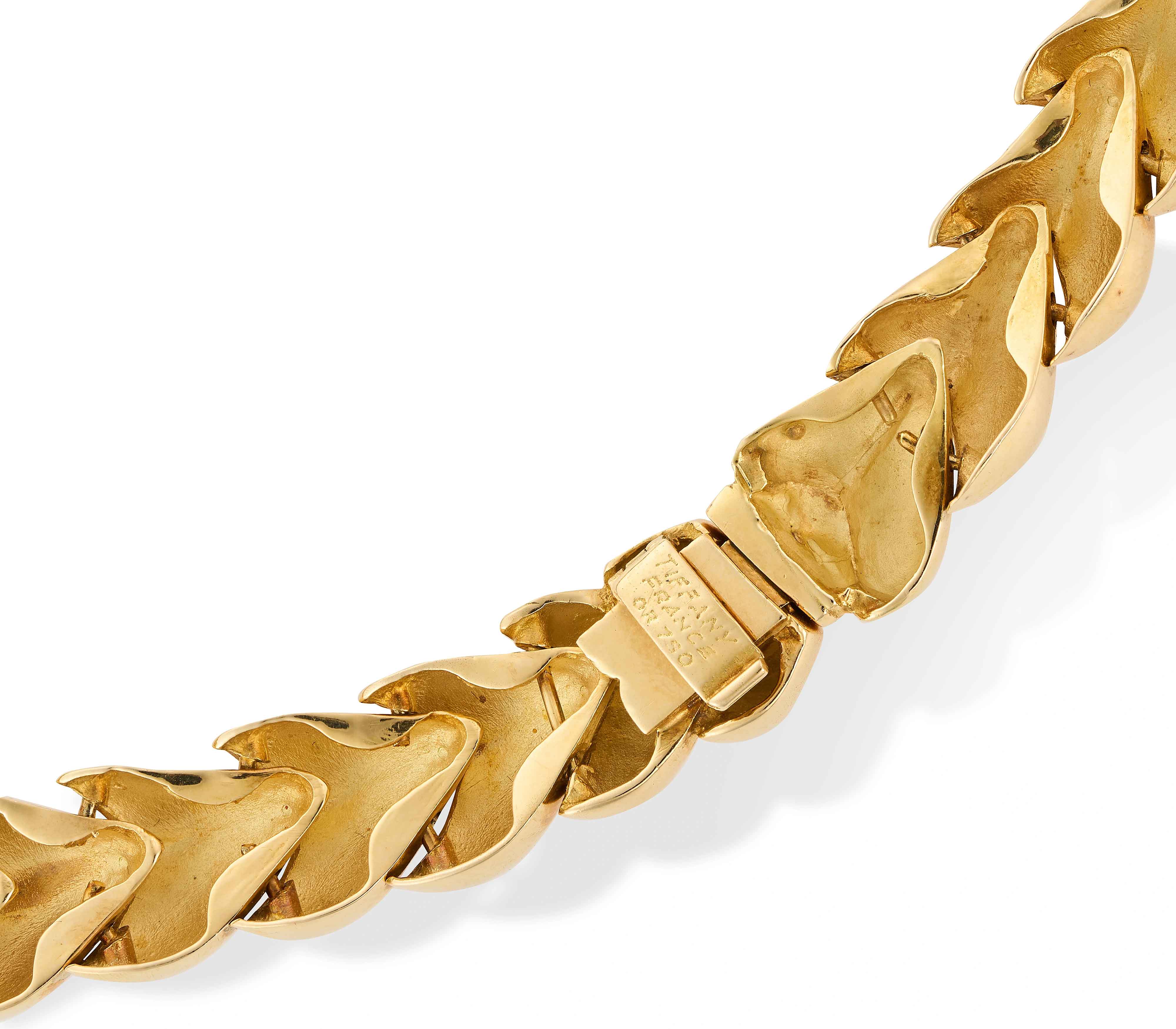
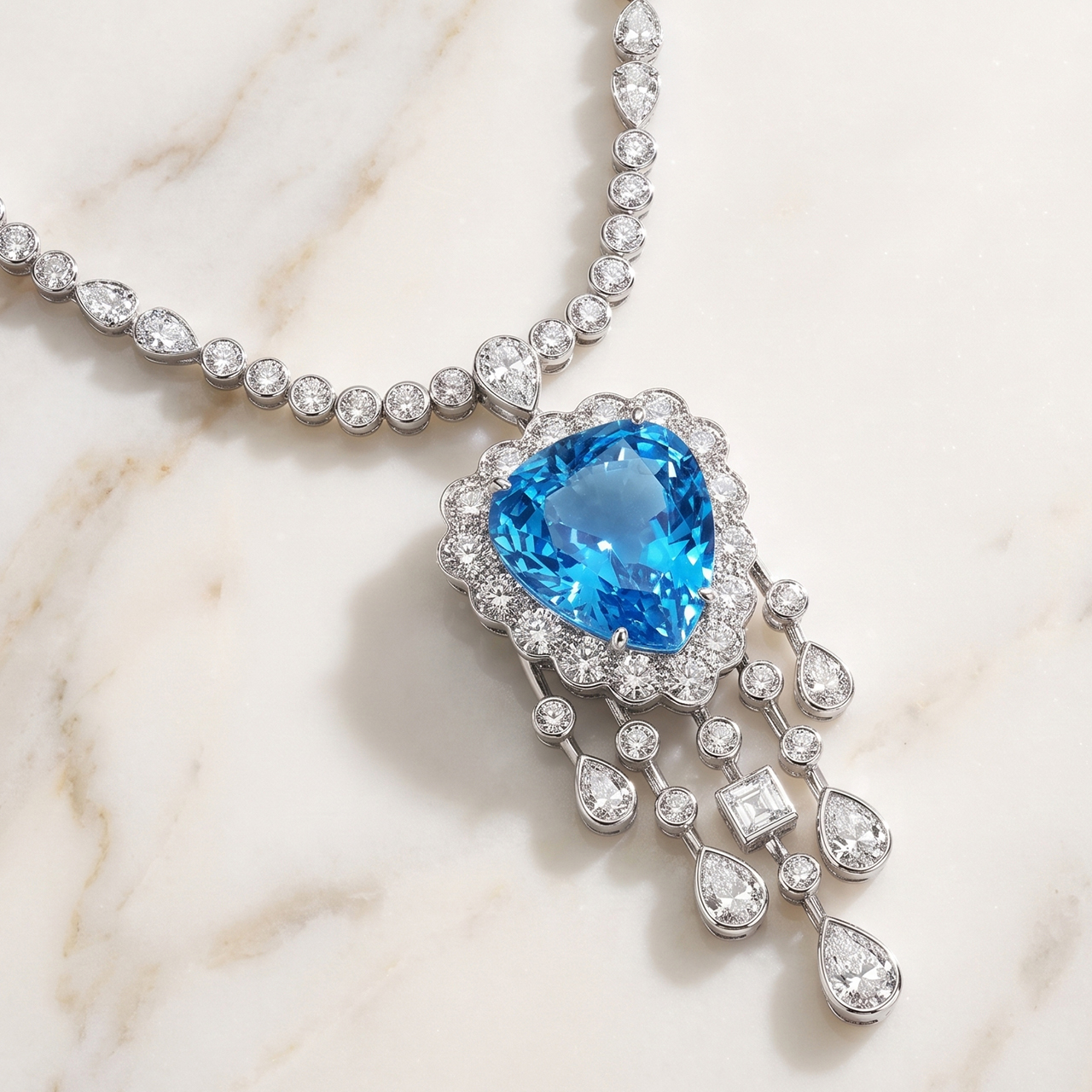
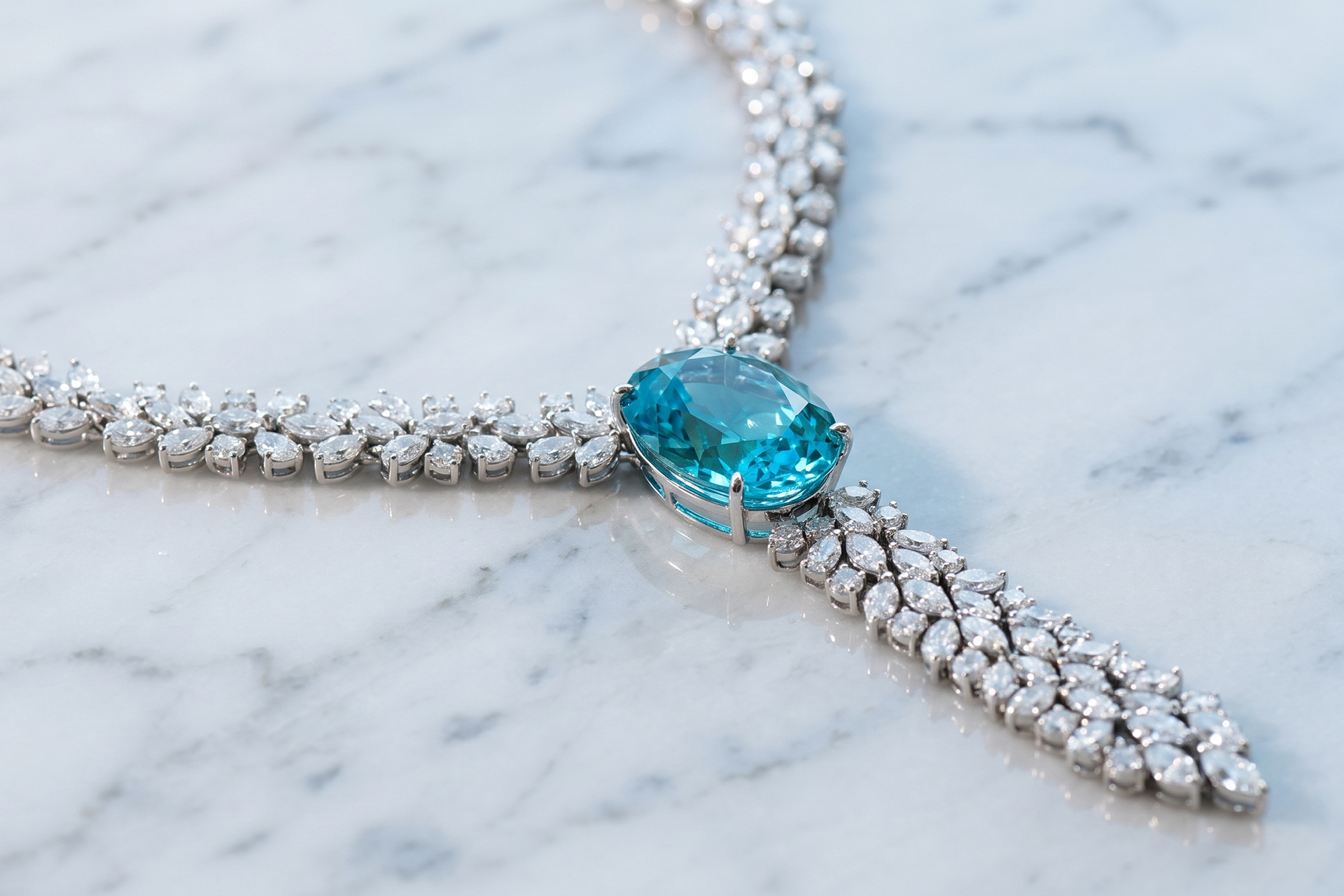
On 10 December 2025, at Christie’s Magnificent Jewels sale in New York, a Tiffany & Co. necklace centred on a 13.54-carat Brazilian Paraíba tourmaline of triangular-brilliant cut sold for $4,223,000. It is the outright world record for any Paraíba jewel at public auction, and it set a per-carat record of roughly $311,890. The necklace came from the Draime Collection with reports from two laboratories, AGL and Gübelin, confirming its Brazilian origin and its delicate low-temperature heat treatment.
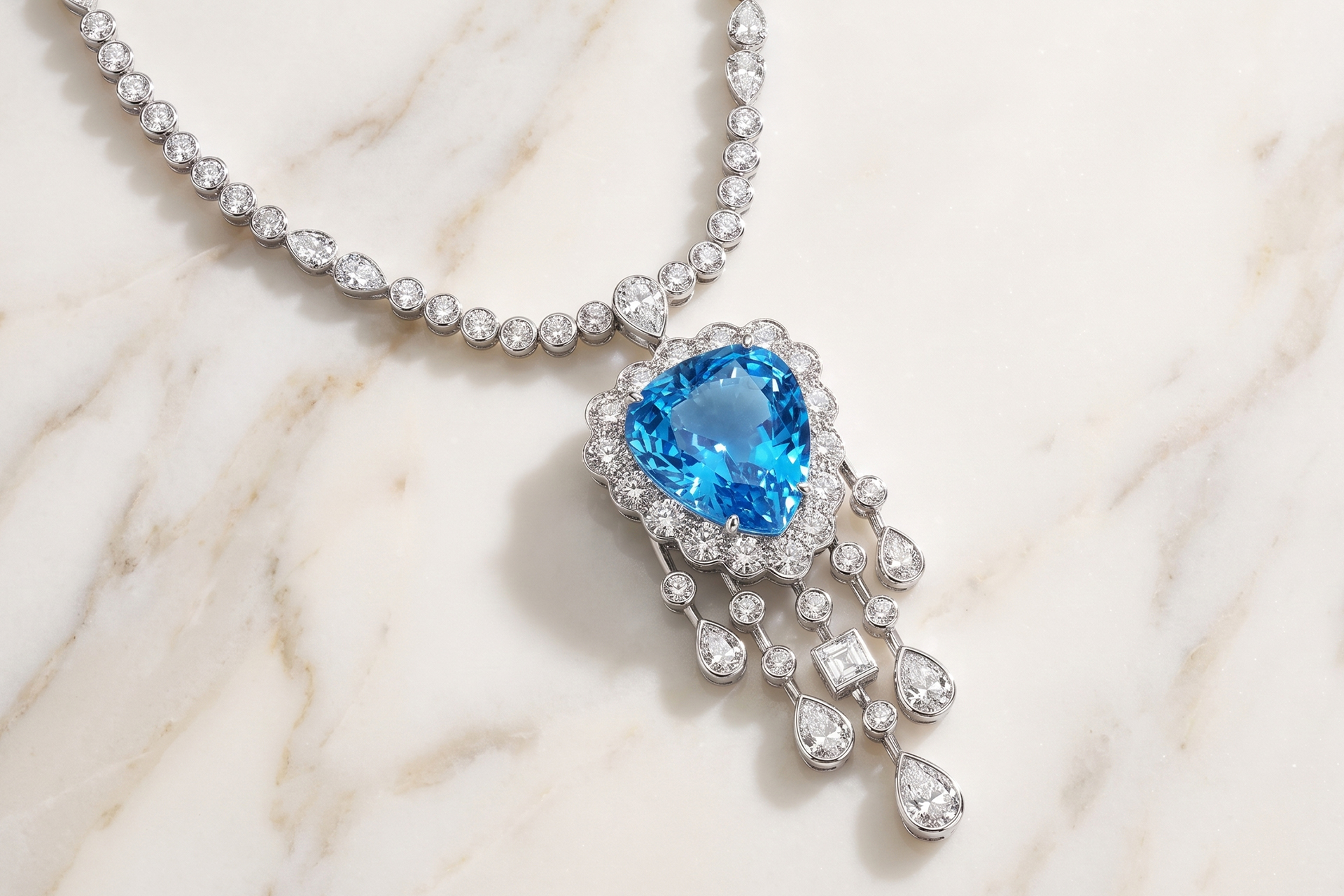
The high estimate had been $600,000; the hammer fell at close to seven times that. At this level, so wide a gap between estimate and result tells its own story — several bidders in the room, each unwilling to let the piece go. The previous record had stood for a full decade: in November 2015 a ring set with a 5.50-carat tourmaline sold at Christie’s Geneva for $3,300,000, about $600,000 a carat. The New York result did not simply beat that mark; it reset the scale by which fine Paraíba is measured.
The Suite That Confirmed the Pattern
The record carried all the more weight because the Draime necklace did not sell alone. The same evening, the matching Tiffany & Co. ear pendants from the suite — two oval Brazilian tourmalines of 3.45 and 3.19 carats, 6.64 carats in all — made $1,270,000, roughly $191,265 a carat. They too flew past expectation: against an estimate of $120,000 to $180,000, the result came in at some seven times the high figure and nearly ten times the low — a point the AGTA was quick to note.
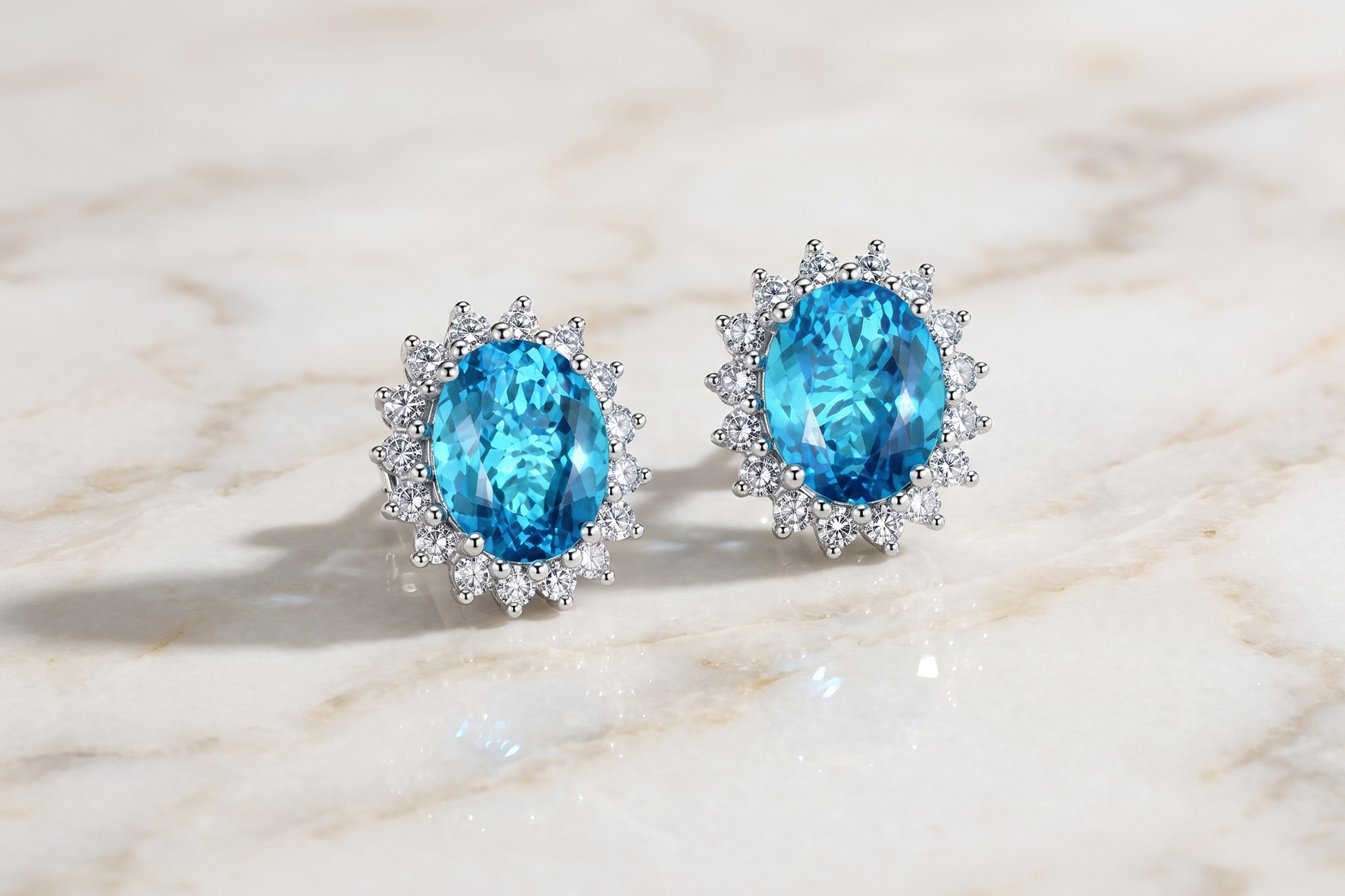
When both the principal jewel and its companion beat expectation sevenfold in a single evening, this is no longer a spike of interest in one lot but a change in how the material itself is read. Christie’s tied the result to the maison’s own history: Tiffany & Co. was among the first to grasp the rarity of Brazilian Paraíba, securing “exceptional access” to the original material soon after the stone’s discovery in 1989. The buyer in December 2025 was paying not only for gem and diamonds, but for the signature, the Draime provenance and the completeness of the suite.
The Most Expensive Paraíba Earrings
The record within the earring category belongs elsewhere. At Christie’s Magnificent Jewels in Hong Kong, a pair of pear-shaped Brazilian Paraíbas — 7.46 and 6.81 carats, 14.27 carats together, heated — sold for $2,780,000, about $194,800 a carat, well clear of the $2.3 million high estimate. That result still stands: for all the noise around the Draime Tiffany earrings, those made $1,270,000, leaving the Hong Kong pair more than twice as dear.
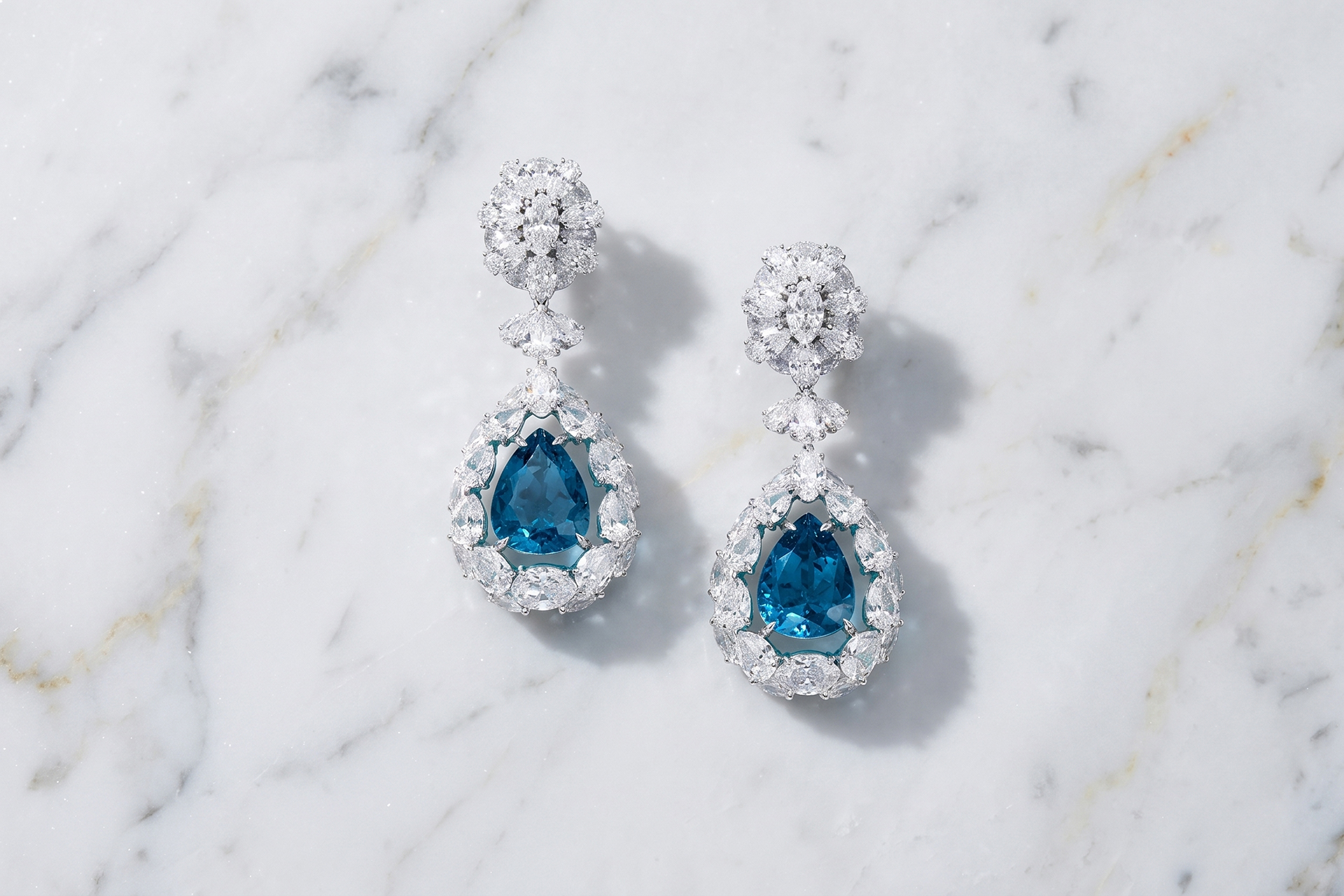
Beyond the sum, the lot speaks to how far demand reaches past New York and Geneva. For a decade now, Hong Kong has been one of the rooms where world prices for the finest coloured stones are made. Two deeply saturated neon-blue tourmalines framed in pear-shaped diamonds offered that rare meeting of size, colour and matched pairing for which collectors will abandon any model.
A Brazilian Pendant Made to Be Reset
On 16 June 2022, at Sotheby’s Magnificent Jewels in New York, a pendant necklace built around a 10.31-carat Brazilian tourmaline sold for $1,197,000, about $116,100 a carat. The stone carried reports from AGL — graded “Classic Brazilian” — and Gübelin, and Sotheby’s noted that it could be reset: a detail that matters to collectors who think of a stone apart from its current mounting.
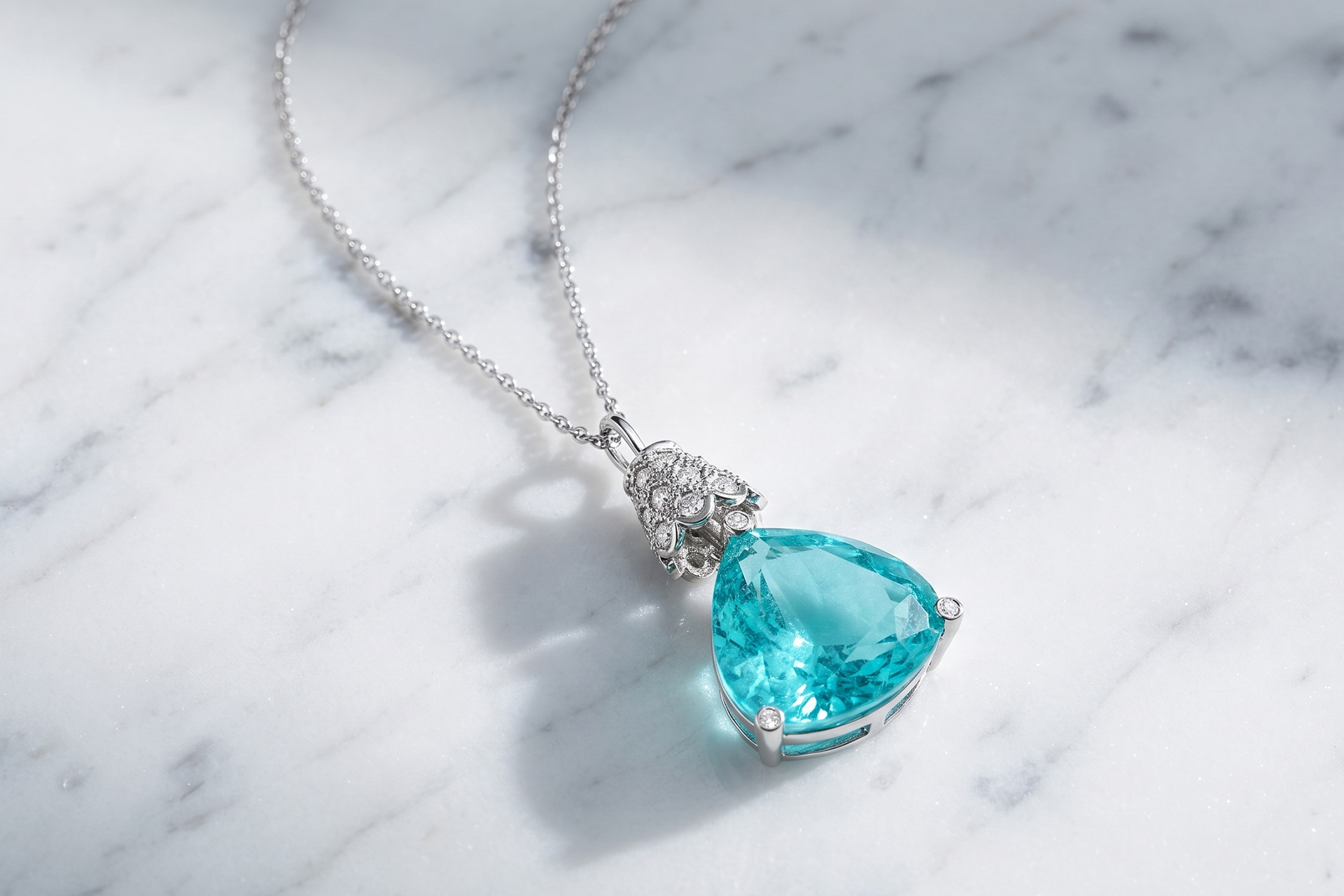
This lot makes a useful baseline. It is the most affordable of the great Paraíbas in absolute terms, and it throws the rise that followed into sharp relief: in under three and a half years, the per-carat ceiling climbed from $116,000 in 2022 to $312,000 with the Tiffany record of 2025.
The Three-to-Seven-Carat Field, Where Everything Is Climbing
Headline records are the summit. The real depth of the market, though, lies in the middle carat range, where most business is done and where the past few years trace an almost unbroken climb.
In September 2024, at Bonhams New York, a ring set with a 5.44-carat cushion-cut Brazilian Paraíba (heated) sold for $533,900 — around $98,143 a carat. In May 2024, a pendant necklace with a 3.39-carat Brazilian stone made $373,000 at Christie’s Hong Kong (about $110,029 a carat). And on 3 October 2024, Phillips sold in Hong Kong a ring set with an unheated 7.04-carat pear-shaped Brazilian Paraíba, its clarity unenhanced, for HK$1.5 million — some $188,051, or roughly $26,711 a carat: a telling premium for a stone left in its natural state.
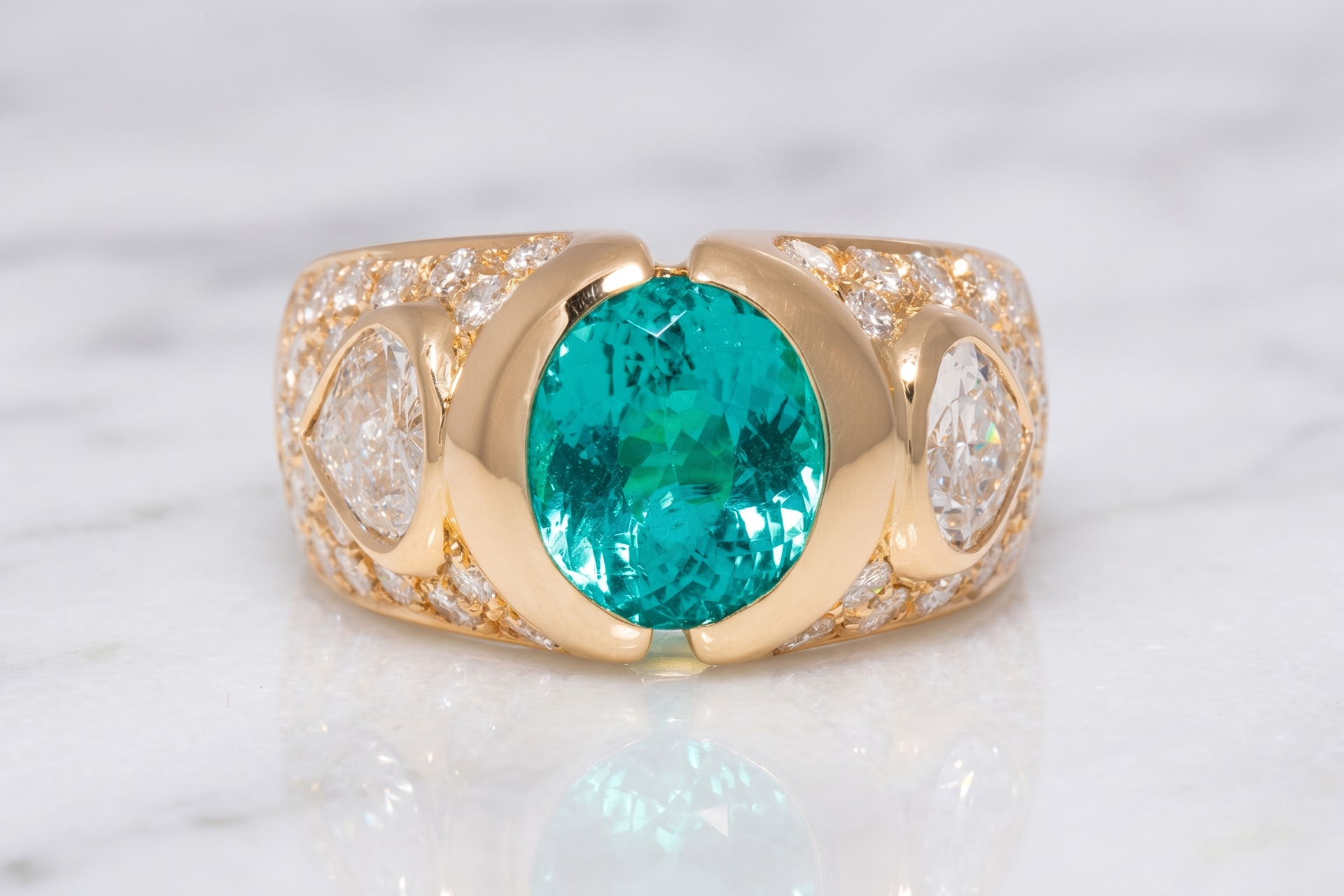
The same story plays out across several years and in many guises — from an intimate Marina B ring set with a 2.80-carat Paraíba at a themed Sotheby’s sale, to a Lorraine Schwartz ring that came up at Christie’s New York, to a 14.20-carat Brazilian stone in a gold mount that took roughly $800,000 at Christie’s Hong Kong. An unheated 1.35-carat Paraíba at Christie’s Hong Kong in 2017 beat its high estimate to reach $88,000 — proof that even at a modest size, an untreated stone finds its buyer. Demand answers to neither the form of the jewel nor the carat range: Paraíba is wanted in equal measure — in earrings and rings, from signed ateliers and open salerooms alike, at a carat and a half as readily as at fourteen.
The Legendary Stones That Never Changed Hands
The story of Paraíba is not all triumph; it is also the sales that never happened, and those tell us as much. A telling paradox runs through it: the largest and most famous stones of this kind have never become auction record-holders. Size impresses, but collectors pay for the glow — and the glow owes nothing to mass.
The best-known case is the Ethereal Carolina Divine Paraíba, a 191.87-carat oval brilliant recorded by Guinness as the largest cut Paraíba in the world. It was faceted in 2009 and valued that year at somewhere between $25 million and $125 million. It belongs to Vincent Boucher (Billionaire Business Enterprises), and in 2013 it was set into the Kaufmann de Suisse necklace “Paraíba Star of the Ocean.” A sale planned for 2014 was called off, and the stone has never reached public auction. Independent appraisers have named far cooler figures: Leon Megé put it at roughly $7 million on its own, about $3 million as mounted. The gap between the price asked and the price the market will bear has kept it unsold to this day.
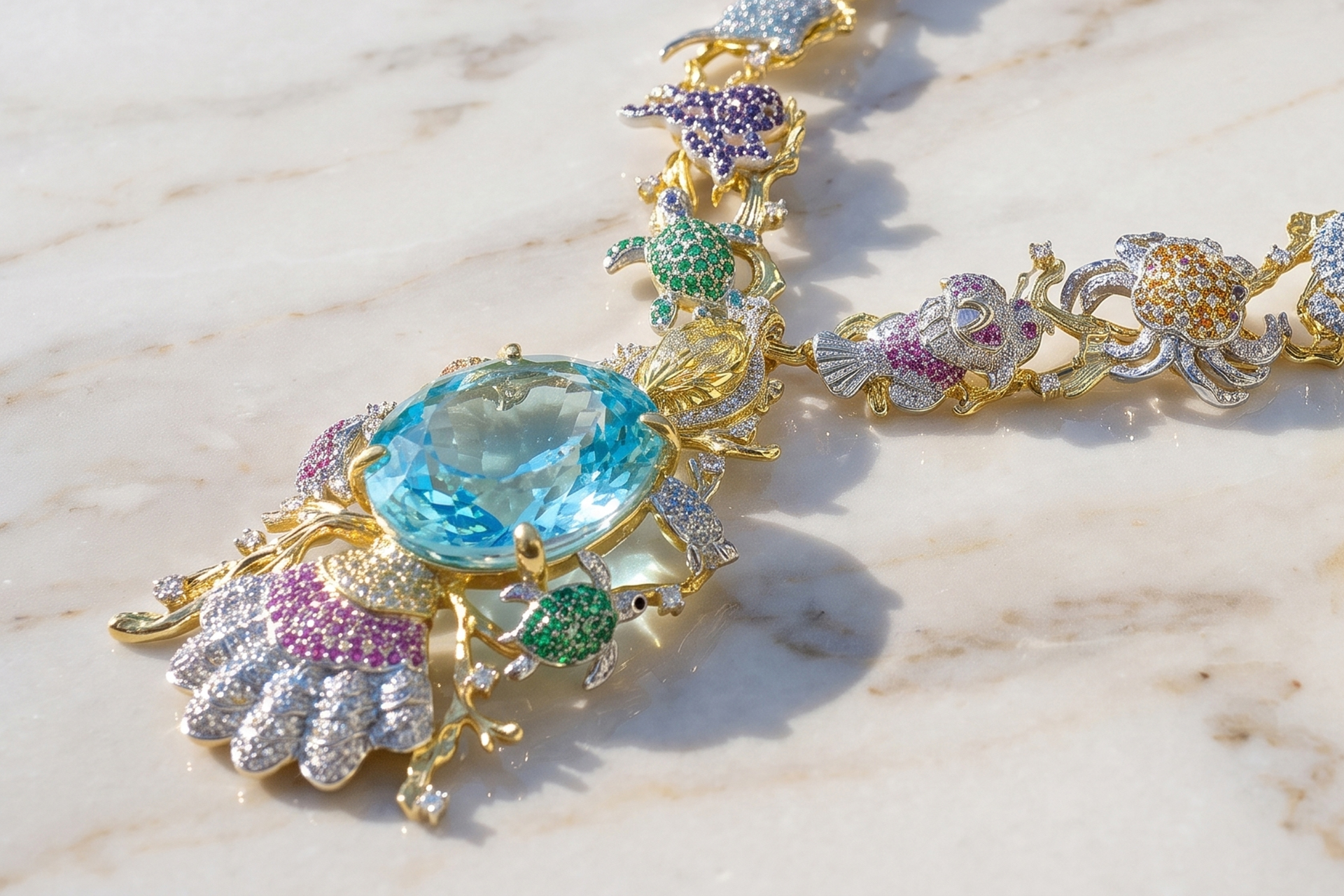
Two large Mozambican jewels have met a similar end. Blue Lagoon — a 93.94-carat unheated Paraíba in an Adler Joailliers necklace with 76 carats of diamonds — was pulled before its sale at Sotheby’s Geneva on 8 November 2023, against an estimate of CHF 1.3–2.5 million and reports from SSEF and Bellerophon. Flawless Jena Blue, a 100.59-carat Mozambican stone, also unheated, found no buyer at Heritage Auctions in Dallas on 5 October 2020: lot no. 72111 went unsold against an estimate of $1–1.5 million and a GIA report.
Against that record, the sale of 22 May 2025 stands out all the more. At Bonhams’ Jewels & Jadeite sale in Hong Kong, the Kat Florence Lumina — an internally flawless, unheated 181.61-carat Mozambican stone recut from an 830-carat crystal Don Kogen unearthed in 2003 — sold, with reports from Bellerophon, AGL and Gübelin, for HK$3,814,000, about US$487,000, to become the largest Paraíba ever sold at public auction. Yet per carat that comes to only some $2,683 — against records in the hundreds of thousands for stones many times smaller. Giants lose value by the carat for a reason: too much size opens “windows,” zones where light passes straight through without bending, dimming the very neon the buyer is paying for.
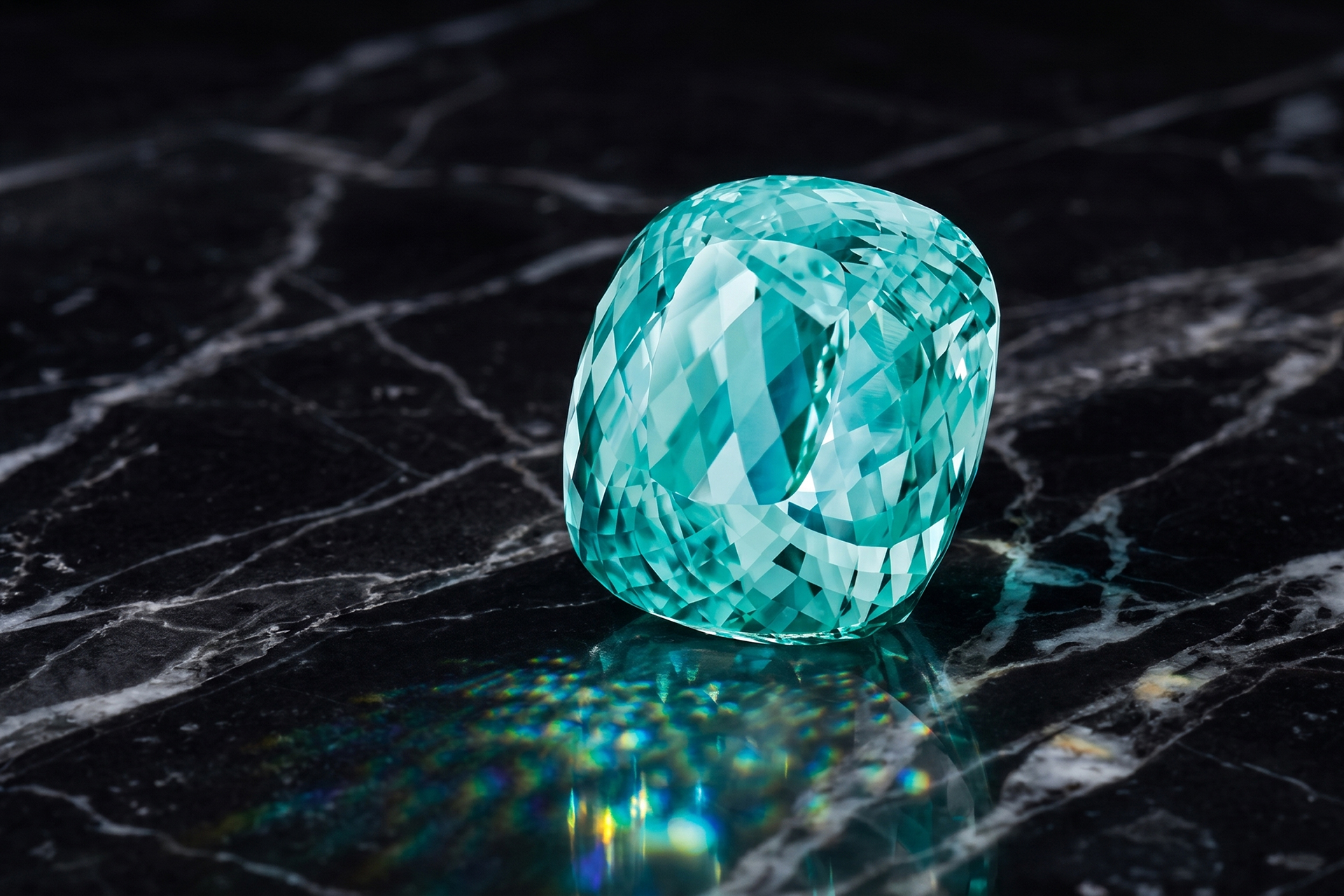
The same holds for an unmounted 22.38-carat oval Mozambican Paraíba, sold at Christie’s Paris on 17 December 2024 for €825,500 — about $969,647, or roughly $43,326 a carat. It cleared its high estimate around sevenfold: the appetite for large African stones is plain once colour and clarity truly convince.
Where the Neon Comes From
In 1989, Heitor Dimas Barbosa struck, at the Mina da Batalha in São José da Batalha in the Brazilian state of Paraíba, a tourmaline unlike any seen before: it glowed from within with a cool, electric light. It is an elbaite tourmaline carrying traces of copper and manganese. Minute amounts of divalent copper (Cu²⁺), together with charge transfer between copper and manganese, produce a luminosity no other gemstone can match. Manganese sets the hue: trivalent manganese (Mn³⁺) gives pink and violet, and with copper and iron, green.
It is copper content that draws the line between Brazilian and African material. By the GIA’s account (Gems & Gemology, Winter 2019), Brazilian stones carry on average about 11,400 units of copper (ppmw) against fewer than 2,000 in African ones. More copper means a stronger neon — though copper alone does not fix the price: SSEF, for instance, will withhold the name “Paraíba” from copper-bearing stones whose colour is not saturated enough.
Most commercial-grade stones are gently heated — around 260–370 °C, with a slow ramp — to nudge violet towards neon-blue and clear the greyness that iron leaves. Unheated stones with naturally saturated colour command a premium of 30 to 100 per cent over treated ones, and demand for them keeps climbing: the Lumina, Blue Lagoon and Jena Blue were all presented, pointedly, as unheated.
Colour: From Neon to Pink
Within a single origin, hue does more than anything else to set the price. The pecking order runs like this: at the top, pure neon “Windex blue,” an electric blue with no trace of green, the shade that has come to mean Paraíba at its best. Below it, electric turquoise, then blue-green, then mint-green and, at the bottom, violet and pink. The top two hues are exceptionally rare in Brazilian stones of three carats and up.
For Brazilian stones of two to three carats, the numbers are concrete. Pure neon “Windex blue,” without a hint of green, runs $30,000 to $120,000-plus a carat and is scarcely seen above three carats. Classic neon blue-green sits at $20,000 to $60,000, the backbone of the high end. Bluish-green and greenish-blue of medium saturation run $8,000 to $25,000, the most common output of today’s Brazilian mines. Mint and clean green, with less copper-blue, run $3,000 to $10,000. Copper-bearing violet and purple — often heated towards blue — fall between $2,000 and $8,000. Pink, cuprian and coloured by Mn³⁺, sits at $1,500 to $5,000, a niche for collectors.
Origin as a Premium: Brazil, Mozambique, Nigeria
Origin sets the baseline. Brazilian material is consistently dearer than African — a premium of two to ten times for like quality. Fine Brazilian stones trade from roughly $10,000 to more than $150,000 a carat; Mozambican, per Rapaport’s survey “The Perpetual Popularity of Paraiba,” typically $2,000 to $25,000; Nigerian, per Alif Gems, $70 to $50,000. The gap widens above two carats and is locked in by origin reports.
Within each origin, quality tiers the price further. For Brazilian material the benchmarks run: commercial and melee (under 0.5 carat), $300 to $2,500 a carat; good (0.5–1 carat), $2,000 to $8,000; fine (1–3 carats, strong neon, clean), $10,000 to $30,000; extra-fine (3–5 carats, saturated electric blue), $30,000 to $80,000; top “Windex blue” (5–10 carats), $60,000 to $150,000; investment and collector grade (10 carats and up), $100,000 to $250,000-plus. Auction results bear this out: a one-carat top-quality Brazilian Paraíba runs about $10,000 to $15,000 a carat, stones from 10 carats $30,000 to $60,000, with auction outliers above $300,000 (the centre stone of the Tiffany necklace). Mozambican and Nigerian stones climb the same ladder, at a fraction of the level.
The market makes the point plainly. Benoît Repellin of Phillips sold an unheated 7.04-carat Brazilian Paraíba in Hong Kong in October 2024 at more than $26,700 a carat, while Sotheby’s estimated the 93.94-carat Mozambican Blue Lagoon necklace in 2023 at only $13,800 to $26,600 a carat — for a vastly larger stone. A documented “Classic Brazilian” origin from AGL or Gübelin adds 50 to 200 per cent over an African equivalent of the same look and weight. Without an authoritative report, even a beautiful copper-bearing stone is priced, by default, on the African scale.
Certification as the Price of Entry
For any stone above a carat, a laboratory report has gone from nicety to condition of sale. The market recognises five houses: GIA, SSEF, Gübelin, AGL (American Gemological Laboratories) and GRS; for the largest stones, Bellerophon joins them, usually alongside one of the five.
The trade definition of Paraíba comes from the Laboratory Manual Harmonisation Committee (LMHC): Information Sheet No. 6, adopted in 2006 and revised in 2023. By it, Paraíba is a tourmaline in blue, bluish-green, greenish-blue, green or yellowish-green tones of medium-light to high saturation, owing its colour mainly to copper and manganese — whatever its geographic origin. There is no numeric copper threshold: the test is the interplay of colour, chemistry and the spectroscopic dominance of copper over iron. Origin is settled by LA-ICP-MS from levels of copper, zinc, gallium, strontium, tin and lead; SSEF singles out copper, gallium and tin as the most telling.
An origin report is no formality but the document that sets the price. A Brazilian stone without one sells at an African price; an African stone with convincing colour and a full set of reports rides to the top of its range. The word “exceptional” from Gübelin or SSEF can add 25 to 100 per cent, and an AGL “Classic Brazilian” report remains the most widely trusted mark of Brazilian origin in the American rooms.
How Collectors Enter the Market
Auction records set the reference points, but there are several ways into the Paraíba market — and each level answers to its own logic.
Up to $50,000 — whether for a finished jewel or a loose stone for a future mounting — buyers tend to settle on a Mozambican Paraíba of 1 to 3 carats with a GIA report: confirmed origin, an approachable price, a straightforward purchase, and a sensible way in for anyone just discovering the material.
From $50,000 to $500,000 — a bracket that spans both signed pieces on the secondary market and certified stones bound for private commission — the conversation moves to Brazilian material. Two things become non-negotiable: a report from a laboratory that carries weight — Gübelin, SSEF, AGL, GIA or GRS — and a documented treatment status. Unproven claims of Brazilian origin count for nothing here.
Above $500,000 — the ground of the major salerooms, where stone, setting and name are weighed as one — a further multiplier comes into play: the signature. Tiffany, Cartier and JAR genuinely move the final price; but at resale that premium returns only on pieces that are truly landmark, with an unbroken ownership history.
At every price, unheated stones — those whose colour formed in the ground, with no thermal correction — appreciate faster and hold their value more surely. Heated stones are perfectly legitimate and common, but over time they trail their untreated peers.
What You Are Really Buying
At the top of the market, price is a sum of parts, and the stone is only one. The Tiffany & Co. signature, the Draime provenance and the completeness of the suite carried the record necklace to $4.2 million, where the 13.54-carat Brazilian tourmaline alone would fetch a conservative $80,000 to $150,000 a carat on the open market — the premium for a celebrated maker running to something like two to four times.
The same ratio holds elsewhere. Signed pieces in the middle segment (Le Vian, Graziela, Mark Henry, Theo Fennell, Martin Katz) tend to cost two to four times the wholesale value of centre stone, diamonds and metal together. High jewellery from the leading houses (Cartier, Tiffany, Bulgari, JAR, Van Cleef & Arpels) runs five to ten times wholesale at primary retail; resale then recovers some 50 to 70 per cent of the original retail figure. For Mozambican pieces, the secondary market — per 1stDibs — sits between roughly $3,170 and $91,315, a median near $56,935, for rings and pendants usually set with stones of 2 to 10 carats.
Every leading house now works Paraíba into its current collections: Bulgari (Aeterna, Mosaic of Time), Cartier (the Panthère line), Pomellato (Barocco), Dior (Diorama, Diorigami), along with Boucheron, Van Cleef & Arpels, Harry Winston, Boghossian, Graff, Marina B and Adler. At the May 2025 Hong Kong sale, Bonhams reported a clean sweep — every Cartier jewel on offer sold.
The December 2025 records, the Hong Kong earrings, the New York pendant, the stones that never found a buyer: all point to the same thing. Paraíba has become a collectible asset, priced by the rules of the art market. Size and colour matter, but it is the origin report, the treatment status, the signature and the provenance that decide value — and that separate a stone at a few thousand dollars a carat from one at three hundred thousand and more.
The glow first unearthed on a hillside in the state of Paraíba in 1989 is now worth more than most diamonds its size. On the evidence of the past thirty-five years, the story is nowhere near its end.