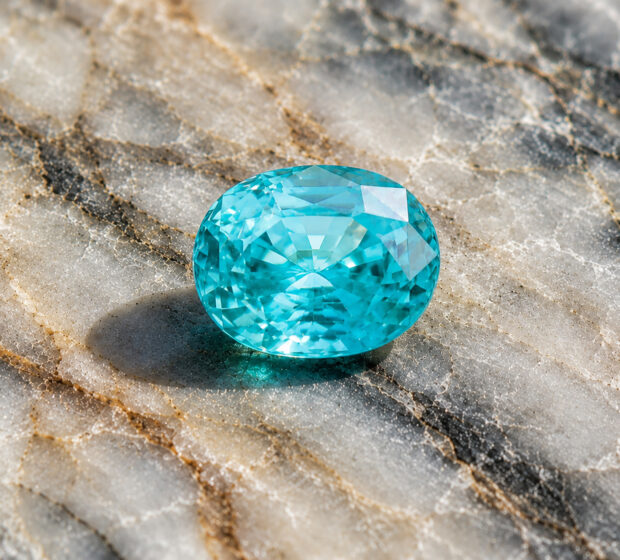







The padparadscha — a rare pinkish-orange sapphire of delicate, seemingly lit-from-within color — remained a connoisseur’s stone for decades. It has never produced sensations on the scale of the great rubies or Kashmir sapphires, but it has built a strict hierarchy of value all its own. This is a niche within a niche: significant sales can be counted on one hand, which is precisely why each one carries so much weight.
Auction results are the most reliable footing in any conversation about padparadscha prices: they are public and recorded to the dollar. Yet this particular stone has accumulated a surprising amount of misinformation. Popular round-ups credit it with sales that never took place, cite “record” figures unsupported by any auction archive, and occasionally pass off famous blue sapphires as padparadschas. This survey is therefore anchored in the most authoritative source of auction statistics for fine corundum — the table of world records maintained by Richard Hughes’s Lotus Gemology laboratory — with a separate section devoted to the doubtful figures. Below: the jewels that set the genuine records, the most famous family story in the stone’s biography, the legends best left unbelieved, and how the padparadscha market works today.
A Record That Has Stood Since 2017
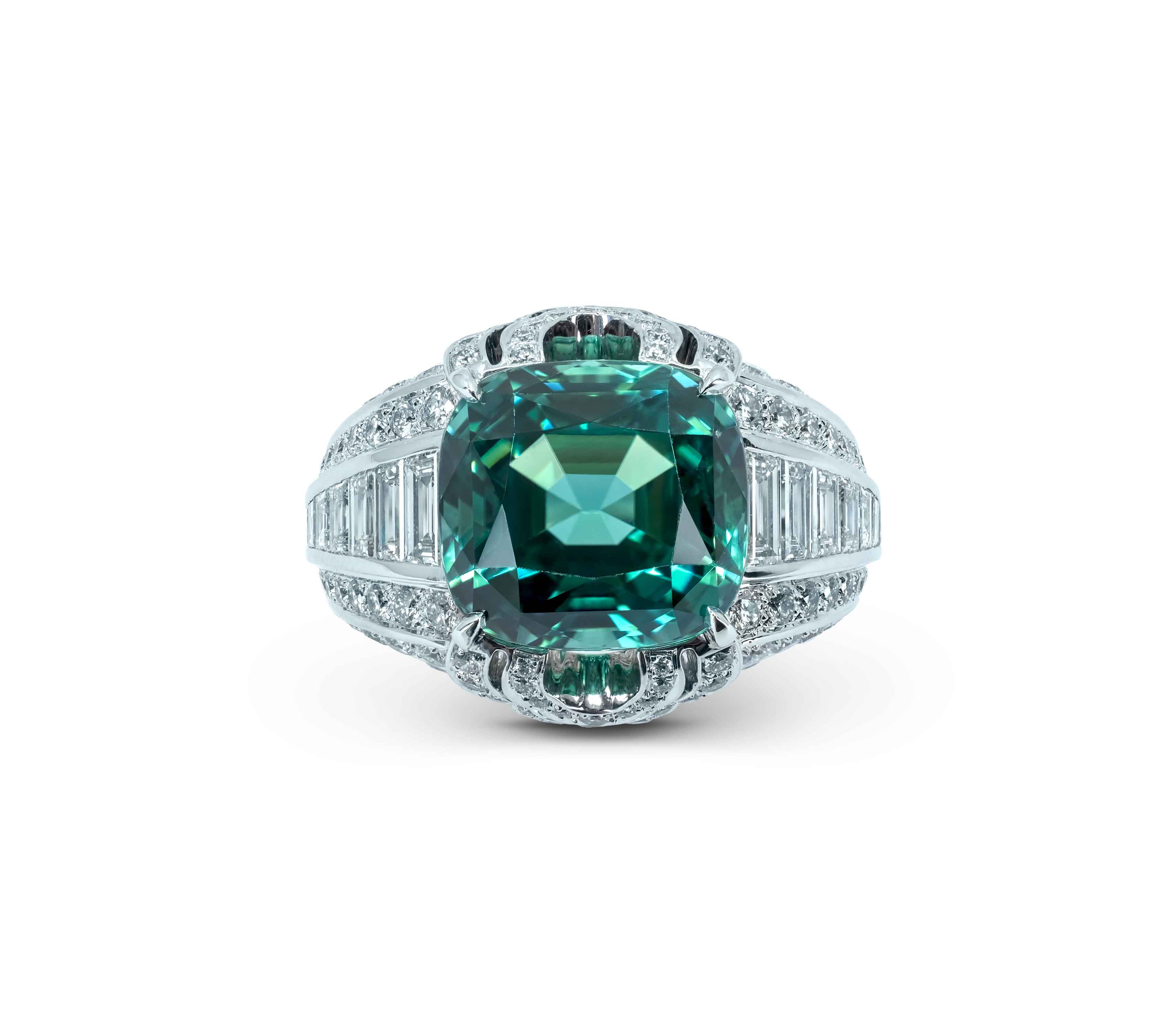
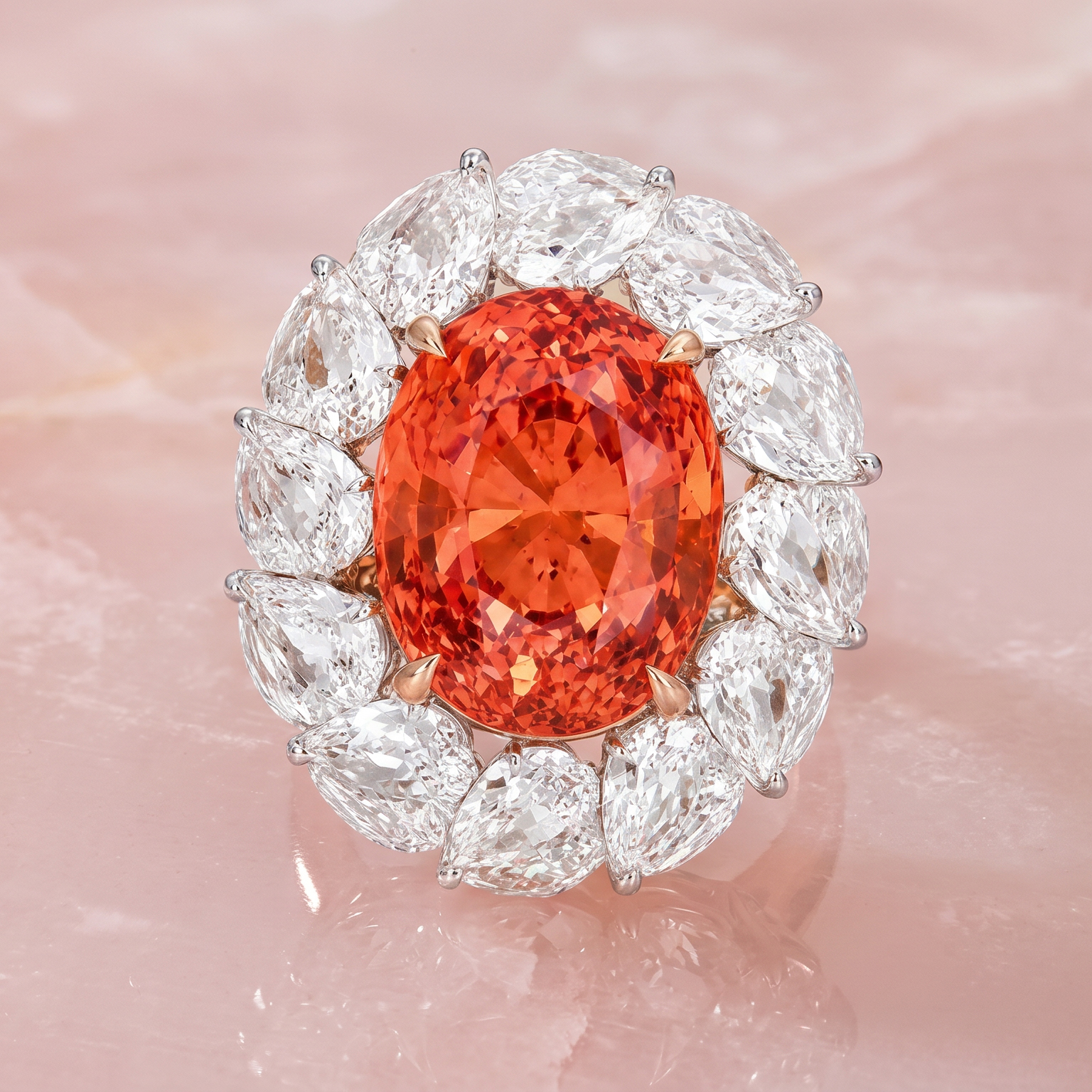
On 28 November 2017, at Christie’s Hong Kong sale Magnificent Jewels & The Pink Promise, a white-gold ring set with an oval Sri Lankan padparadscha of 28.04 carats, framed by diamonds, sold for $2,489,354 — roughly $88,779 per carat. It remains the absolute world auction record for any padparadscha jewel: no piece set with this stone has cleared the two-and-a-half-million-dollar mark before or since. Christie’s gemological note singled out the stone for its remarkable combination of size and weight with an attractive orangy-pink color and excellent purity.
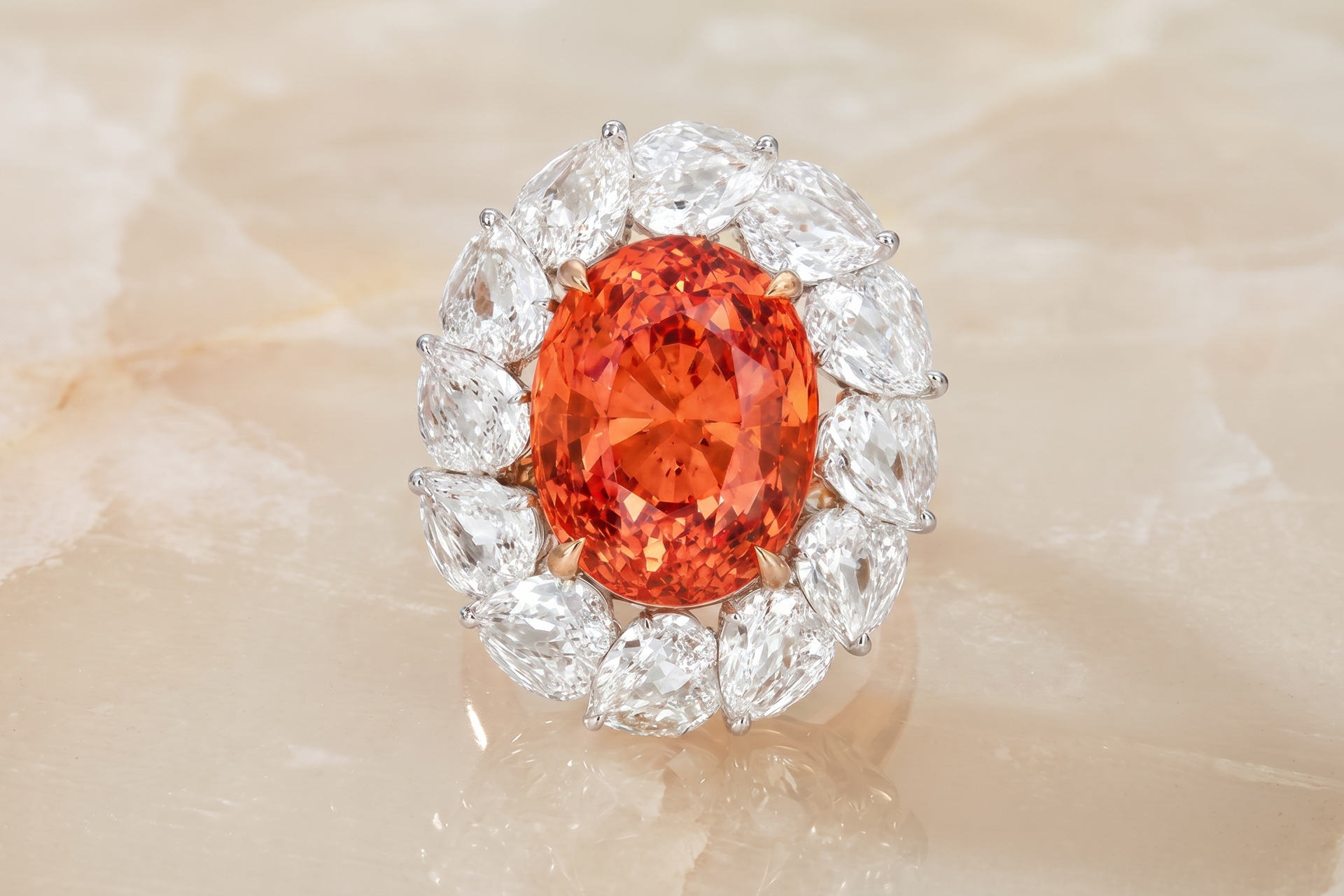
The company it kept is telling: the ring led the padparadscha portion of the same celebrated session at which The Pink Promise, a pink diamond of some 15 carats, was sold — and sharing the room with one of the decade’s defining diamond lots only underscored the stone’s standing. Slightly rounded versions of the result, around $2.47 million, circulate in the trade, but the Lotus Gemology record table, updated in June 2025, gives precisely $2,489,354, and that is the figure to rely on.
Just as telling is what the table does not contain. Across the entire history of public sales, Lotus Gemology recognizes only two auction records for padparadscha — total price and price per carat — both set in 2017, both by Sri Lankan stones. The five- and four-million-dollar sales that drift through popular listicles simply do not exist in these statistics; we will return to them separately.
The Per-Carat Record: $97,478
In the trade, 2017 is remembered as the year of the padparadscha — and not only for the Christie’s ring in Hong Kong. Two months earlier, on 3 October 2017, Sotheby’s Hong Kong set the second world record still standing today: price per carat. A ring set with an 8.01-carat cushion-cut Sri Lankan padparadscha — unheated, accompanied by reports from two leading Swiss laboratories, SSEF and Gübelin, and flanked by a pair of old mine-cut diamonds — sold for $780,800, or $97,478 per carat.
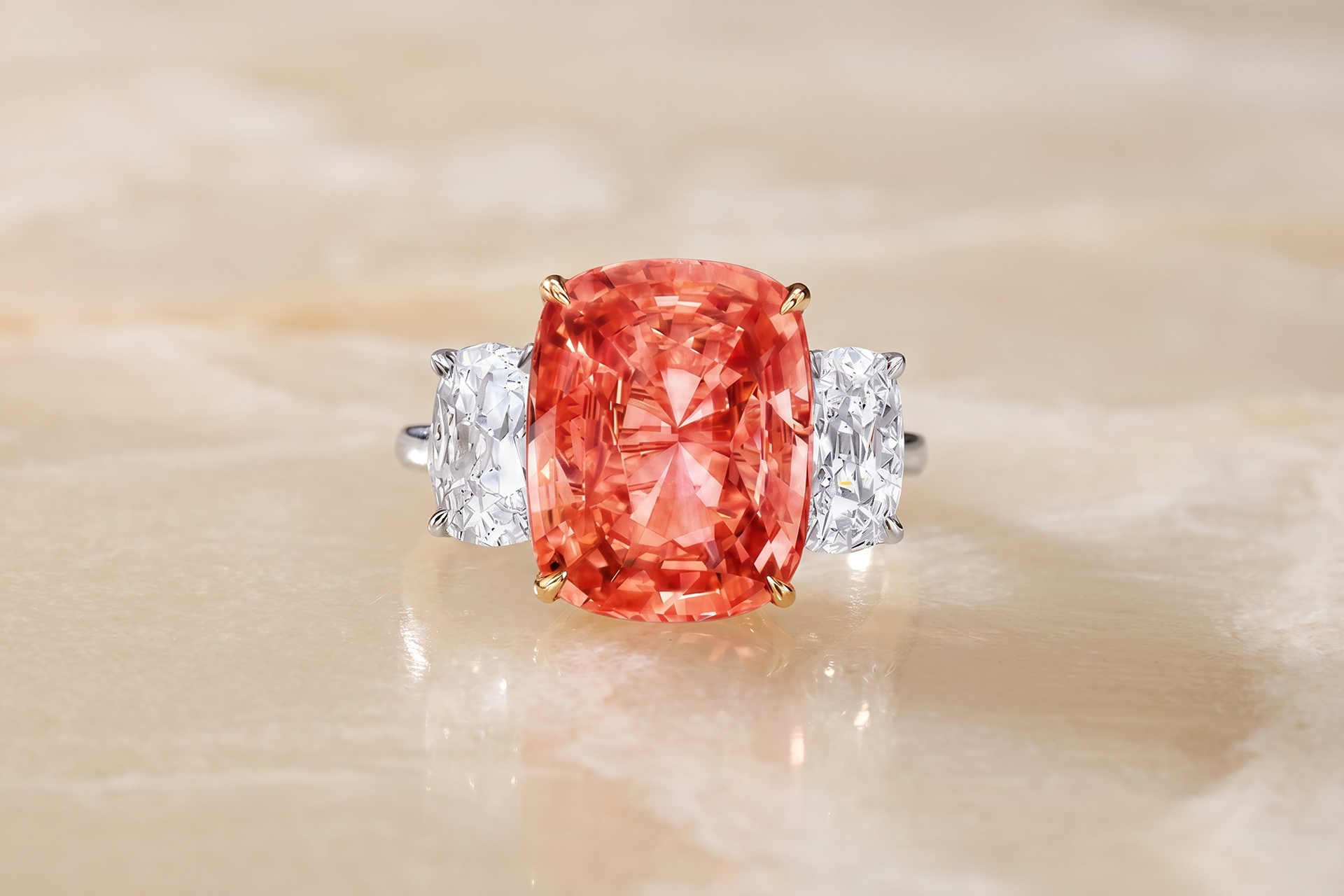
Comparing the two record-holders explains a great deal about how this market works. The Sotheby’s stone is three and a half times lighter than the Christie’s stone, yet each of its carats commanded nearly ten percent more. For padparadscha this is the rule rather than a paradox: per-carat value is set by color quality, the absence of heat treatment and impeccable documentation — and only then by size. A small stone of exceptional color easily outruns a larger but lesser one, carat for carat. Both records belong to Sri Lanka, both were set within a single autumn — and in the nine years since, neither has been surpassed.
The du Pont Padparadscha: The Price of Provenance
If the Hong Kong lots of 2017 are records of numbers, the greatest record of history belongs to another jewel. On 8 December 2020, at Christie’s Magnificent Jewels sale in New York, a ring set with a 24.58-carat Ceylon padparadscha — a cushion modified mixed cut of orangy-pink color, unheated, signed Perry, with an AGL report — sold for $930,000 against an estimate of $500,000–700,000. It is the second-highest result in padparadscha auction history and the most expensive documented named stone of the variety.
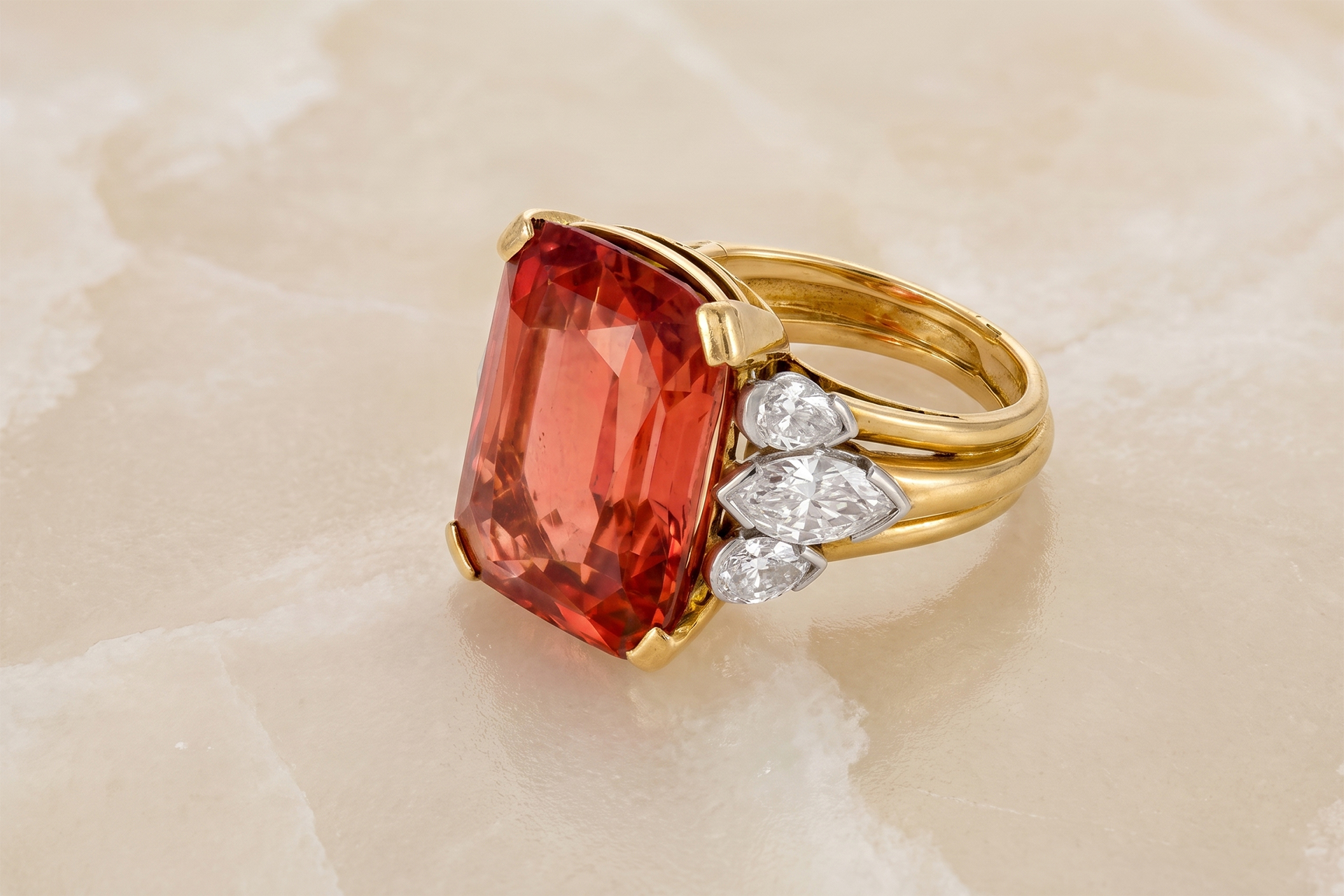
Christie’s catalogue preserved the stone’s history: it was acquired by the present owner’s great-grandmother while traveling in Ceylon in 1937. The trade journal JCK adds that the buyer was a member of the famed du Pont family, visiting the “island of gems” on a journey through Asia. The ring’s later fate is instructive in another way. In the autumn of 2022, two years after the auction, the stone reappeared in the catalogue of the antiques house M.S. Rau — now with a private asking price of $2.45 million, more than two and a half times the auction result. At auction, price is born of a single evening’s competition among bidders; a dealer names his own price and can wait years for the right client. Which is how the same stone can be worth $930,000 under the hammer and $2.45 million in a gallery vitrine — and both price tags are honest in their own way. The du Pont padparadscha demonstrates this mechanism more clearly than any explanation could.
The Second Tier: From Henry Dunay to a Lotus of Diamonds
Records are the summit; the truer picture of prices comes from the tier below, between one hundred and four hundred thousand dollars. This is where you can see what the market pays for willingly — and what it discounts.
For years, until the Hong Kong triumphs of 2017, the most expensive padparadscha jewel remained a ring designed by Henry Dunay: its 20.84-carat stone sold at Christie’s New York on 7 June 2005 for $374,400 — about $18,000 per carat. Twelve years later, the per-carat price of the record lots would grow fivefold: the best measure of how swiftly the market revalued this stone. The lot also has a curious postscript. It sold with a laboratory report, yet Hughes himself, analyzing its catalogue photograph years later, concluded that the color was darker and more saturated than the LMHC definition adopted that same year allows. In other words, the former benchmark might well fail today’s examination — eloquent evidence of how much stricter the criteria have become.
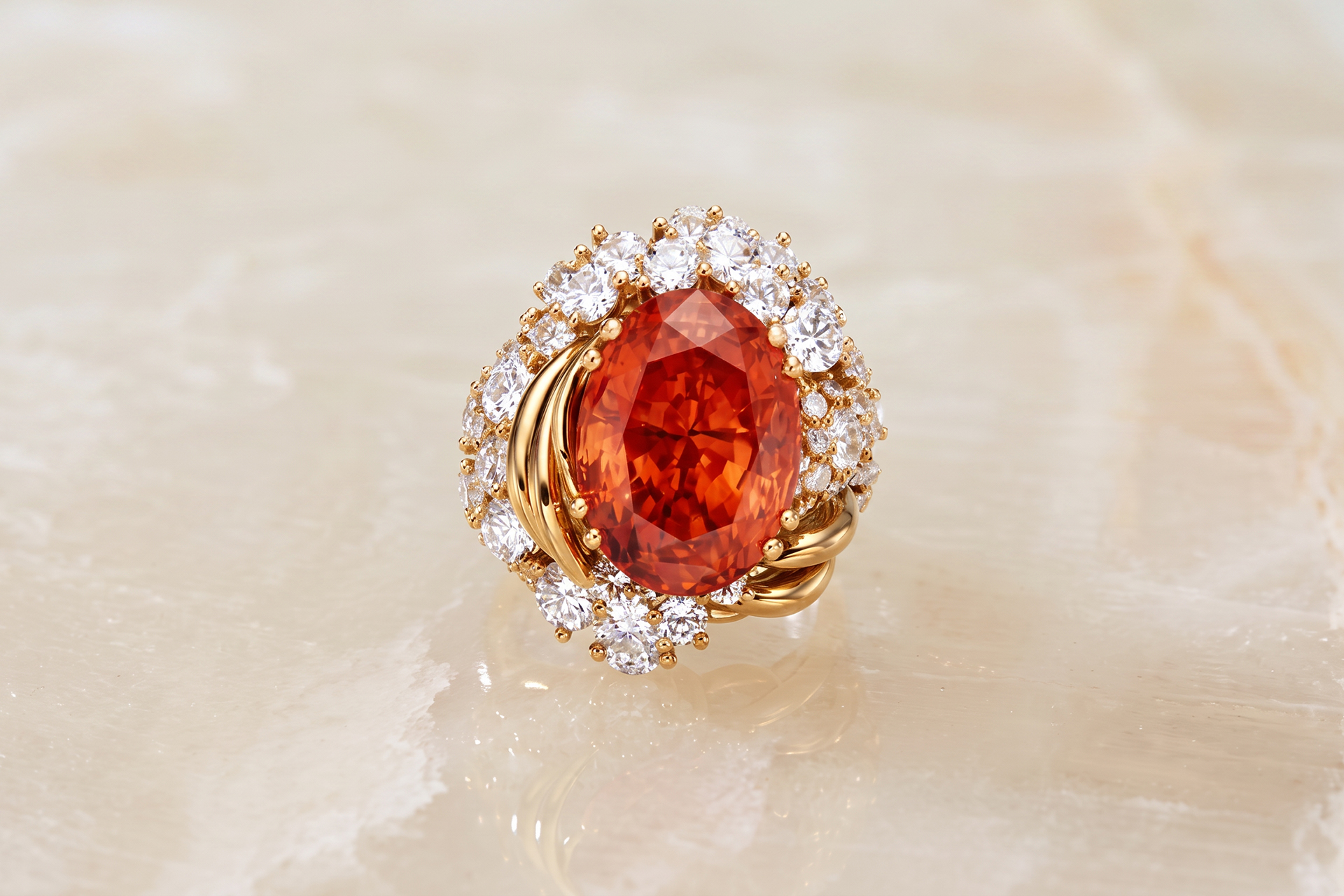
A ring set with an unheated 8.60-carat Sri Lankan padparadscha, SSEF report no. 89431, surrounded by roughly 13.5 carats of diamonds arranged as a lotus blossom in 18-karat white gold, sold at Bonhams Hong Kong for HK$2,163,000 — about US$277,000. A heart-shaped 12.94-carat padparadscha in a diamond halo brought approximately $250,000 at Sotheby’s Magnificent Jewels in New York on 19 April 2016.
One Bonhams lot, from 19 September 2017, deserves particular attention: a 30.77-carat Ceylon padparadscha — larger than the Christie’s record stone — cushion modified mixed cut, unheated, with an AGL report, in 18-karat rose gold, sold for $199,500. A stone nearly three carats heavier than the 28-carat record-holder cost more than twelve times less, and the difference lies entirely in the quality of color. In padparadscha, weight without saturation is worth little.
Closing the upper list are two results: a ring with a 26.17-carat stone sold at Christie’s Jewels Online for $107,950 — more than triple its $30,000 high estimate — and a ring with a 10.27-carat padparadscha in a pavé of colorless diamonds accented with pink ones, which brought $103,800 at Bonhams’ Rare Jewels and Jadeite sale on 31 May 2017. The first deserves a note of its own: tripling the estimate on an online platform, without the theater of the saleroom, is proof that competition for padparadscha extends well beyond the flagship evening sessions.
Taken together, the second tier paints a coherent picture. The format is almost always the same — a ring: the padparadscha remains a solitaire around which the setting is built, not a component of elaborate parures. The geography is Hong Kong and New York, with rare exceptions. And at every price level the same pair of conditions recurs: Ceylon origin and no heat, certified by an authoritative laboratory.
The Morgan Stone: A Padparadscha Money Cannot Buy
The largest known fine padparadscha has never come to auction. It is an oval stone of approximately 100.18 carats held by the American Museum of Natural History in New York, part of the museum’s Morgan collection, associated with the financier John Pierpont Morgan. The Pala International buying guide, written by Richard Hughes, calls it “probably the largest fine stone known” of the variety. An essential caveat: the precise weight rests on Hughes’s authority and trade tradition rather than on a primary museum catalogue, which is why the correct wording is exactly that — “probably the largest,” with no claim to the absolute.
Myths That Don’t Survive Scrutiny
Padparadscha history is littered with pseudo-records, and a conscientious collector does well to know them by name. The stone of some 478 carats linked to Queen Marie of Romania and routinely included in lists of “great padparadschas” is in fact a blue Ceylon sapphire. The Star of Adam — the world’s largest blue star sapphire at 1,404.49 carats — has nothing to do with padparadscha, though it turns up in the lists all the same. No reliable source confirms the existence of a 126-carat “Royal Thai” padparadscha. And the “47.39-carat Morgan Padparadscha” appears in a single dubious publication — most likely a garbled weight of that same hundred-carat museum stone.
Outright fabrication is a category of its own. A widely circulated list of the “ten most expensive padparadschas” credits stones with sonorous names — “Ratnapura,” “Lotus Blossom,” “Sunrise Splendor” — with sales of $5.8, $4.6 and $3.9 million. Not one of these figures is supported by any auction archive or by the Lotus Gemology database: the sums appear to be simply invented. The genuine records stand unchanged — $2.49 million for the 28.04-carat stone and $97,478 per carat for the 8.01-carat stone, both from 2017. Any figure above them should be presumed false until an auction-house archive proves otherwise.
Princess Eugenie’s Ring
It was not the auction world that made the padparadscha famous, but a royal engagement. In 2018 Princess Eugenie revealed an engagement ring set with an oval padparadscha in a halo of diamonds — and a stone known for decades only to gemologists and a narrow circle of collectors found itself, for the first time, at the center of public attention. That single ring did more for the padparadscha’s renown than every auction record combined.
Curiously, even the ring’s value divides the experts. Michael Arnstein, president of The Natural Sapphire Company, put it at $35,000–55,000 on the wholesale scale; The Antique Jewellery Company suggested £100,000–120,000; the stone’s exact weight and the price paid have never been disclosed. A two-to-threefold spread between professional appraisals of one and the same jewel says almost more about this market than the figures themselves: a padparadscha’s value cannot be reduced to a formula. Too much depends on the nuances of color, on treatment status, and on whether the count is kept at wholesale or retail.
Origin, Heat and Color Stability
Behind the spread of auction prices stand three simple rules.
First, origin. Sri Lanka (Ceylon) supplies nearly all the top lots and trades at a premium. Madagascar is the backbone of the middle market, its stones markedly cheaper. Tanzania and Vietnam remain secondary sources.
Second, heat. The phrase “no indications of heating” on a report is the single biggest driver of value: an untreated stone can be worth several times a comparable heated one. In recent years a further question has joined the classic one about heat — color stability. Some pinkish-orange sapphires fade over time, and the leading laboratories now test for this as well.
Third, paperwork. The same names recur on the reports behind the most expensive lots: SSEF, Gübelin, AGL, GRS and GIA; the 2017 Sotheby’s record-holder, sold with two Swiss reports at once, set the standard here. The strictest laboratories — Gübelin and SSEF — construe padparadscha narrowly: a stone of light-to-medium tone with a balanced ratio of pink to orange. Many stones a seller would happily call padparadscha fail that examination and remain, on paper, merely pinkish-orange sapphires. Strictness has a direct market consequence: the fewer stones pass the test, the more each one that passes is worth.
Hence, too, the market’s central dispute. Purists recognize only Sri Lankan stones as padparadscha: to them, the name is inseparable from its historic homeland. The harmonized LMHC definition, by contrast, describes padparadscha through color and admits any origin. The argument is anything but academic: which approach one adopts determines which stones can be compared at all. Auction practice, for now, sides with tradition — every expensive lot discussed above is Ceylonese.
Houses and Signatures
Among signed padparadscha jewels, Cartier appears more often than anyone else: the house is behind a ring with a 14.67-carat stone sold at Christie’s Geneva on 13 November 2018, and the high-jewelry Solar ring with a 10.04-carat padparadscha. It was Cartier, too, that stood out in the uneventful 2025 season: the house’s ring with a Madagascan stone achieved one of the year’s highest per-carat prices — a rare case in this market of a signature compensating for “non-canonical” origin.
Other great names work with the stone as well: Tiffany & Co. in its Blue Book collections, Chaumet in the Joséphine line; the roster of houses and workshops that turn to this corundum includes Boodles, Boghossian, David Morris, Omi Privé, Oscar Heyman, JB Star and Bayco. Two historic signatures stand out: the du Pont padparadscha bears the name Perry — carried into the very title of the Christie’s lot — while the 2005 record-setter was designed by Henry Dunay.
Telling, though, is that both standing world records belong to stones without a great signature: the 28-carat Christie’s record-holder and the 8-carat Sotheby’s record-holder were bought as stones, not as the work of famous workshops. In many corners of the jewelry market a house’s name can double or triple a price; in padparadscha, the stone still outweighs the stamp — the top of the hierarchy belongs to color, origin and paperwork, not to the maker’s mark.
The Market, 2023–2026: Quiet Years and a Rising Bar
Recent seasons have been paradoxical for padparadscha: interest in the stone runs high, while genuinely outstanding material is all but absent from the block. In 2024, Christie’s Hong Kong sold online a platinum-and-diamond ring with a 20.29-carat oval padparadscha for HK$529,200 — about US$67,700: substantial size at a modest price, reflecting the stone’s lighter color.
2025 was flatly called a quiet year by the specialist tracker The Rare Gem: only a handful of stones at the major auctions met modern laboratory standards. The largest padparadscha of the season, by the same source, was an unheated 11.14-carat Ceylon stone sold at Sotheby’s for around $27,600 with a GIA report — a modest price for the size, and for the same reason as before: lighter saturation and tone. Another detail of the year is telling: one of the highest per-carat prices went to a Cartier ring with a small Madagascan stone. Signature and quality outweighed both size and “wrong” origin.
Dealer and retail benchmarks for 2025 converge. Fine certified stones above two carats, with even color and minimal inclusions, trade at $10,000 to upwards of $30,000 per carat; the best unheated Sri Lankan examples reach $30,000–50,000 and beyond. Heated stones are several times cheaper: a one-carat heated padparadscha is valued at around $5,500 per carat, a two-carat stone at about $8,500. The gap between a heated and an untreated stone of comparable appearance is measured not in percentages but in multiples — for a buyer, arguably the single most important number of all.
The overall direction is clear: supply is tightening, laboratory standards are rising, and documentation — origin, treatment status, color stability — increasingly outweighs carat weight in setting price. The quiet 2025 is deceptive in this sense: it speaks not of cooling interest but of how little material now meets today’s requirements. The chief constraint on this segment is not demand but the scarcity of certifiable quality.
How to Read Padparadscha Prices
For a collector, the auction statistics resolve into a practical scale. A fine untreated Ceylon stone offered below roughly $20,000 per carat is an attractive price. The $30,000–50,000 band is fair value for top color and clarity. Above about $50,000 per carat, the buyer is paying record-lot rates — the territory of the 8.01-carat ring — and is entitled to demand exceptional, fully documented quality: origin, no heat and color stability, confirmed by SSEF, Gübelin, AGL, GRS or GIA.
The priorities in choosing a stone are just as definite. First, origin: Sri Lanka. Second, no heat — stated explicitly on the report, not assumed. Third — and this is the comparatively new requirement — an express statement on color stability: the laboratory must confirm that the pinkish-orange hue will not fade with time. The target size is above two carats; the target color balanced, of medium saturation, leaning neither into pink nor into orange: the equilibrium of those two hues is the very essence of padparadscha in its strict laboratory sense. Heated and Madagascan material should be priced well below these benchmarks — and when an offer breaks that rule, it is cause not for delight but for further questions.
The last rule follows from the whole history of imaginary records: every figure, every resonant stone name, every “historic sale” should be checked against a primary source — an auction house’s archive or the Lotus Gemology database. The aggregated lists of “the most expensive padparadschas,” as we have seen, do not survive that check.
It is worth remembering, too, the limits of auction statistics themselves. Public sales do not describe the whole market: the finest stones, as Lotus Gemology notes, change hands privately at prices above the auction level, while dealer asking prices — as the du Pont padparadscha showed — can exceed auction results more than twofold. And the results quoted here include the buyer’s premium, while conversion from Hong Kong dollars, francs and pounds depends on the exchange rate on the day of sale — dollar equivalents are approximate by definition.
A Niche Within a Niche
The padparadscha never became a stone of headline sensations — and therein, perhaps, lies its strength. The absolute record has stood for nearly nine years, the per-carat maximum has not been exceeded since October 2017, and the annual harvest of worthy stones is counted in single digits. A market like this lives not on speculative surges but on scarcity — and the demands on the material are growing faster than the supply: the strict Gübelin and SSEF definitions, color-stability testing and mandatory origin reports cut off ever more claimants to the great name.
The story the auctions tell comes down to a few constants. The top tier belongs to Ceylon. Color and the absence of heat are worth far more than mass: a thirty-carat stone can lose to an eight-carat one by multiples if it loses on color. Dealer prices diverge from auction results by a factor of two and more, and the loudest “records” in the popular round-ups exist only on paper. And the finest examples — from the hundred-carat stone of the Morgan collection in New York to the unshaken record-holders of 2017 — change hands reluctantly, or not at all.
For the stones that do pass today’s laboratory examination, all of this means one thing: certified rarity appreciates. The records of 2017 still stand — but the very logic of this market, where documented quality grows scarcer by the year, suggests they will not stand forever.