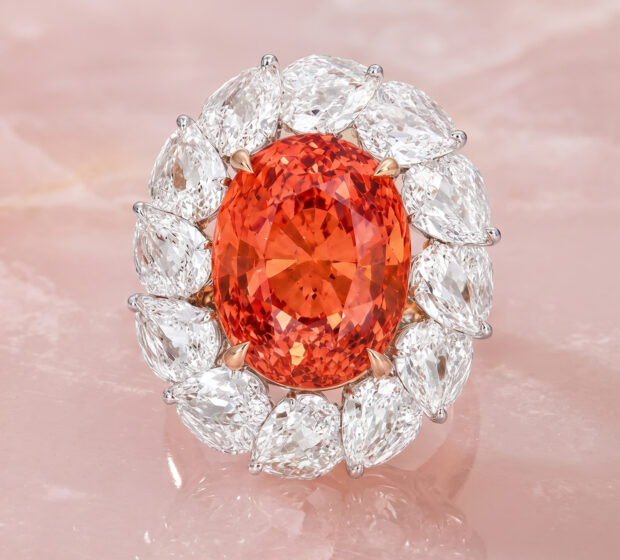




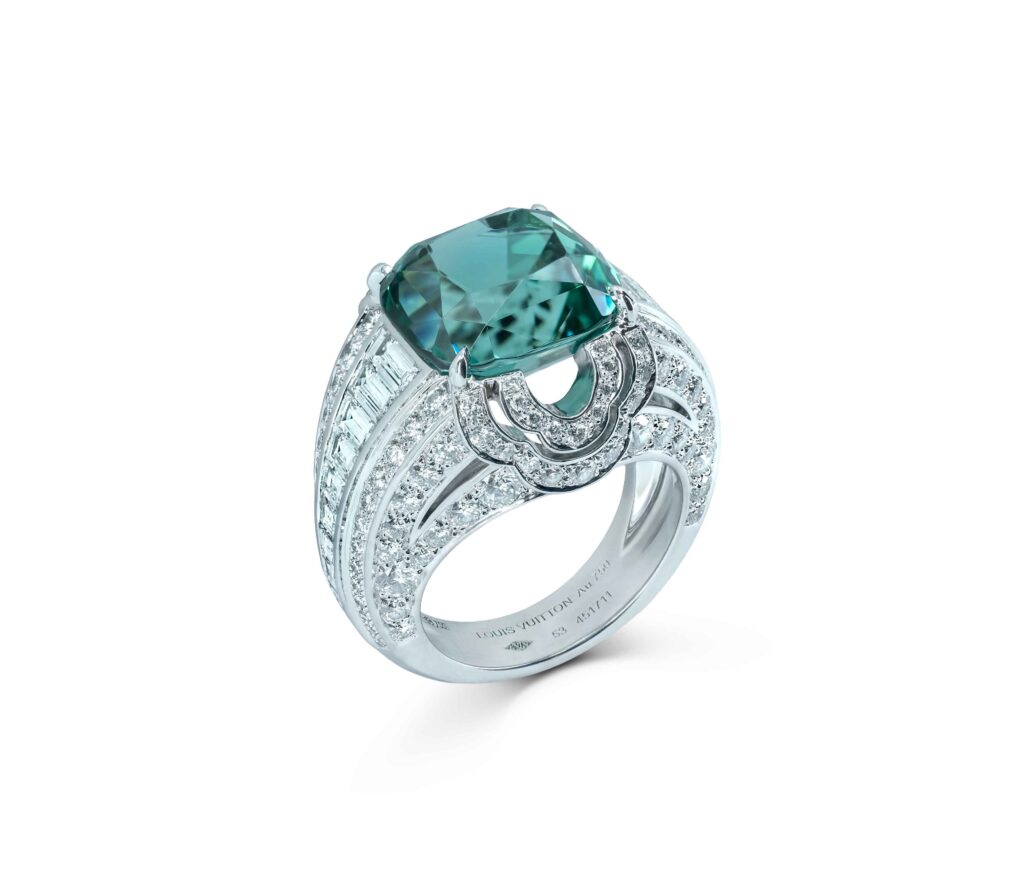
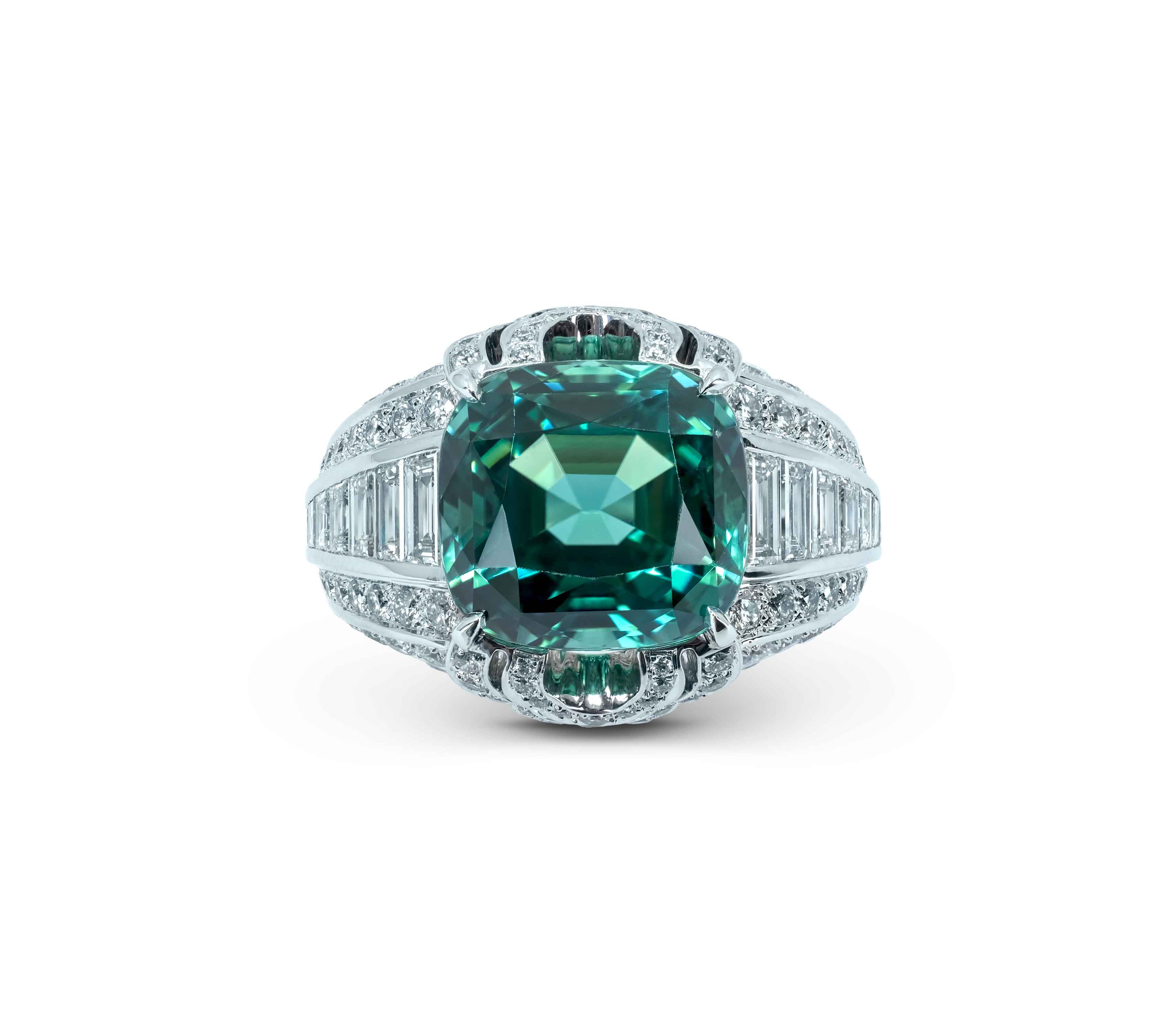

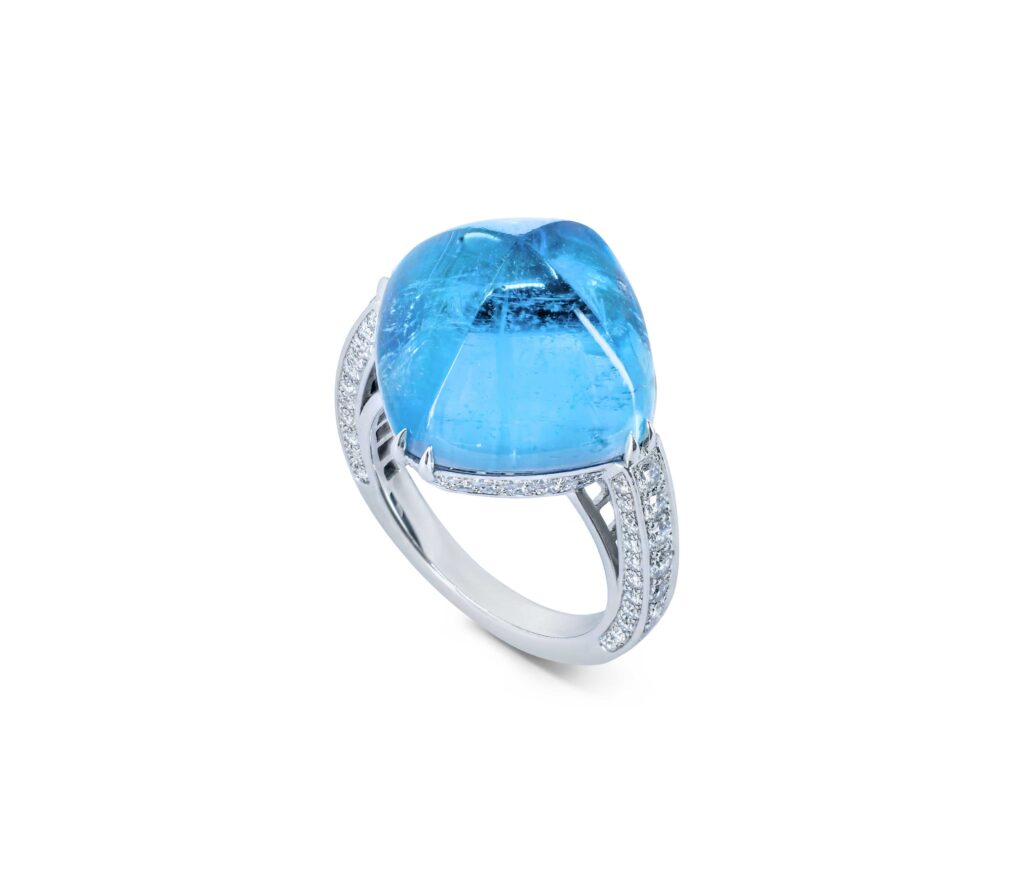
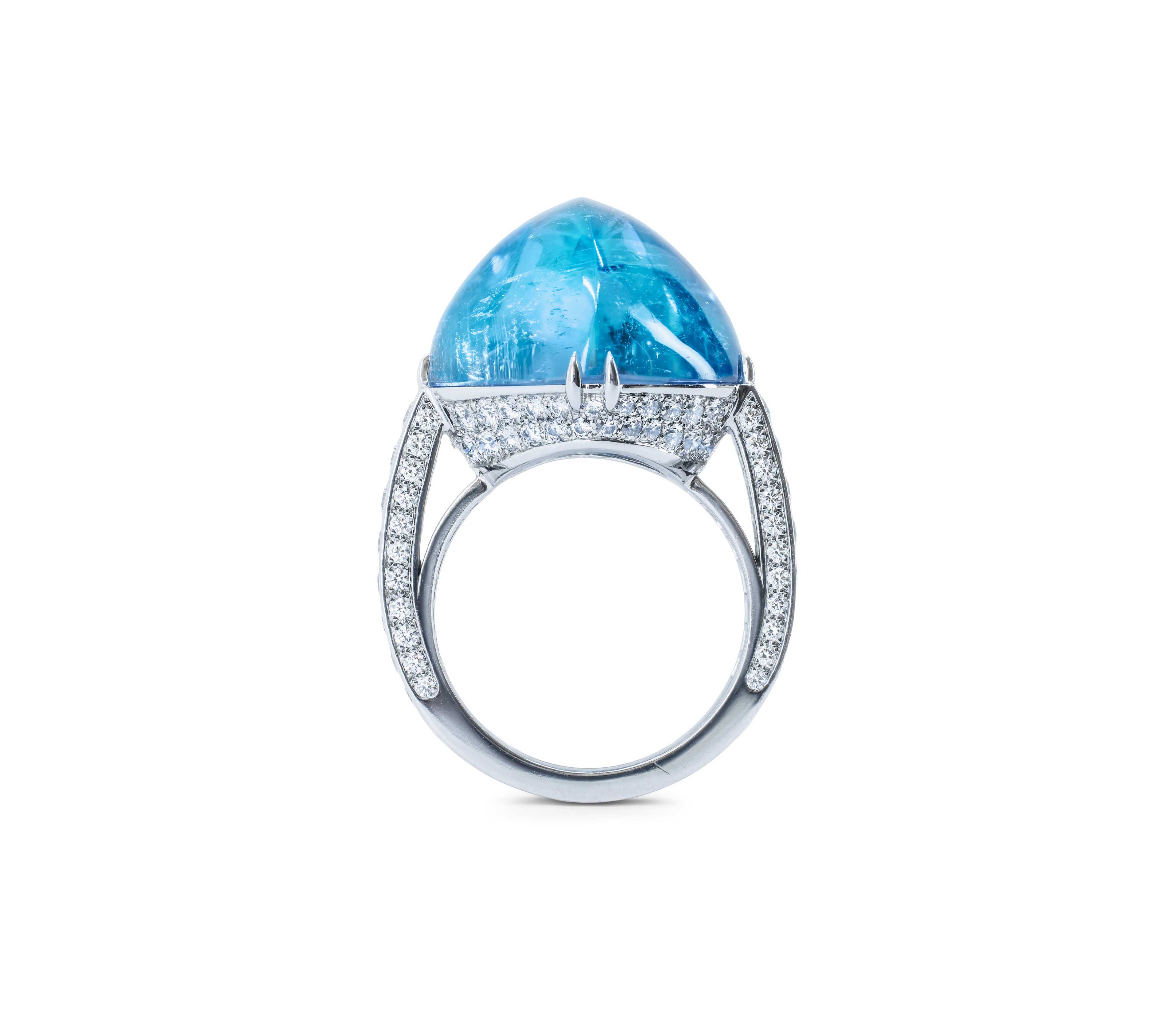
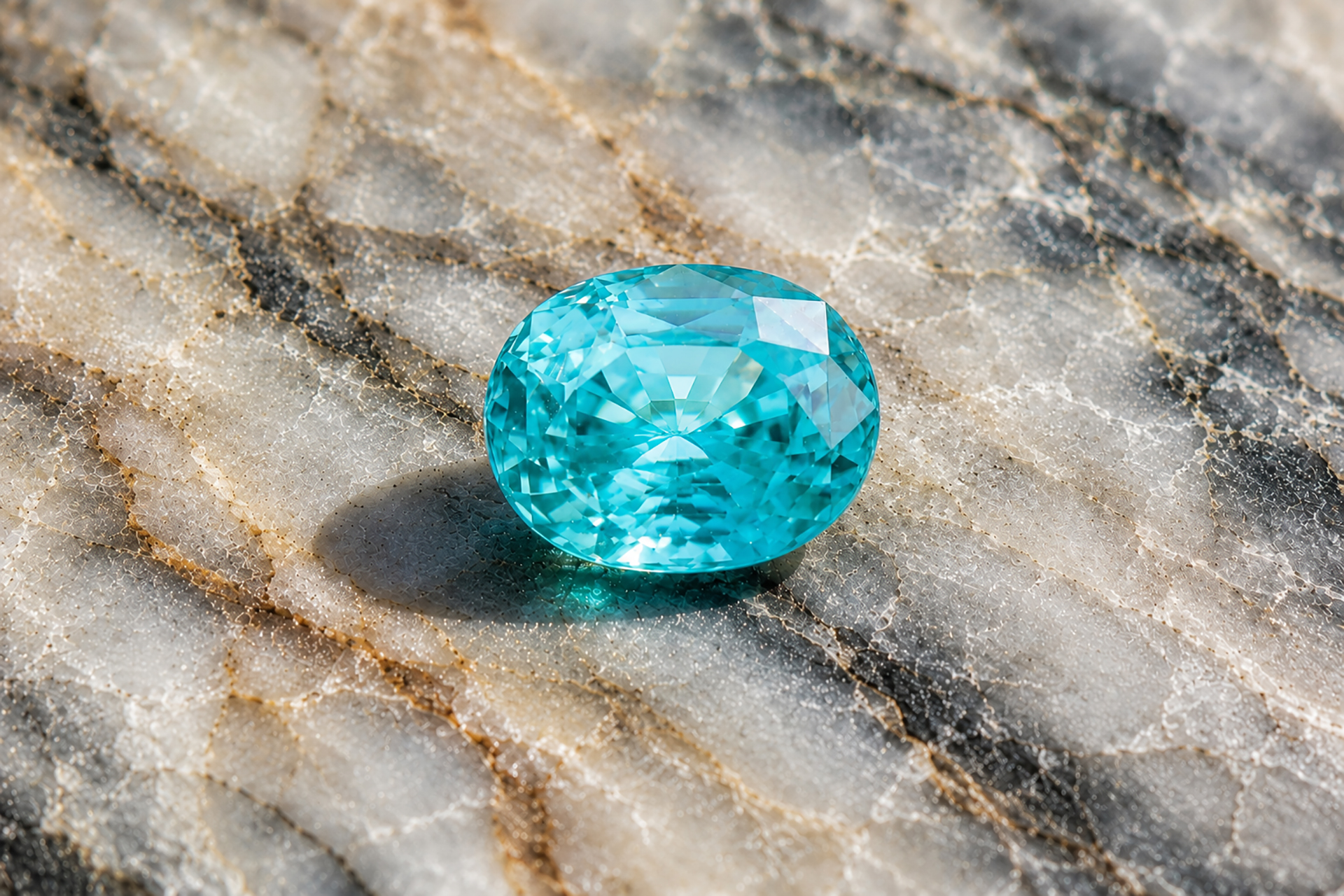


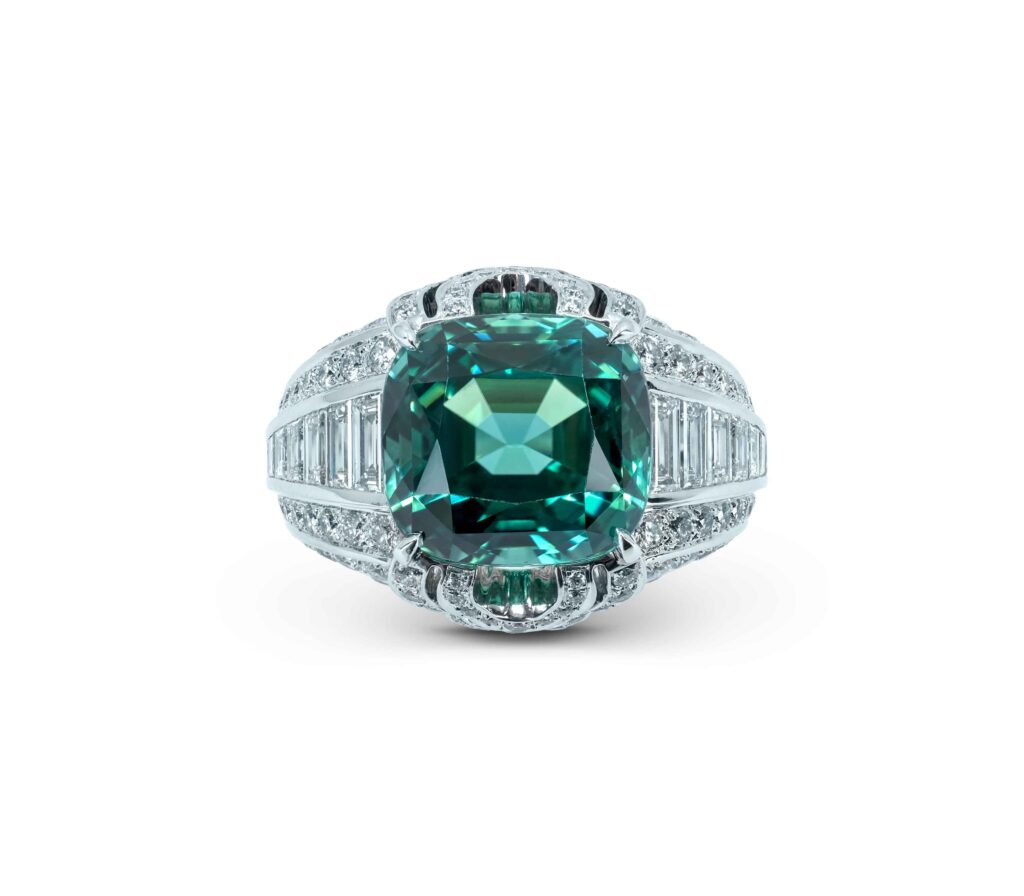
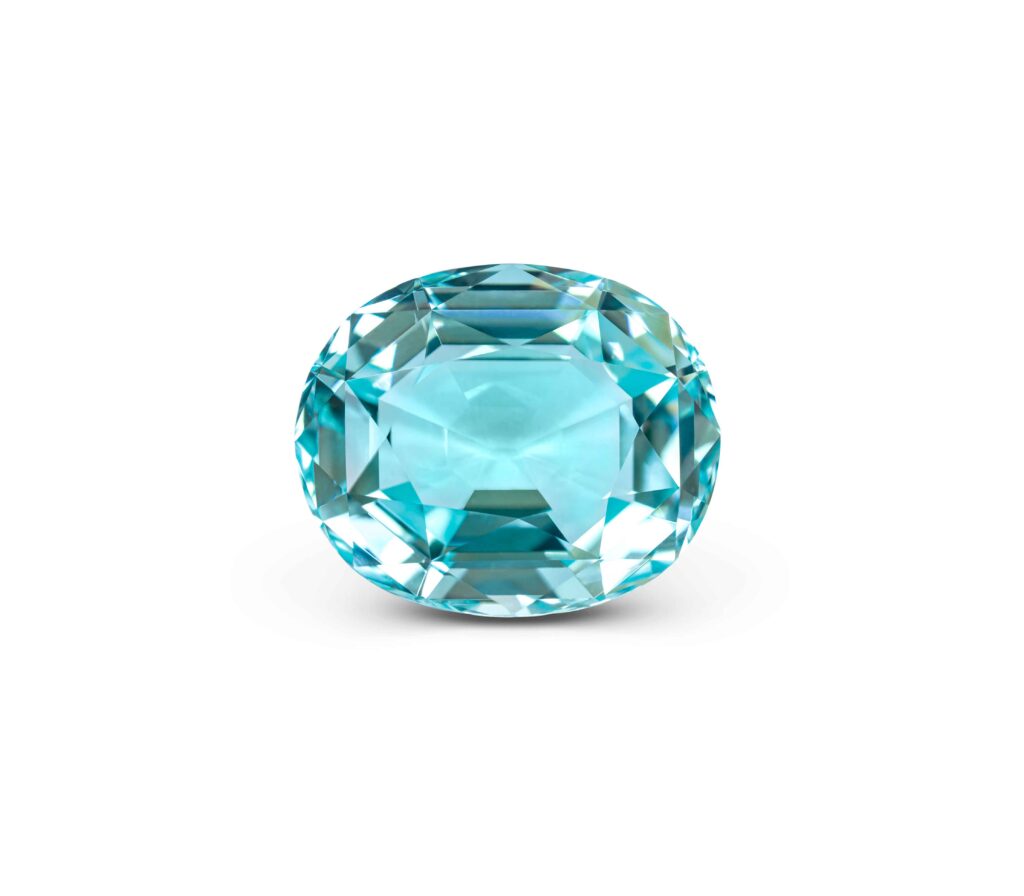
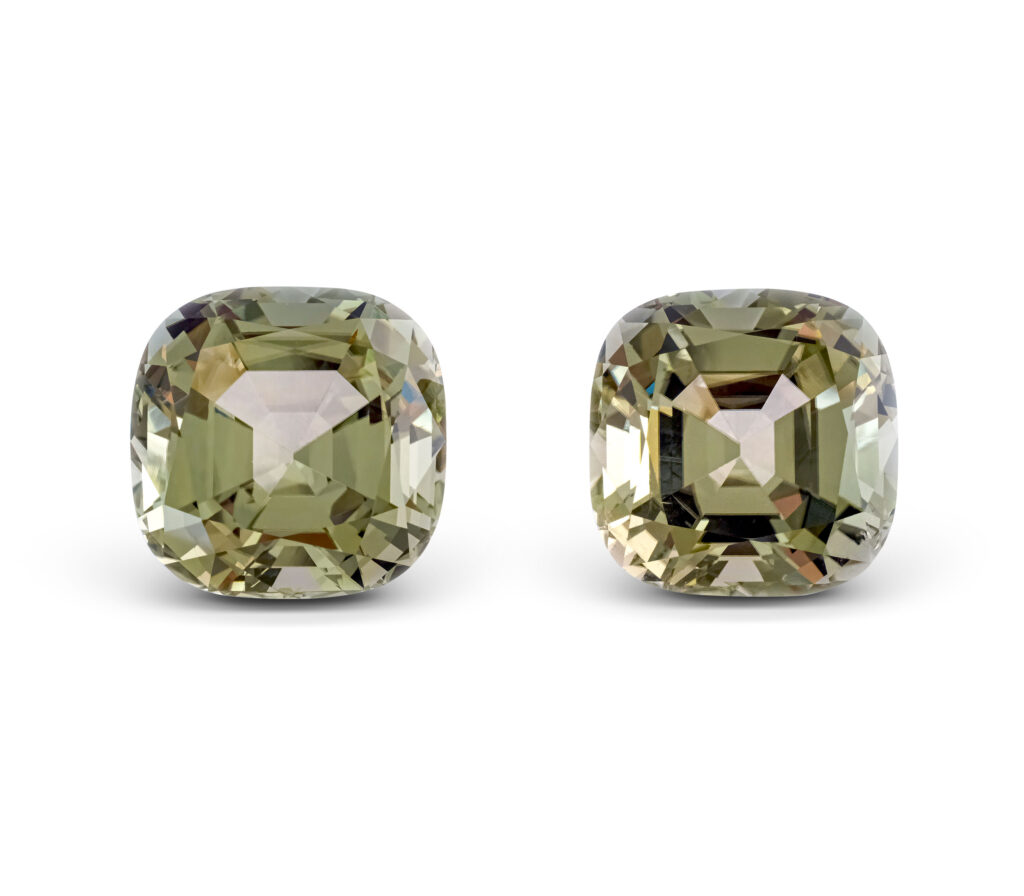
There are gemstones one admires, and there are gemstones that stop a connoisseur mid-sentence. The Paraíba tourmaline belongs unmistakably to the second category. Set it beside a fine sapphire or a vivid emerald and something curious happens: the eye refuses to leave it. The color does not merely sit on the surface of the stone — it appears to radiate outward, glowing with an almost artificial intensity, as though a small electric current had been sealed inside the crystal.
For nearly forty years this gem has occupied a singular position in the world of high jewelry. It is younger than almost every other stone a serious collector pursues, yet it has climbed faster and higher in both desirability and price than any rival. To understand why a single Paraíba can now command more per carat than many fine diamonds, one must understand three things: the science that produces its impossible glow, the obsessive man who pulled it from the Brazilian earth, and the rules of rarity that govern its value today.
A Gem Lit From Within: The Science of the Glow
The Paraíba tourmaline is, in mineralogical terms, a copper-bearing variety of elbaite — the lithium-rich species within the broad tourmaline family. Elbaite is a complex borosilicate that crystallizes in the trigonal system, built from rings of silicate tetrahedra bound together by triangular boron units and twisting columns of octahedra. It is a hard, durable stone, registering between 7 and 7.5 on the Mohs scale, with no cleavage to weaken it. In ordinary forms, elbaite gives us the familiar pinks, greens, and bicolored “watermelon” tourmalines beloved by collectors for generations.
What transforms ordinary elbaite into Paraíba is a single, decisive element: copper.
Copper is the defining signature of this gem, and it colors no other tourmaline variety on earth. When copper ions are present in the crystal lattice, they produce that unmistakable neon blue-to-green. A second element, manganese, plays the supporting role, pushing the hue toward violet, purple, and pink depending on its concentration. The interplay between copper and manganese is what gives the Paraíba its remarkable range — from turquoise and the so-called “Windex” electric blue, through pure neon green, to rare violet tones. When the first Brazilian crystals were analyzed, gemologists were astonished by what they found: copper concentrations reaching nearly two percent by weight, far higher than anyone had expected to see in a tourmaline.
But the truly fascinating question is not the color itself. It is the glow.
The luminous, lit-from-within quality of a fine Paraíba is not a marketing flourish or a trick of jewelry photography. It is a measurable optical phenomenon. Copper in the crystal absorbs light across two broad regions of the spectrum, with the absorption extending well into the near-infrared, beyond what the human eye can perceive. The result is that only a narrow, intensely saturated band of color is allowed to pass through and reach the eye. The stone therefore reads as vivid and saturated even in poor light, where other gems fall flat and gray. Laboratories now use this very signature to identify the gem — the characteristic dominance of one infrared absorption band over another is one of the surest indications that a stone is genuinely copper-colored Paraíba, rather than an ordinary blue tourmaline tinted by iron.
Most Paraíba on the market today has been heated, and this deserves honest explanation rather than concern. Gentle heating alters the state of the manganese within the crystal, removing the purplish and reddish components and leaving behind a cleaner, purer blue-green. The treatment is permanent, entirely stable, and does not weaken the stone in any way. It is, in this sense, closer to the routine and accepted heating of sapphire than to anything controversial. The collector’s task is not to avoid heated stones — the overwhelming majority are heated — but to know the treatment status with certainty, because that knowledge bears directly on value.
For the technically minded, the gem’s constants sit close to a refractive index of around 1.62, with a birefringence high enough that the doubling of facet edges is often visible through a simple loupe, and a specific gravity in the region of 3.06 to 3.10. These figures confirm the species, but they cannot, on their own, tell a laboratory where a stone was born — and as we shall see, origin is everything.
One Man’s Conviction: Heitor Dimas Barbosa
Every legendary gem has a discovery story, but few are as improbable, or as deeply personal, as that of the Paraíba tourmaline.
In the early 1980s, in the modest, scrubby hills surrounding the village of São José da Batalha in the state of Paraíba, in the impoverished northeast of Brazil, a man named Heitor Dimas Barbosa began to dig. He was not following a geological survey or chasing a known deposit. He was following a conviction — an unshakable, almost stubborn belief that something extraordinary, something the world had never seen before, lay hidden beneath those unremarkable hills.
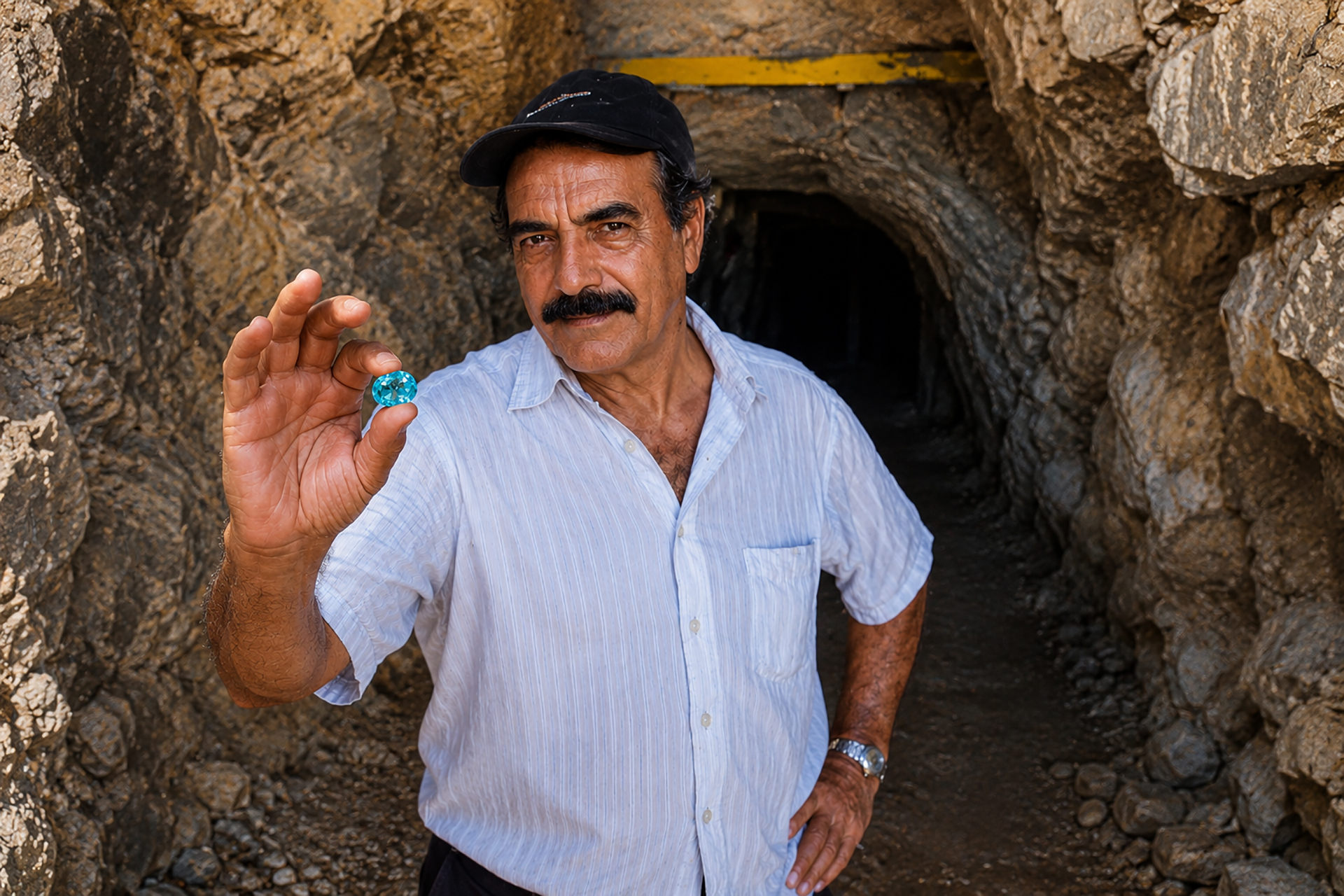
For years, Barbosa and his small team found nothing of consequence. They worked the pegmatite with the simplest of tools, by hand, often lit only by candlelight in the cramped tunnels. The skepticism of those around him grew. By any rational measure, the venture was a failure. And yet he persisted, driven by an instinct that resisted every discouragement.
His patience was finally rewarded in 1989, when his team unearthed the first crystals of a tourmaline whose color no one had ever encountered — a searing, electric blue-green that seemed to belong to a different world. (Some accounts in the trade place the very first crystals as early as 1987, with the gem reaching the wider market in 1989; what is beyond dispute is that the discovery followed nearly a decade of fruitless, faith-driven labor.) Over the two years that followed, working still with hand tools and candles, Barbosa and his team recovered only a small quantity of the precious material — a matter of ten to fifteen kilograms in total.
That tiny yield would change the colored-stone market forever.
When the gem made its public debut at the Tucson Gem and Mineral Show in 1990, the reaction was electric in every sense. According to accounts from that show, the first stones sold for a few hundred dollars per carat at the opening, and within days were changing hands for thousands. Prices climbed past twenty thousand dollars per carat with a speed that bewildered even seasoned dealers. A gem that had not existed in the world’s consciousness a year earlier had suddenly become one of the most sought-after stones on the planet.
Heitor Dimas Barbosa died in 2023, but his legacy is permanent. The original deposit bears his name in the mineral world, and his son continues to oversee the mine today. He remains the rarest of figures: a man who willed an entirely new gemstone into existence through sheer conviction.
From Brazil to Africa: Origin and the Great Naming Debate
The original Brazilian deposit, known as the Mina da Batalha, was breathtakingly small. Copper-bearing tourmaline was soon found in the neighboring state of Rio Grande do Norte as well, but the heart of Brazilian production was essentially exhausted within roughly five years of the first discovery. This is the central fact of Brazilian Paraíba: it was never abundant, and what little came out of the ground is now, for practical purposes, finished.
Then, around the turn of the millennium, the story took an unexpected turn.
In 2001, copper-bearing tourmaline was reported from Nigeria, with a color and chemistry strikingly similar to the Brazilian material. A few years later, the more significant discovery came from Mozambique. Material had begun to surface there around 2001, but its copper content was not recognized until 2003, and it did not reach the market in volume, with disclosed origin, until 2005. The Mozambican deposits, worked from alluvial gravels in the Alto Ligonha pegmatite district of Nampula Province, near the locality of Mavuco, proved far more productive than anything in Brazil — and they yielded larger, often cleaner crystals.
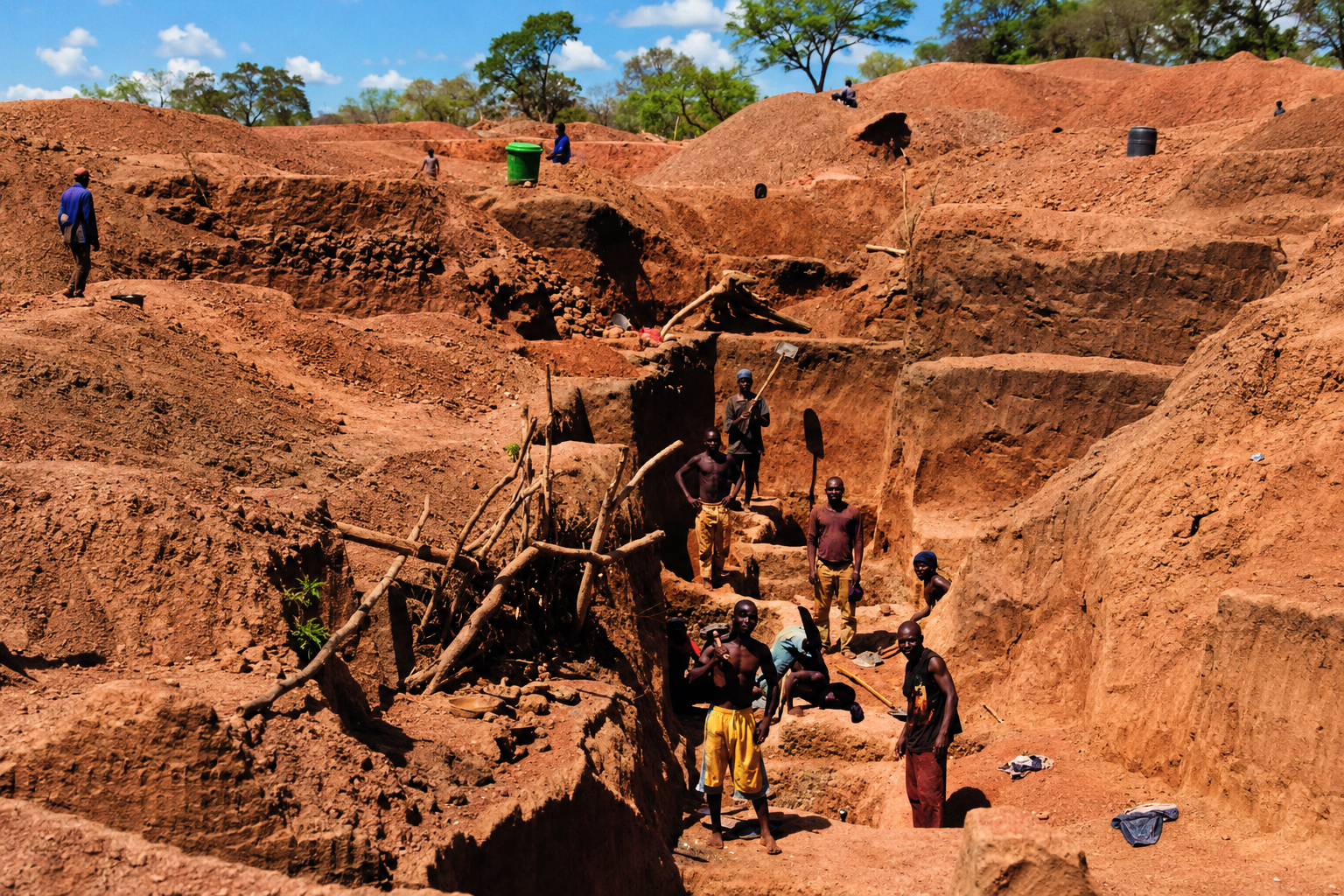
The near-identical chemistry of the Brazilian and African stones is no coincidence. It is a quiet testament to deep geological time: before the continents drifted apart, the land that became northeastern Brazil sat against the land that became West Africa. The same ancient processes that enriched one were at work in the other.
The arrival of African material forced the trade and the world’s laboratories to confront a genuinely difficult question. Could a copper-bearing tourmaline from Nigeria or Mozambique legitimately be called “Paraíba” — a name that referred, after all, to a specific Brazilian state? Or was the name reserved forever for the place of its birth?
The decision fell to the Laboratory Manual Harmonisation Committee, the body that coordinates standards among the world’s leading gemological laboratories — among them GIA, the Gübelin Gem Lab, SSEF, and the major American and Asian institutions. After deliberations in 2005 and 2006, the committee reached a landmark conclusion: Paraíba would be defined by its nature, not its address. The official definition describes a blue to green tourmaline of medium-light to high saturation, colored chiefly by copper and manganese — of whatever geographical origin.
In other words, “Paraíba” became a varietal name, describing the gem’s chemistry and color, rather than a guarantee of where it came from. This single decision has profound consequences for collectors to this day. Because the name itself no longer reveals origin, and because origin dramatically affects value, a credible laboratory origin report is no longer a nicety — it is the most important document accompanying the stone.
It is worth noting that the three origins are not equal in the eyes of the market. Brazilian material remains the most prestigious by a wide margin: the smallest stones, the most intense saturation, the highest prices per carat. Mozambican material is larger, frequently cleaner, slightly softer in saturation, and considerably more available. Nigerian material varies in quality and is the least represented at the top of the market. Some purists, including certain great houses, sidestep the entire debate by using the strictly technical term “cuprian elbaite tourmaline.”
The Collector’s Perspective: Rarity, Records, and Value
If the science explains the magic and the history explains the legend, it is rarity that explains the price.
The numbers that circulate in the trade are striking. It is commonly said that for every ten thousand diamonds unearthed, only a single carat of Paraíba is found — a figure that should be understood as the trade’s vivid shorthand rather than a peer-reviewed statistic, but one that captures the essential truth. This is one of the rarest gemstones in commercial existence. And unlike many precious stones, no commercially viable synthetic Paraíba has ever reached the market, which means that demand cannot be diluted by laboratory-grown alternatives. Every fine Paraíba is a natural one.
The auction record tells the story most dramatically. In December 2025, at Christie’s in New York, a Tiffany & Co. necklace set with a 13.54-carat Brazilian Paraíba sold for 4.223 million dollars. The figure shattered the previous benchmark and established a per-carat record of more than 310,000 dollars — a result that exceeded its high estimate roughly sevenfold, and its low estimate roughly tenfold. The matching pair of earrings, set with smaller Brazilian stones, sold for a further 1.27 million dollars, themselves ten times their estimate. Both pieces, drawn from a single distinguished American collection, were accompanied by laboratory reports confirming Brazilian origin and disclosing a low-temperature heating. The previous record, set a full decade earlier in Geneva, had stood at 3.3 million dollars for a 5.50-carat ring. The market had not merely advanced; it had leapt.
The great named specimens are objects of legend in their own right. The largest cut Paraíba in the world, a 191.87-carat stone known as the “Ethereal Carolina Divine Paraiba,” holds a Guinness World Record and has been the subject of valuations reported anywhere from the tens of millions to well over one hundred million dollars — though it has never actually changed hands at auction, and those figures should be read as owner estimates rather than realized prices. More recently, in May 2025, an extraordinary 181.61-carat internally flawless and unheated Paraíba of African origin — recovered in Mozambique and named the “Kat Florence Lumina,” cut from an 830-carat crystal — sold at Bonhams in Hong Kong.
For the practical collector, the most important lesson hidden inside these records is the tyranny of size. Brazilian Paraíba is characteristically minuscule. The overwhelming majority of faceted stones weigh less than a single carat, and a clean Brazilian stone above three carats is a genuine rarity. Crucially, value does not rise in a straight line with weight — it accelerates. A fine five-carat Brazilian stone is not worth five times a comparable one-carat stone; it is worth many multiples more, precisely because clean material at that size barely exists.
The gem’s status has been confirmed, too, by the world’s greatest jewelry houses. Tiffany & Co., which secured early access to the original Brazilian rough, remains closely associated with the stone. But Bvlgari, Chopard, Cartier, Dior, and Boodles have all built spectacular high-jewelry creations around it, alongside a circle of specialist designers who have made the gem their signature. On the red carpet, the stone has had its moments of glory — most memorably when a major Bvlgari Paraíba necklace appeared during a recent awards season, sending a quiet ripple of recognition through the connoisseurs watching.
How to Buy: Certification and Judgment
For the serious collector, acquiring a Paraíba is an exercise in discipline as much as desire. A few principles should govern every purchase.
Demand a report from a top-tier laboratory. A meaningful Paraíba should never be acquired without a report from GIA, the Gübelin Gem Lab, SSEF, or AGL. That report must state three things: that the stone is a copper- and manganese-bearing elbaite, its geographic origin, and its treatment status. Because the name “Paraíba” no longer guarantees origin, the origin determination is the single most consequential line on the document — and the difference between Brazilian and African provenance can transform the stone’s value.
Rank the value factors correctly. Color comes first, always. The intensity and purity of the glow — that electric, saturated quality — is what separates a great Paraíba from a merely good one. Size comes second, and it matters enormously given the gem’s natural scarcity at scale. Clarity comes third. Unlike a diamond, a Paraíba need not be flawless; minor inclusions are entirely acceptable when the color is exceptional. The connoisseur learns to forgive a small inclusion in a stone that glows, and to reject a clean stone that does not.
Understand the heat question. With rubies and sapphires, the absence of heat treatment can multiply value many times over. Paraíba follows a gentler logic: because heating is the industry norm, fine heated stones retain their full standing in the market. That said, naturally vivid unheated stones — particularly from Brazil — are the connoisseur’s quiet grail, and specialists report that such stones can command meaningful premiums over their heated equivalents. The report will tell you which you are buying.
Match the stone to the goal. A collector seeking the ultimate trophy — the deepest saturation, the purest pedigree — should look to Brazil and accept that size will be modest and price extraordinary. A collector seeking presence and scale, a stone with visual drama for an important piece of jewelry, will find that fine Mozambican material offers larger, cleaner stones at a meaningfully lower cost per carat. Neither choice is wrong; they are simply different expressions of the same passion.
Beyond the Glow
The Paraíba tourmaline is, in the truest sense, a modern marvel. It was unknown to the world before the late 1980s, conjured into existence by the stubborn faith of a single man who dug for years in the Brazilian hills against all reasonable advice. In the decades since, it has risen to a position that older and more famous stones took centuries to attain — coveted by the great houses, chased at the world’s leading auctions, and crowned, at the end of 2025, with a per-carat price that few gems on earth can rival.
Its appeal is not difficult to explain. It is the glow — that impossible, lit-from-within color that no other gem possesses, born of copper and sealed into the crystal across hundreds of millions of years. To hold a fine Paraíba is to hold something genuinely scarce, irreplaceable, and beautiful in a way that photographs can never quite convey.
For the collector who is drawn to it, the path forward rewards knowledge and patience above all. The right stone, with the right report, acquired with a clear understanding of origin, color, and treatment, is among the most rewarding acquisitions in the world of colored gems. At Grygorian Gallery, our role is to bring that clarity to the pursuit — to source, evaluate, and advise so that what you acquire is precisely what it claims to be, and worthy of a place in a serious collection. The glow, after all, is only the beginning of the story.