





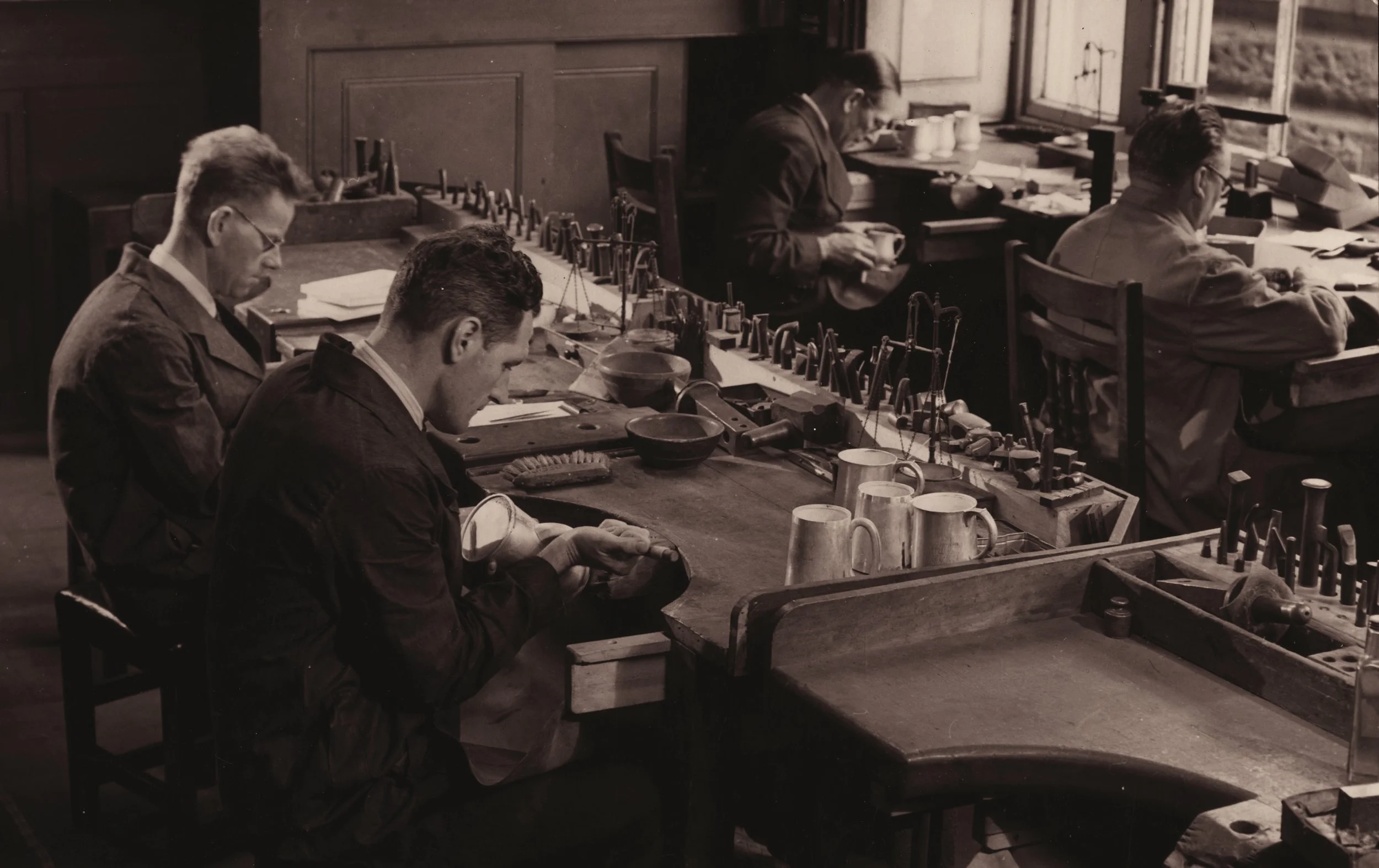




In medieval Europe, hallmarking began as a legally enforced system guaranteeing the purity of precious metal goods. For example, in 1300 King Edward I required that all sterling silver items (92.5% purity) be assayed and stamped with the leopard’s head at Goldsmiths’ Hall in London. This effectively made Goldsmiths’ Hall London’s official assay office for silver. Similarly, under Louis IX in France, the Livre des Métiers (compiled around 1268, though sometimes dated to 1260) mandated that orfèvres (goldsmiths) guarantee the fineness of their work. By 1275 each guild had its own poinçon de titre to certify silver, and in 1313 Philip IV extended state hallmarking to gold. Thus, hallmarking began in the Middle Ages as a legally enforced quality control: it assured buyers of metal purity, protecting coinage and trade, and provided a record for taxes and duties.

Early hallmark symbols were pictorial so they could be understood regardless of literacy. The marks formed a visual language: often royal or national imagery conveyed authority. For example, the English Lion Passant (a walking lion, crowned only in its first years, 1544-1549) was adopted in 1544 as the mark of sterling silver. France’s Eagle’s Head for gold (introduced in 1838) recalls the Napoleonic imperial eagle. Crowns, national personifications, and heraldic creatures were chosen to broadcast state sanction. These marks satisfied legal mandates while remaining memorable. Importantly, a hallmark is not a maker’s private stamp but an official assay mark. It is struck by an authorized office after testing, whereas a simple “.925” or “18K” may be applied by the artisan with little oversight. In short, hallmarks were created by law to certify quality, not merely decorate a piece.
Key tasks of hallmarking emerged early: ensure purity, prevent fraud, and record taxable trade. Over time, hallmarks also tracked place and date of assay, giving each item a traceable identity. For instance, from 1478 London introduced a date-letter to identify the assay year. New laws kept hallmarking evolving: in 1697 Britain raised its silver standard to 23¾ parts in 24 (95.84% – the “Britannia” standard) and replaced the lion and leopard with a seated Britannia figure. Each change left its mark: hallmarks form a visual timeline of regulations.
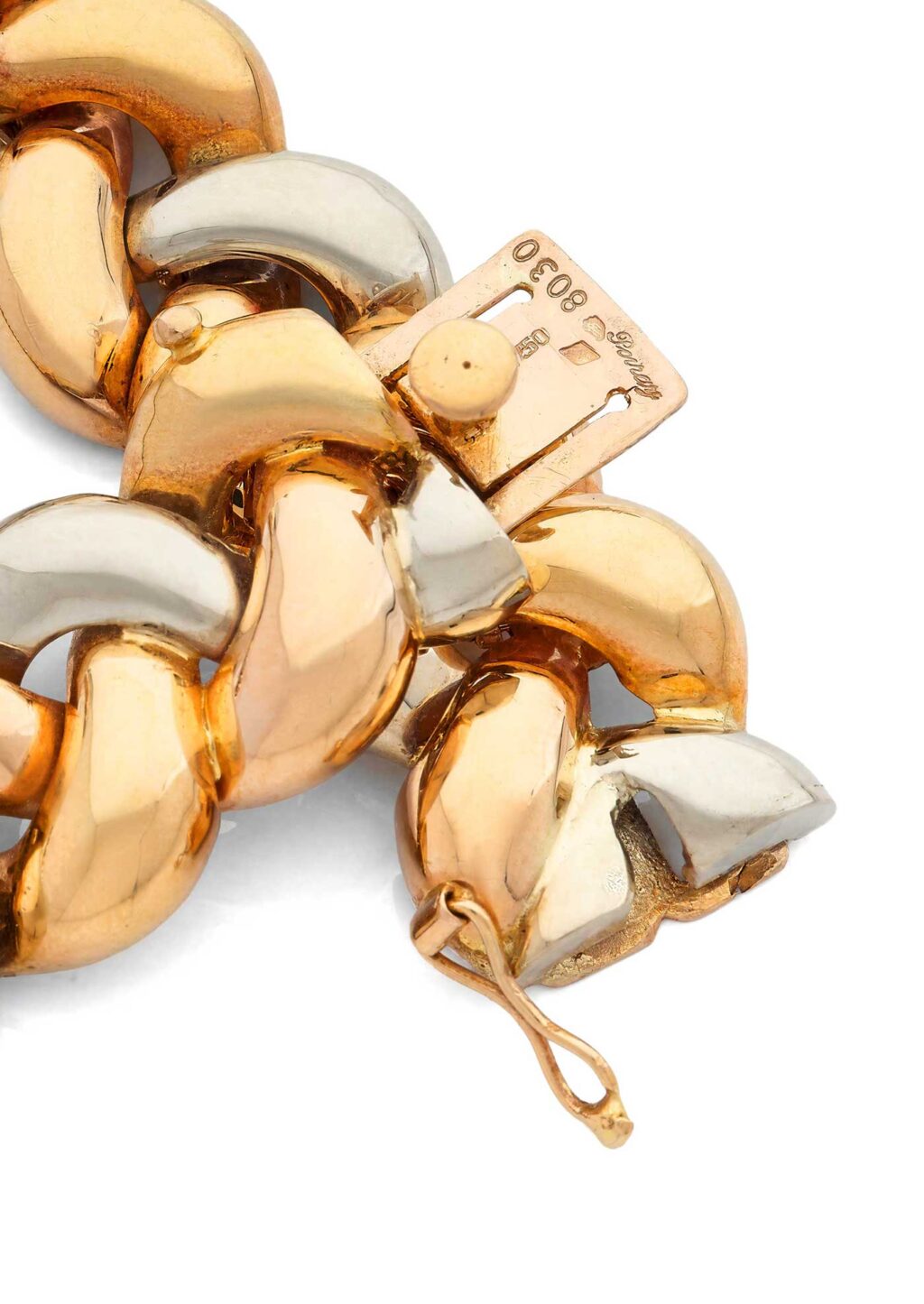
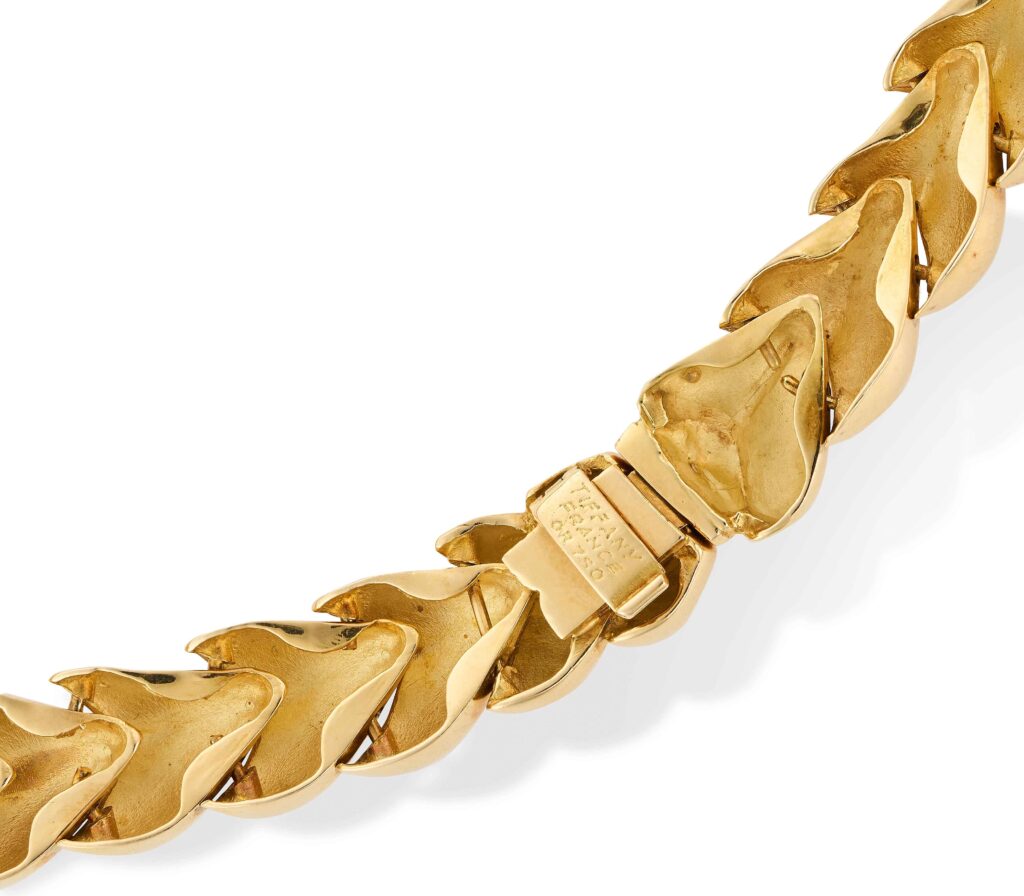
A hallmark differs from a simple fineness stamp in that it is multi-part and state-sanctioned. In England, a full hallmark traditionally includes the maker’s mark, the assay-office symbol (e.g. London’s leopard’s head, Birmingham’s anchor, Sheffield’s rose), and the standard mark (e.g. the lion passant for 925 silver). In France a full hallmark includes the poinçon du maître (maker’s mark) and the poinçon de garantie (e.g. eagle’s head or Minerva) indicating fineness, often with an assay-office control mark. Together, these make hallmarks a coded statement: who made it, where it was tested, when, and how pure it is, backed by law.
Reading these marks can be essential when establishing the authenticity and history of a vintage piece. Professional authenticity verification brings together hallmarks, maker’s marks, construction and other details to assess whether a piece corresponds to its attributed origin and period.
Hallmark is more than a fineness number
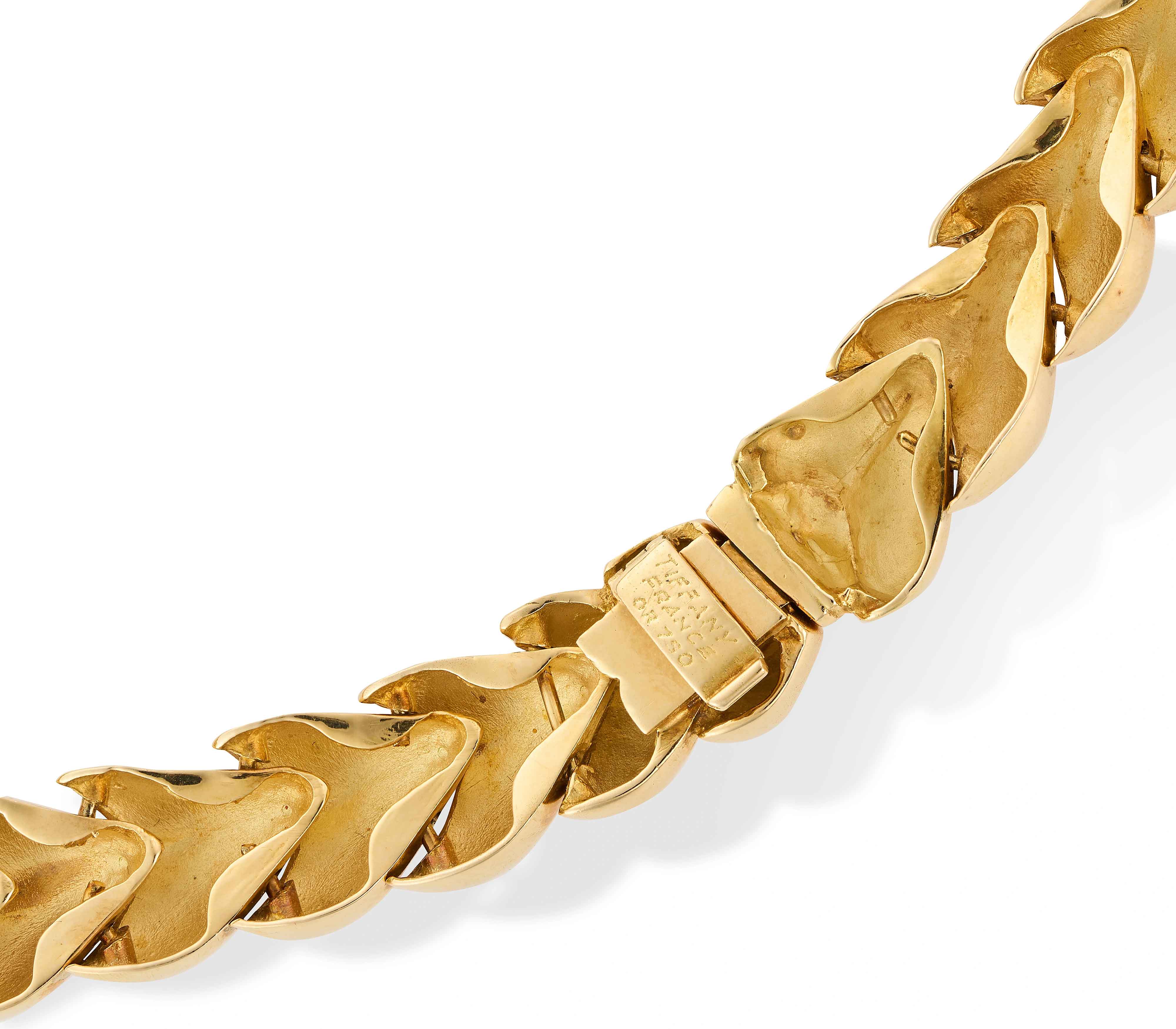
A number like 925, 750 or 950 describes metal fineness, but by itself it says nothing about origin or authority. A formal hallmark belongs to an official assay system, and its parts work together to identify metal, legal standard, and jurisdiction. This is crucial in historical jewellery: a modern “750” stamp might have been applied later, whereas an authentic hallmark reveals the legal environment at the time of assay. The same numerical fineness may appear in different visual forms in different countries or eras.
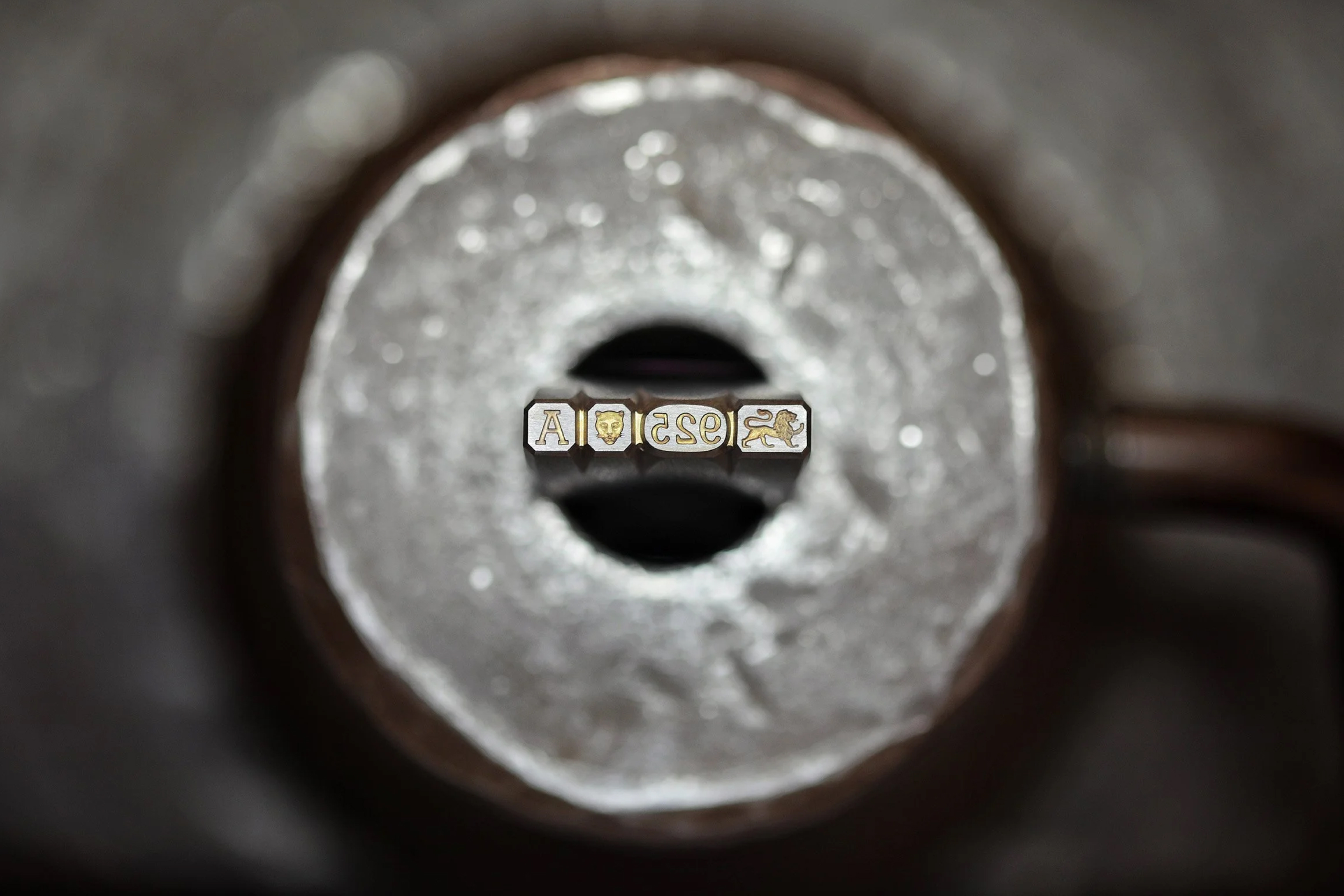
Consider the UK system: under current rules a full hallmark identifies the submitting sponsor (maker), the metal fineness, and the Assay Office. A date-letter may also appear though now optional. Moreover, the fineness number sits in a shaped cartouche that indicates metal: gold uses a rectangle with clipped corners, silver an oval, platinum a pentagon. In other words, an expert does not read “750” in isolation, the surrounding cartouche and assay mark must be considered together.
British Hallmarks: A Heraldic Language
In Britain the hallmark system grew out of medieval guild practice and royal statutes. Goldsmiths’ Hall in London was established under Edward III (1327) and gradually extended powers that are still reflected today. By Act of 1544, each piece of silver plate had to be assayed for 92.5% purity (sterling), marked with a Lion Passant (walking lion) and the city’s symbol. This lion mark, inspired by the royal arms, became the universal symbol of “sterling England,” appearing on every city’s hallmark thereafter. Intriguingly, the style of the lion itself changed over time: from 1544-1549 it was crowned and guardant (full face), from 1550-1821 guardant uncrowned, and after 1822 in profile. An expert can even roughly date a piece by whether the lion faces the viewer, guardant, before 1822, or walks in profile, facing the direction of travel, after 1822.
For gold, early British hallmarks likewise bore royal symbolism. From 1798 the crown motif was used on gold, first marking the newly introduced 18ct (750/1000) standard with a Crown and the number “18”; 22ct gold, meanwhile, went on being struck with the same lion passant used on sterling silver. From 1816, to avoid confusion with gilt silver, an additional “sunburst” (“sun in splendour”) mark was used on 22ct gold until 1844. In that year the 22ct standard was formally denoted by a Crown and “22” instead of the lion. By the 19th century, therefore, British gold pieces typically bore a Crown symbol rather than a lion. These pictorial marks were eventually supplanted by numeric 750 or 916 marks under the international hallmarking Convention and later UK legal reforms in the late 20th century.
Another uniquely British figure is Britannia, the armoured goddess. During a currency crisis in 1697, all silver plate was briefly required to meet 23¾ parts in 24 fineness (95.84%) and was hallmarked with Britannia’s seated figure. This protected British coins from being melted down. Sterling (92.5%) was restored in 1720, and Britannia remained only an occasional mark thereafter, later revived as an optional higher standard, and still available today. Its presence on an older piece therefore usually, though not always, given its later revivals, points to the 1697-1720 window.
Finally, the Orb and Cross was introduced in 1975: Britain’s platinum standard (95.0%) now carries an orb-shaped mark, echoing the lion’s historic role. For centuries, each British hallmark symbol – crowned leopard, lion, crown, orb – has served not just as decoration but as a government guarantee. An item with a crowned lion and leopard’s head clearly dated to 1700, for example, immediately reveals its origin.
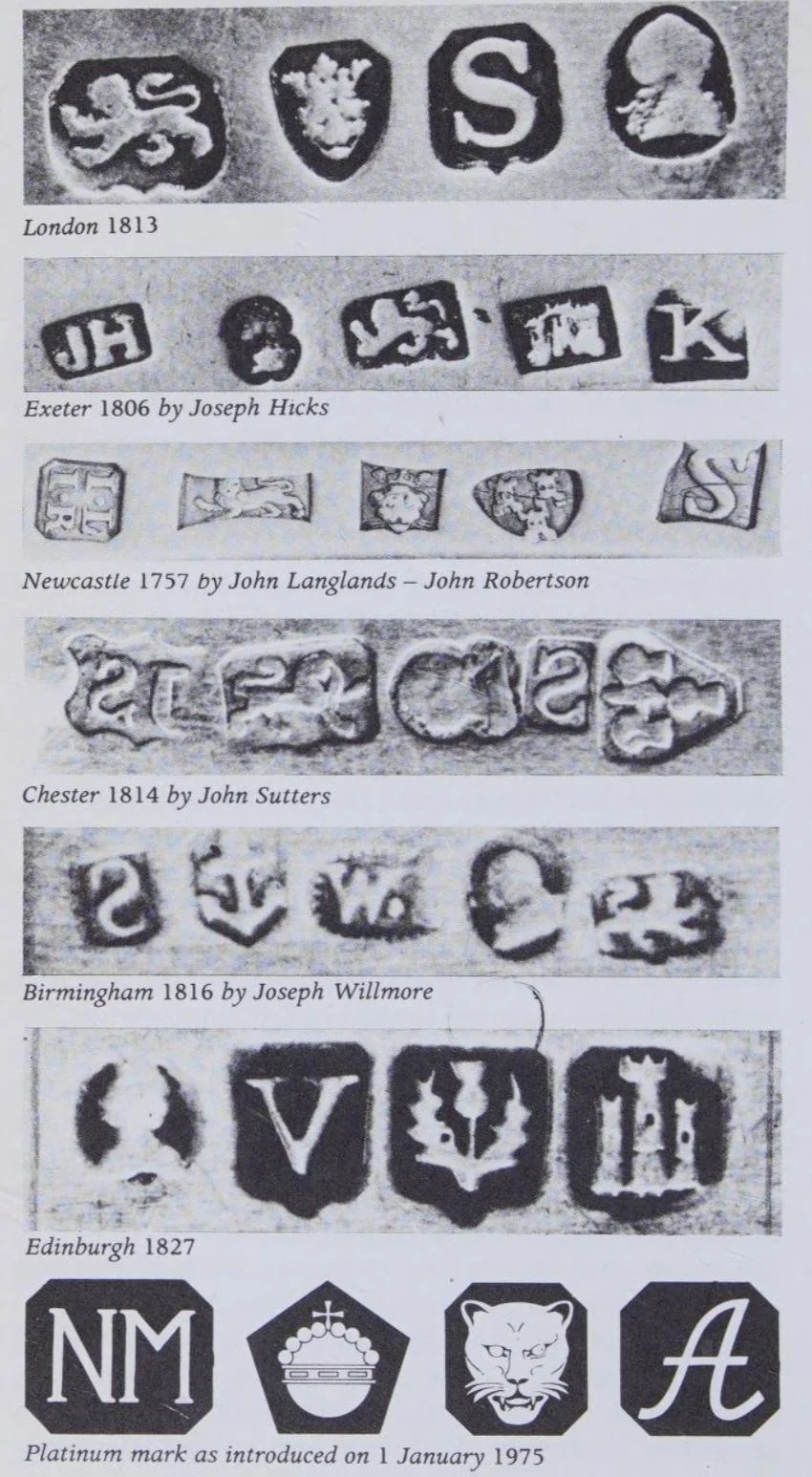
Throughout, British hallmarks have told a story of design as well as law. For centuries a crowned leopard’s head, a lion, a crown or an orb, all drawn from royal regalia and heraldry, have been more than decorative: they asserted government guarantee. Museum and trade reference guides commonly describe the lion passant as the official British symbol of 92.5% pure silver. An expert would add that each symbol’s incarnation evolved: subtle changes in crown style or lion pose track reforms and dates. For example, the Sheffield assay office struck a Crown town-mark from 1773 until 1975, after which it switched to a Tudor Rose) These office marks (crown, anchor, rose, etc.) are not fineness marks but indicate where the assay was done.
Numeric purity stamps (925, 750, 916, etc.) became the sole compulsory standard mark only in 1999, when the traditional pictorial marks became optional additions rather than a legal requirement; date letters became optional at the same time. Yet an item dated 1820 with a crowned lion and Britannia figure, for example, immediately reveals its era and origin. Interpreting British hallmarks thus means reading multiple devices in context: the maker’s initials, the assay city mark, the purity symbol, and often a date letter or duty mark. No single mark stands alone.
| Mark | Meaning / Use | Important Period |
|---|---|---|
| Leopard’s head | London assay-office (town) mark | From 1300 onward |
| Lion passant | Sterling silver standard (925) | From 1544 onward |
| Date letter | Year of assay (starting 1478) | From 1478 onward |
| Maker’s mark | Maker’s (sponsor’s) identification | From 1363 onward |
| Britannia | High silver standard (23¾ parts in 24 / 95.84%) | 1697–1720 (compulsory; optional afterward) |
| Sovereign’s head | Duty mark (tax on precious plate) | 1784–1890 |
| Crown + number | Gold fineness (e.g. 18 ct, 22 ct) | From 1798 (18ct); 1844 (22ct) |
| Orb and cross | Platinum standard (950) | From 1975 |
French Hallmarks: A Distinctive System
France developed a separate hallmark tradition, with its own rich symbology. French hallmarking dates to medieval guild laws (1260, 1275, 1313 as above) and underwent major reform under Napoleon. From 1798, the Consulate-era guarantee system set up by the law of 19 Brumaire Year VI (9 November 1797) came into force. Under this system, gold of 22 carats (916‰) bore the Coq (Gallic rooster) with a numeral, while 18 carats (750‰) bore a Coq with “3”. Silver bore the same Coq, not a separate symbol: the numeral 1 marked the 950‰ standard and the numeral 2 the 800‰ standard. The now-famous “tête de vieillard” (old man’s head) did not appear on French silver until 1819, when it replaced the rooster until 1838, see the table below. These head symbols and numbers formed the Republican/Napoleonic coding system.
In 1838, the French standards and symbols were overhauled. An eagle motif recalling Napoleon’s imperial eagle replaced the rooster: the Tête d’Aigle became the official poinçon de garantie for gold. From 1838 on, French 22 carat gold was marked with an eagle’s head and the number “1”, and 18 carat with an eagle and “3”. For convenience, small pieces often show the eagle without number (a “petite garantie” test). This eagle motif remains France’s gold hallmark today, a direct descendant of the Napoleonic eagle and still recognized by the State. In contrast, an eagle on British gold would never appear.
Alongside the eagle, France also used other marks unique to its system. Notably, the Tête de Cheval (horse’s head) was introduced in 1838 as a “fanciful device” to certify 18ct and higher gold; it was used until July 1919. After 1919 the horse’s head was retired, leaving the eagle as the main domestic gold control mark, import marks such as the owl continued alongside it. For import and travel, a special mark was used: the Charançon (weevil), first struck in 1838 and redesigned in 1864, was stamped on foreign gold and silver entering France; from 1893 it was restricted to gold only, while a new Swan (cygne) took over marking imported silver. These import marks alert experts that the piece was assayed in France despite foreign manufacture.
French silver has its own iconography, most famously the Tête de Minerve. Since 9-10 May 1838, French silverware has borne the profile of Minerva (head of the Roman goddess) as the guarantee mark: one version for 1er titre (950‰ silver, originally marked as 1st titre Minerva) and another for 2e titre (800‰, second-grade). For small or export silver articles, the silver Boar’s Head (sanglier) and Crab (crabe) have been used on 800‰ pieces since 1838. For example, until 1962 Paris used a boar’s head on small 800 silver, then switched to the crab that the provinces had already used since 1838. The effect is that a French silver item might show Minerva with “1” or “2”, or a boar or crab, whereas British silver would use a lion or Britannia.
France also uses the distinctive import/control marks described above. The Owl (hibou), for imported gold, and the Swan (cygne), for imported silver, were both introduced on 29 June 1893, replacing the charançon for that purpose. These marks signal that a foreign-made piece was submitted to French assay.
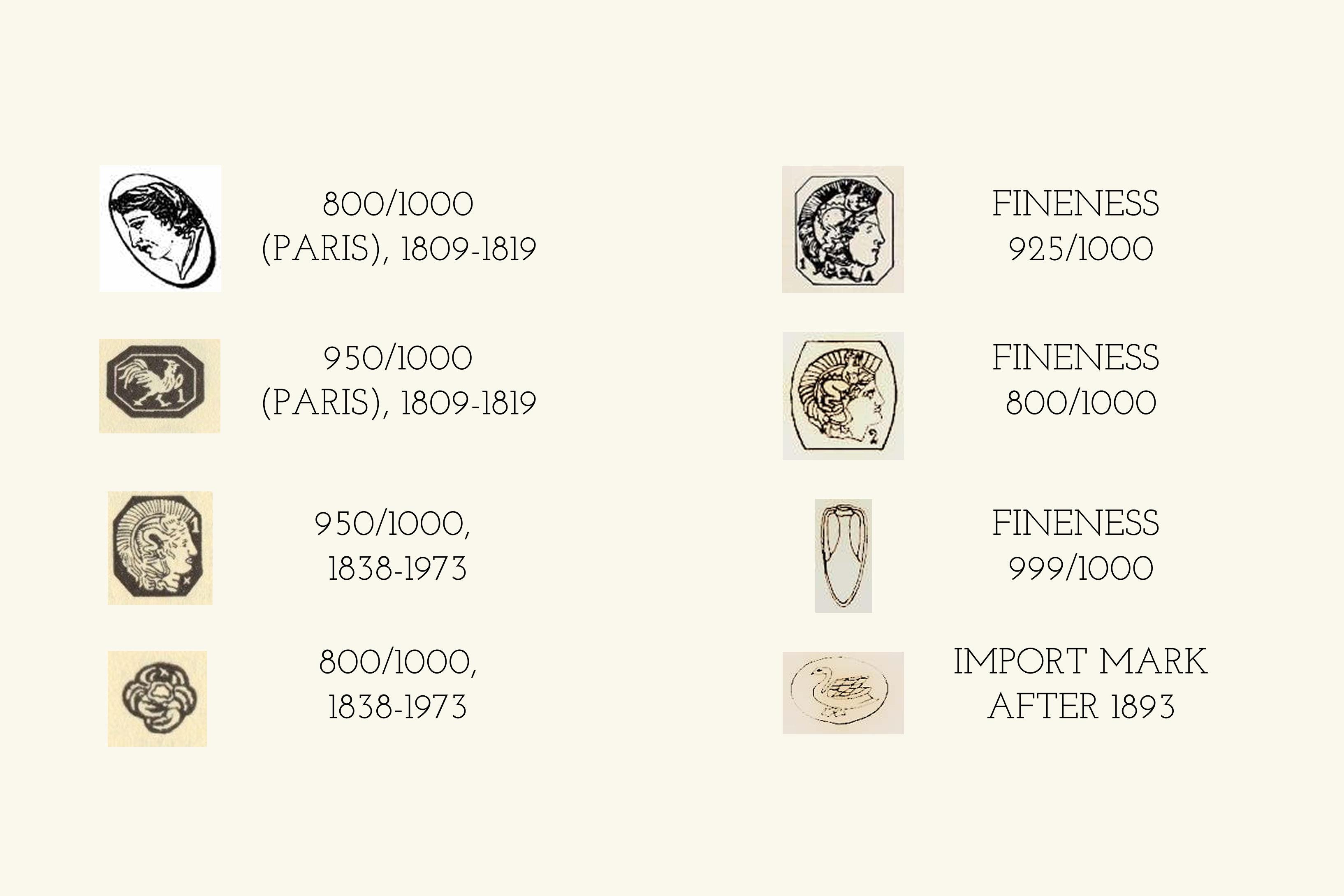
Even numeric standards differ: France kept 22 ct/18 ct gold (916/750) and only added 14 ct (585‰) and 9 ct (375‰) in 1994. French hallmark laws also evolved: the Revolution of 1791 abolished the old guild marks, and the 1797 loi du 19 Brumaire created the modern Bureaux de Garantie. Later decrees (1838, 1919, 1994, etc.) updated symbols and standards, but the use of heraldic imagery remained.
| Mark | Meaning / Use | Period |
|---|---|---|
| Gallic Rooster (Coq) | French silver guarantee mark (1st/2nd standard) | 1798–1819 (Napoleonic) |
| Le Vieillard (Old Man) | French silver guarantee mark (1st/2nd standard) | 1819–1838 (Bourbon) |
| Minerva’s Head | French silver guarantee (950/800) | 1838–present |
| Boar’s Head (Sanglier) | Small silver (800) guarantee mark (Paris) | 1838–1962 (Paris control) |
| Crab (Écrevisse) | Small silver (800) guarantee mark (departments) | 1838–present (departments); Paris from 1962 |
| Eagle’s Head | French gold guarantee mark (22K/18K) | 1838–present |
| Horse’s Head | French gold mark (18K+) | 1838–1919 |
| Weevil (Charançon) | French import mark (foreign gold/silver) | 1838–1893 (redesigned 1864) |
| Owl (Hibou) | French import mark (foreign gold) | 1893 onward |
| Swan (Cygne) | French import/“chance” mark (foreign silver) | 1893–present |
| Poinçon de Maître | Maker’s (silversmith) mark | Various (lozenge or star punch) |
Hallmarks and Legislation: A Co‑Evolution
Hallmarks changed hand-in-hand with law. Each new stamp usually marks a legal shift. In England, the Act of 1697 raised the silver standard to 23¾ parts in 24 (95.84%) and changed the symbols, introducing Britannia. When sterling was re-authorized in 1720, the older marks returned. In 1838 (the same year France overhauled its system) Parliament codified hallmarking under the Assay Offices Act. The 1973 Hallmarking Act (effective 1975) consolidated previous laws and introduced platinum marks, Orb and cross. This Act also aligned Britain with the International Convention on Hallmarking and introduced convention marks; the millesimal (parts-per-thousand) number became the sole compulsory standard mark only later, from 1999. Later UK laws added palladium in 2009 and allowed overseas assaying in 2013.
France’s laws likewise reshaped hallmarks. The 1797 loi du 19 Brumaire abolished the old guild punches and created the state Bureaux de Garantie, laying the foundation for the modern system. Decrees of 1838 standardized the eagle, horse, Minerva and boar marks. After World War I, a 1919 law retired the horse’s-head mark. Late-20th-century decrees (1994 and after) added 14K and 9K gold standards, while retaining 22K/18K figures. Since 2003, mixed-metal items are simply labeled rather than hallmarked. Each legal reform left its fingerprint on the punch shapes or numbers, for example, a French eagle head from 1890 will have the imperial design, whereas one struck today looks slightly different; note that, unlike Britain’s annual date-letter cycle, the French system generally identifies the office and period through the “différent” symbol rather than a systematic date letter.
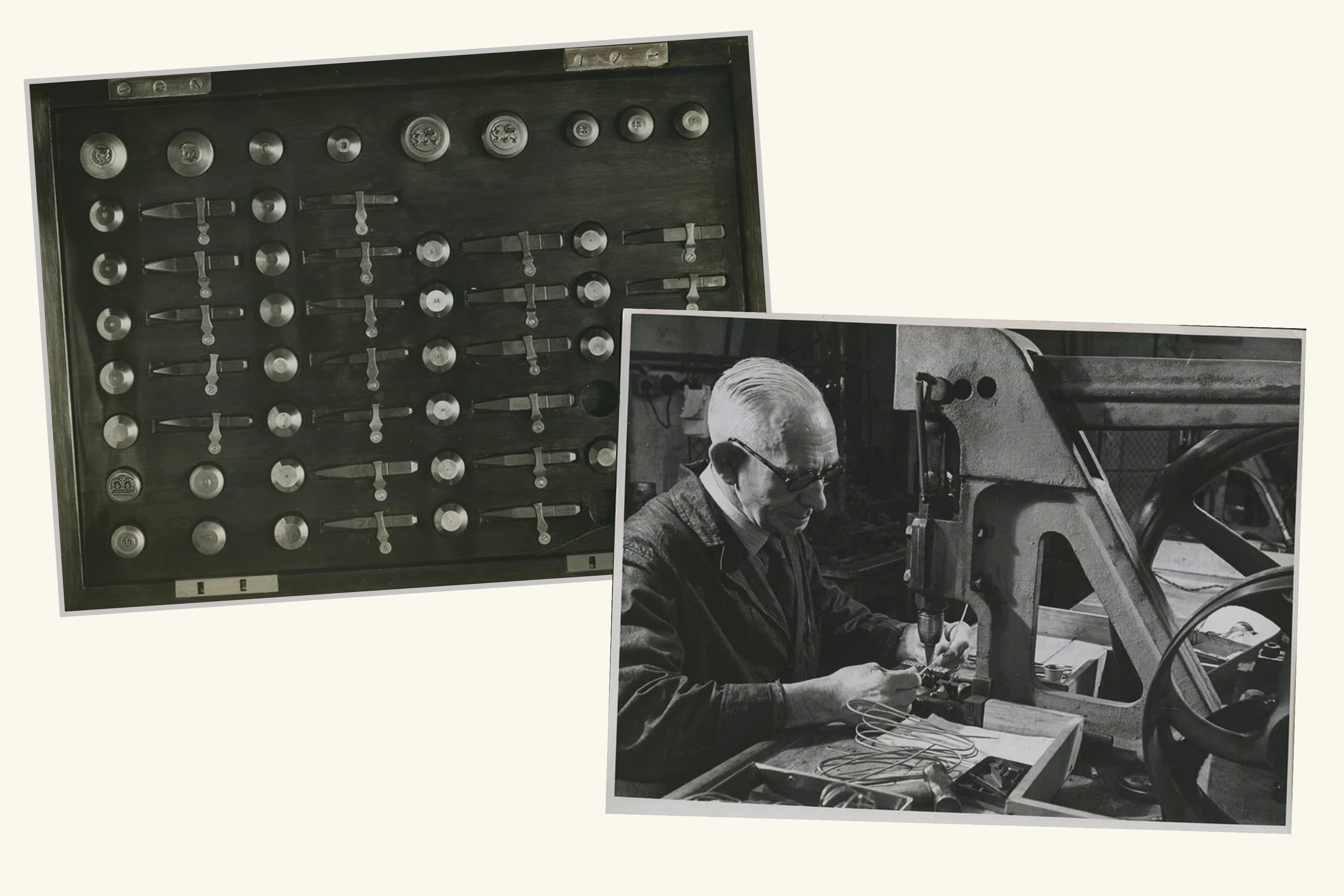
These changes often meant one symbol disappearing and another appearing. For example, British 22K gold was marked with the lion until 1844; it then switched to Crown + 22. The numeric “916” and “750” did not officially become the sole compulsory mark until 1999, 1975 was instead when the Hallmarking Act 1973 itself took effect and introduced the platinum orb. Likewise, France phased out its rooster (1798-1819), horse (1838-1919), and early charançon forms. New symbols came and went by decree. The result is that the “same” metal can bear very different marks in different eras. A French 18K ring from 1820 would show a rooster with “3”; one from 1920 shows an eagle with “3”. A British 22K brooch of 1790 carries a crowned lion and sun, one from 1880 shows Crown + 22. By tracing these emblematic shifts, historians can often date and localize jewelry with surprising precision.
Place of Manufacture vs Place of Assay
A crucial lesson is that a hallmark shows where a piece was assayed, not necessarily where it was made. Under both systems, importers often sent foreign-made items to a local assay office for testing. The London Assay Office even today accepts items from around the world, these are simply punched with a British town mark. Thus a necklace made in France might bear a London anchor and date letter if it was assayed there for sale in the UK. Conversely, a piece made in London but assayed in Paris would carry French marks. In France, an item bearing the Hibou or Cygne mark flags that it was foreign-made but controlled in France. Likewise, UK law allows a Convention “Common Control Mark” (a pair of scales within a shaped cartouche, alongside the fineness number) for goods assayed in the UK for other treaty countries. In short, do not assume heraldry = origin. The hallmark records assay jurisdiction.
For example, one might see a Swiss gold watch case with a British guarantor’s punch (and the orb mark, if platinum) if it were sent to London for assay. Or a French gold ring with a Paris maker’s mark and an English leopard’s head, this means it was Parisian-made but sent to London for hallmarking. Always read all the punches together. In complex cases the sequence: maker → assay office → fineness, reveals the journey of the piece. Being aware of this distinction prevents misattribution: a lion passant on its own marks silver legal in Britain, but if accompanied by a Paris master mark it means a French assay master borrowed the lion symbol (France itself never used a lion).
Reading a Complete Hallmark
An expert ‘reads’ hallmarks as a composition of marks. In the British system, the minimal hallmark includes four key elements: the maker’s initials, the assay office mark , the standard mark, and a date letter for the year. For example, a mark showing “ †ABC (lion) (leopard’s head) a ” (in 18th-century style) would be parsed as maker “ABC”, lion = sterling silver, leopard’s head = London, and date-letter “a” = 1695. Under current rules, the compulsory elements are the maker’s mark, office mark, and fineness mark; the date letter became optional after 1999. Additional symbols are interpreted as extras.
In France, a hallmark typically includes the poinçon du maître-orfèvre followed by the poinçon de garantie and sometimes a control letter for date. For example, a French gold brooch might carry “L* ” (maker code), then an eagle’s head with the numeral “750”, and then the letter “P*” in a cartouche (meaning the assay house of Paris in year 1926). Each symbol must be read in context: the eagle alone says “French 18K gold”, but the number with it and the shape of the punch refine that. Unlike British marks, French guarantee symbols often change size between big and small objects. Nor is the maker’s code always obvious at first glance.
To use a real case as illustration: suppose we see on a silver antique a crowned lion next to “a 18” and a maker’s initials. Knowing British hallmarks, we recognize this as post-1817 sterling, dated 1818, and made in London. On the other hand, a piece marked “(owl head)(717)” is clearly French: owl = gold import mark, “717” = 18K (though slightly off from the normal 750), indicating it was retested in France. In practice one consults reference charts for each country’s date-letters and symbols.
In all cases, an expert looks at the whole set of punches on a piece. A single lion or eagle is a clue, but not a conclusion. It is the combination, metal mark plus city mark plus date and maker, that yields the story. Trade and reference guides likewise stress that a complete British hallmark must be read as a set of marks, not a single fineness number in isolation. By piecing together the visual language of each symbol, a trained eye can pinpoint the metal content, assay location, legal standard, and even the decade of manufacture, rather than relying on tradition or guesswork. When the marks are worn, incomplete or difficult to interpret, specialist examination becomes especially important. Authenticity verification and professional appraisal can help turn a handful of cryptic punches into a documented history.