






Astrology lives by an elegant paradox: mocked aloud, consulted in private. One is free not to believe the stars. Yet there is a question humankind has been asking for several thousand years, and sooner or later it finds everyone: which stone is mine?
That question opens a new series from our Education Center. Chapter by chapter, we will walk the full circle of the zodiac and set beside each sign the stone that history, myth, and the jeweller’s tradition have appointed as its companion. We will speak of astrology not as prophecy but as one of the oldest systems of meaning ever devised — a system in which sky, metal, and crystal are woven into a single pattern. Whether to sense magic behind that pattern, or to see in it only a beautiful play of the mind, is a choice every reader makes alone.
A Bond Born Before Horoscopes
The bond between stones and the heavens is itself far older than any newspaper horoscope. As early as the first century, the historian Flavius Josephus saw a correspondence between the twelve stones of the breastplate of the High Priest Aaron, described in the Book of Exodus, the twelve months of the year, and the twelve signs of the zodiac; late-antique Christian authors — Saint Jerome among them — carried forward the tradition of reading those twelve stones symbolically. For centuries, in prosperous circles, the refined practice was to own all twelve stones and wear each in its month — the jewel changed as the sky changed. The habit of wearing a single stone tied to one’s own birth is comparatively recent: the mineralogist George Frederick Kunz traced it to eighteenth-century Poland, while the Gemological Institute of America traces its early forms to Germany in the 1560s. And the list the world uses today was fixed only in August 1912, when the American National Association of Jewelers met in Kansas City and adopted it by formal resolution.
In the East, by then, a far more elaborate system had existed for many centuries — we will come to it shortly, for it concerns our first protagonist directly. For now, one observation will do: Babylon and Jerusalem, India and Greece, Rome and Burma — civilisations that agreed on almost nothing — each arrived, in its own way, at the same thought: the stars have their stones. That consonance is worth more than any proof.
We begin where summer reaches its zenith — with Leo. And with the ruby.
The Sign Ruled by Light
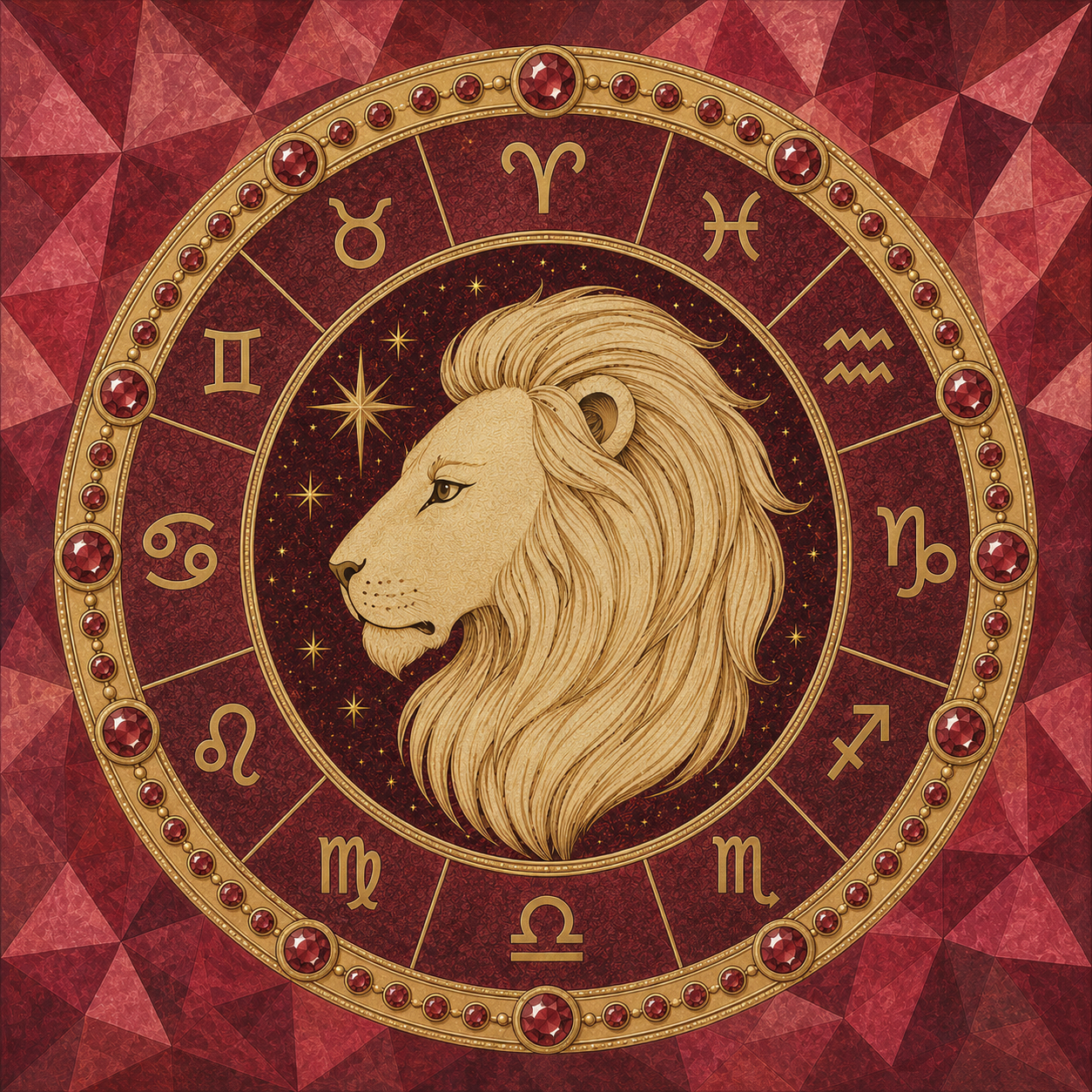
Leo is the fifth sign of the zodiac; in the Western tradition it holds the very crown of summer, roughly the 23rd of July to the 22nd of August. It is a fire sign and, in astrology’s vocabulary, a fixed one — which the tradition reads as constancy, loyalty, and a magnificent, almost regal stubbornness. Its symbol is the lion; its glyph is read as the curve of the lion’s mane.
But the essential thing about this sign is the detail that makes it unique in the entire circle. The two luminaries share their dominion with no one: the Moon is given Cancer, the Sun is given Leo. And Leo alone in the whole circle is ruled by the source of light itself. A union without rivals and without second roles. So Ptolemy described it in the second century: in the Tetrabiblos, Leo is fixed as the hot, dry, fixed fire sign of the Sun — and in that capacity it has endured for nearly two thousand years. In astrology’s symbolic grammar, the Sun is the centre: the vital principle, the source around which everything else arranges itself. Tradition grants those born under this sign a measure of that solar nature — the gift of being not reflected light, but its source.
No wonder the lion became an emblem of power in nearly every culture that knew it — from the sphinxes of Egypt to the Lion of Judah, from the Ishtar Gate of Babylon to the heraldry of Europe’s dynasties. Even astronomy rhymes with the myth here: the brightest star of the constellation Leo bears the name Regulus — Latin for “little king.” Royalty is written into this sign at every level: the royal beast, the royal star, the royal luminary. And the luminary, since time immemorial, has had its stone.
At the Court of Surya
The Western tradition gave Leo its solar nature; the Indian tradition went further still, binding the ruby to the Sun by name and for good. In Sanskrit the stone is called manikya, a name still in use today. The oldest texts often gave the most precious red stones another name as well — padmaraga, “lotus-hued,” for their kinship with the deep crimson of the flower. And then the most eloquent title of all: ratnaraja, the king of gems. The phrase is more than ornament. It is fixed in the Sanskrit sources, and its English echo — King of Gems — survives in the modern references of the Gemological Institute of America.
In Vedic astrology — Jyotisha, the “science of light” — the ruby belongs to Surya, the Sun. It stands at the heart of the navaratna, the “nine gems”: a sacred circle of stones, each assigned to one of nine celestial powers. The ruby to the Sun, the pearl to the Moon, red coral to Mars, the emerald to Mercury, the yellow sapphire to Jupiter, the diamond to Venus, the blue sapphire to Saturn, hessonite and cat’s-eye to the two lunar nodes. In the classical navaratna jewel the ruby occupies the centre of the composition — the place of the Sun, around which the eight remaining stones are arranged. The setting itself repeats the architecture of the sky.
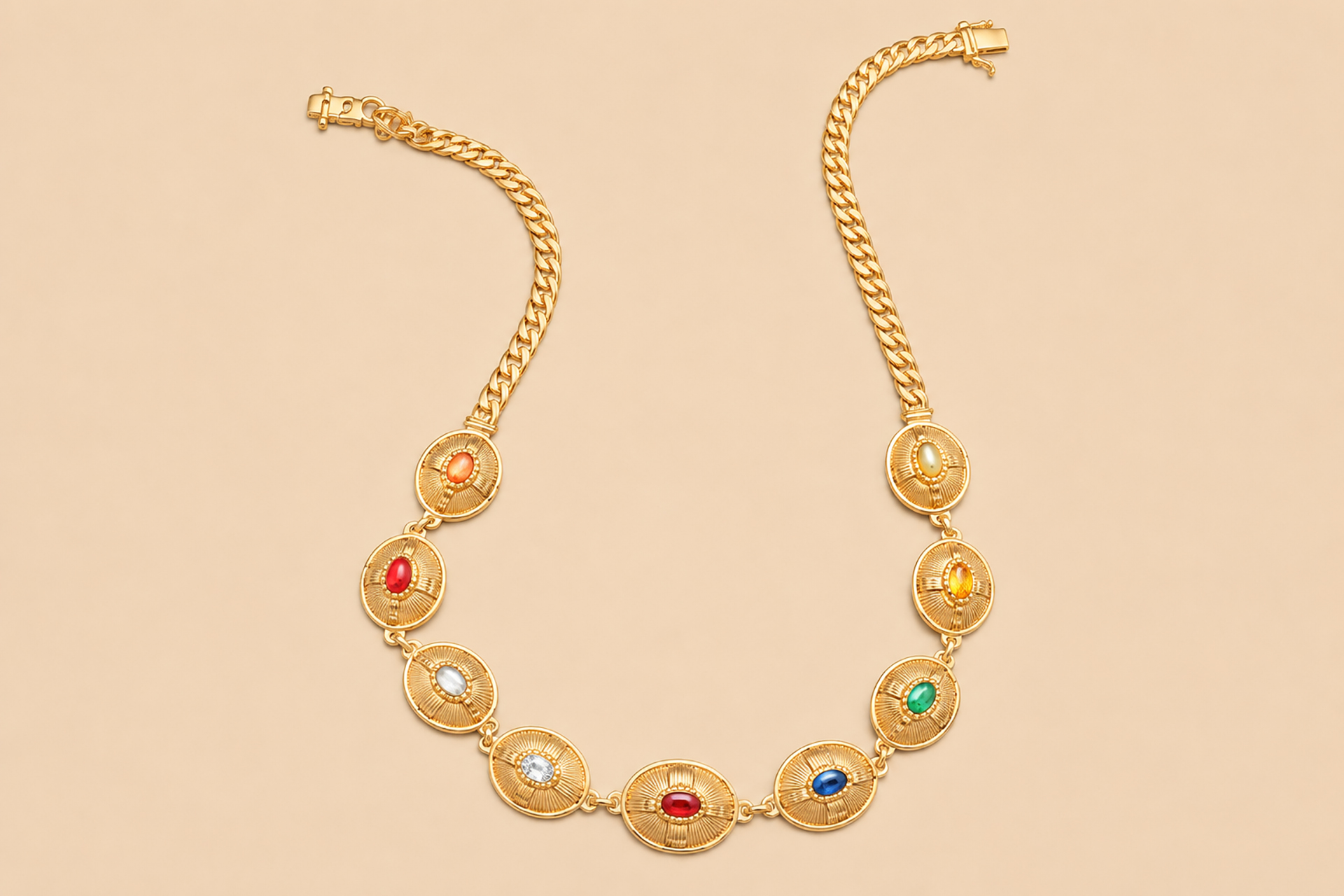
Nor is this the haze of folklore: it is a written tradition with names and dates. The ruby, under the name padmaraga, is examined at length in the Brihat Samhita of Varahamihira — the sixth-century polymath who left one of the earliest systematic Sanskrit accounts of precious stones. The explicit correspondence of ruby and Sun is fixed in the classical astrological treatises: in the Jataka Parijata of Vaidyanatha Dikshita, where each of the nine planets is assigned its gem, and in the Phaladeepika of Mantreshvara. Tradition holds that the Sun governs the soul, authority, vitality, and the figure of the sovereign — and the ruby, glowing as though from within, was meant to strengthen precisely these principles in its wearer. One need not share the belief; one need only admire the elegance of the pairing — the most solar of stones given to the most solar of signs.
A Flame with a Formula
Here myth meets science — and something rare happens: science does not debunk it, but confirms it.
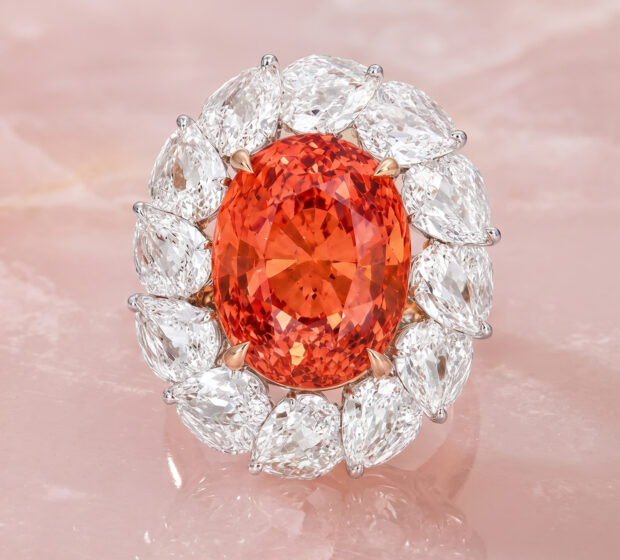
The ruby is the red variety of the mineral corundum, crystalline aluminium oxide, Al₂O₃. Pure corundum is colourless. What makes it red is a single trace element — chromium, replacing a vanishingly small share of the aluminium atoms in the crystal lattice. The same mineral, coloured otherwise, is called sapphire; only red earns the name ruby. The entire difference between a modest colourless crystal and the most expensive coloured gemstone on the planet is a pinch of chromium.
The ruby is extraordinarily hard: 9 on the Mohs scale, with only diamond above it. Its refractive index lies between roughly 1.762 and 1.770; its specific gravity is about 4.00. Under magnification, fine stones reveal a delicate net of needle-like rutile inclusions — jewellers poetically call it “silk,” and for the gemmologist it is one of the important diagnostic marks of natural origin, though not the only one.
But the ruby’s most astonishing property is something else. An ordinary stone merely reflects the light that falls on it. A ruby can glow on its own. The culprit is the same chromium: it absorbs the invisible ultraviolet part of daylight and returns it as visible light — a red glow. This is why a fine ruby looks brighter in sunlight than it “should”: an inner red radiance is added to the stone’s own colour. The effect is strongest in Burmese stones, which contain almost no iron — the element that usually mutes the glow.
Hence all the legends of an inextinguishable flame inside the stone. For centuries it was told that the ruby hid a coal that could not be put out, that it could bring water to the boil, that its light pierced any cloth. This miracle has a scientific name — fluorescence. And it is no minor effect: it was on this very phenomenon that the first laser in history was built in 1960, with a rod of synthetic ruby at its heart. So the stone really does burn from within. The legend simply outran science by a couple of millennia.
The union of that glow with a pure, faintly cool red is the famous pigeon’s blood, the highest grade of ruby colour — said, by old tradition, to match the first two drops of blood from a pigeon. The name is ancient, but the standard is not: only in the mid-1990s did the gemmologist Adolf Peretti become one of the first to set out precise criteria for it — a saturated red paired with pronounced fluorescence. Even now there is no single canon. The leading laboratories — the Swiss SSEF and Gübelin, the American GIA — read the term with subtle differences, and the GIA prefers the more measured vivid red. Which is why a connoisseur reads the certificate as closely as the stone.
The Great Imposters
No honest account of the ruby is possible without one of the most exquisite confusions in the history of jewels: some of the world’s most famous “rubies” are not rubies at all.
Until 1783, when spinel was chemically separated from corundum, any large red stone was called a ruby, or a “balas ruby.” To the eye the two minerals are nearly indistinguishable — both, by irony, owe their colour to that same chromium — yet in composition they are different substances: spinel is an oxide of magnesium and aluminium. A medieval jeweller could not tell them apart, and so the treasuries of the world are filled with magnificent red spinels under an assumed name.
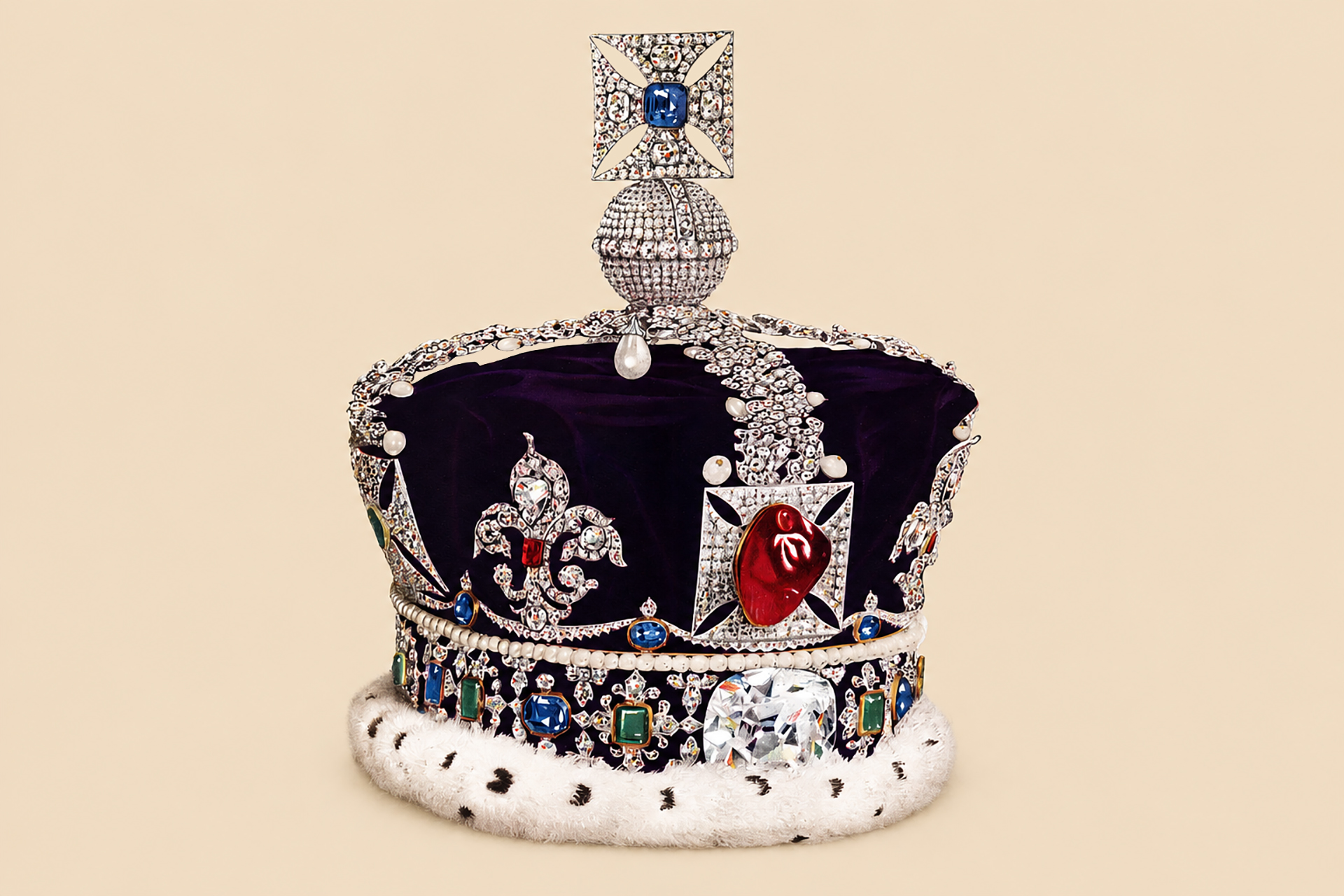
The most celebrated of them is the so-called Black Prince’s Ruby: a large, irregular red spinel of about 170 carats, mined in all likelihood in the deposits of Badakhshan, in the lands of present-day Afghanistan and Tajikistan. Tradition holds that in 1367 the stone came to Edward of Woodstock, the Black Prince, from Pedro of Castile — and that in 1415 Henry V wore it on his helmet at Agincourt, where it survived a blow that nearly cost the king his life. Today it shines at the brow of the Imperial State Crown of the United Kingdom, directly above the Cullinan II diamond — one of the oldest stones of the British regalia and, for all its fame, a spinel.
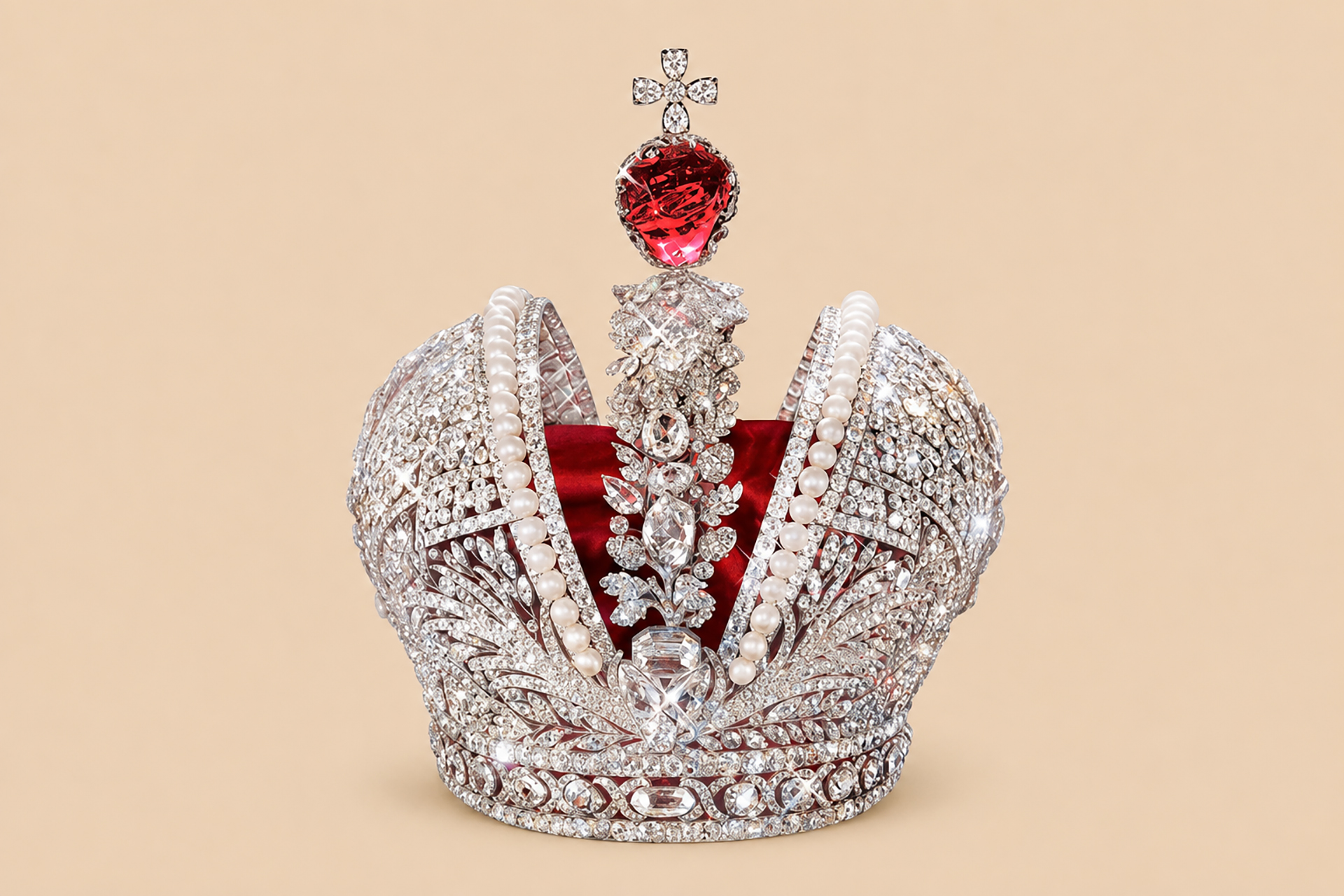
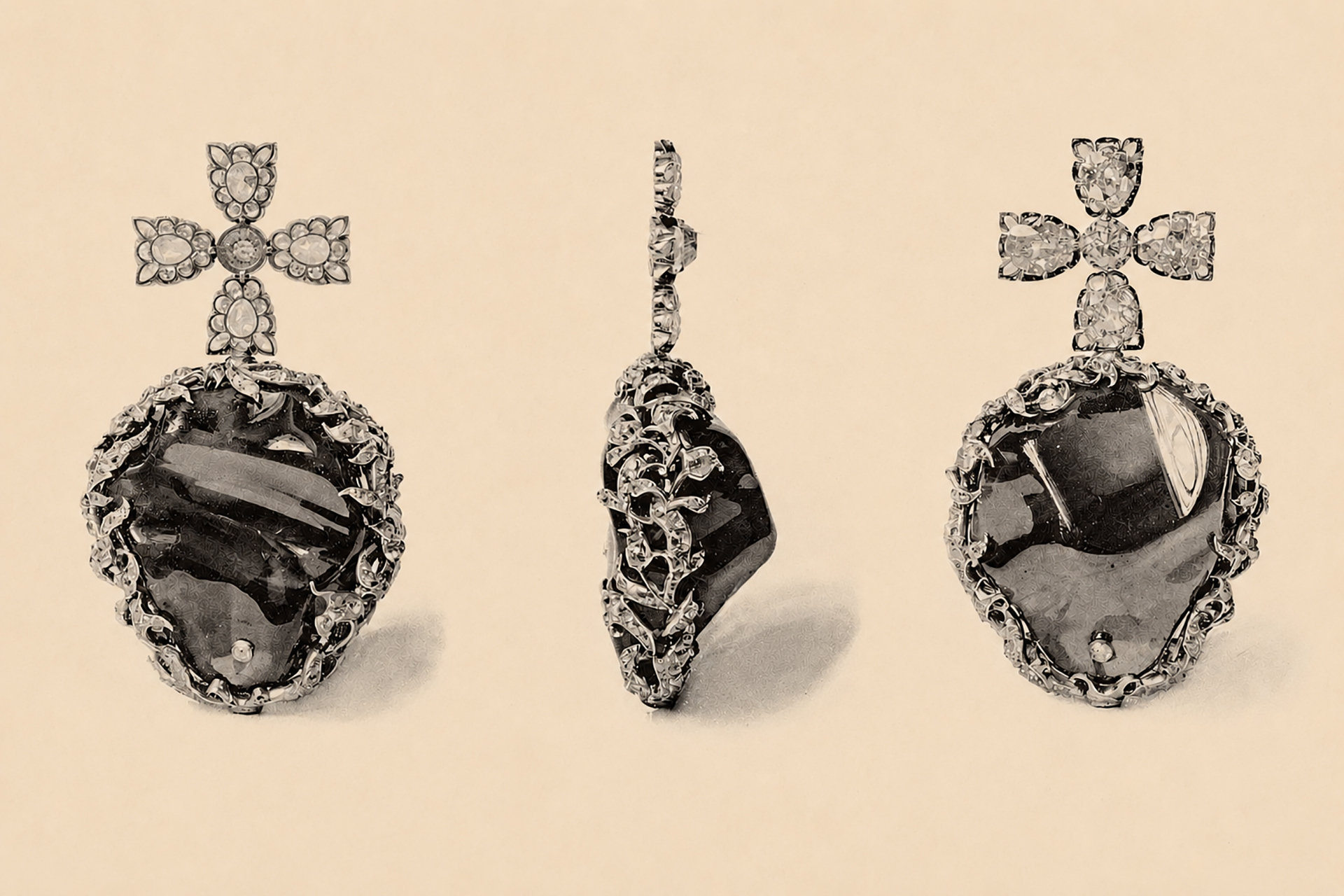
The story repeated itself in the north. The Great Imperial Crown of Russia, made in 1762 by the court jewellers Georg Friedrich Eckart and Jérémie Pauzié for the coronation of Catherine the Great, is crowned by an enormous red spinel of 398.72 carats — one of the largest in the world, brought to Russia as early as the seventeenth century. Generations took it for a ruby; it presides to this day over the most magnificent of the Romanov regalia in the Diamond Fund. The lesson of these stories is simple and has lost none of its force: even the most practised eye needs a laboratory.
The Colour of Power
Long before spectrometers, the ruby was the stone of warriors, kings, and gods.
The Romans gathered the red stones under the word carbunculus — “little coal”; the Greeks before them said anthrax — “burning ember.” Pliny the Elder wrote of glowing stones in his Natural History; in the eleventh century, Bishop Marbodius of Rennes called the ruby the most precious of the stones of creation. Medieval Europe credited it with the gift of health, wisdom, fortune in love, and protection from harm; it was even said that the stone darkened to warn its owner of approaching danger.
Nowhere was the faith more literal than in Burma, home to the finest stones. Burmese warriors were said to believe a ruby made a man invulnerable in battle — but only, legend insisted, if the stone were not merely worn but set beneath the skin, made part of the body itself. In the Indian tradition, the offering of a fine ruby to Krishna promised the giver rebirth as an emperor. Through all these stories — Rome, India, Burma, medieval Europe — runs a single thread: the conviction that a stone the colour of blood and fire holds within it the very principle of life. Belief is optional. But even today, millennia later, that colour works on a human being exactly as it worked on a Roman legionary and a Burmese warrior.
Two Valleys
The geography of the ruby is a novel in itself. For more than eight centuries, the finest stones in the world came from the Mogok valley in Upper Burma, present-day Myanmar — the legendary “Valley of Rubies.” By a rare geological caprice, rubies were born there in marble almost devoid of iron — which is why their red is so pure and their glow so visible: nothing stood in the way of chromium’s fire. The mines of Mogok yielded many of the most celebrated rubies in history, and the word “Burmese” on a certificate still commands a premium no other origin can match.
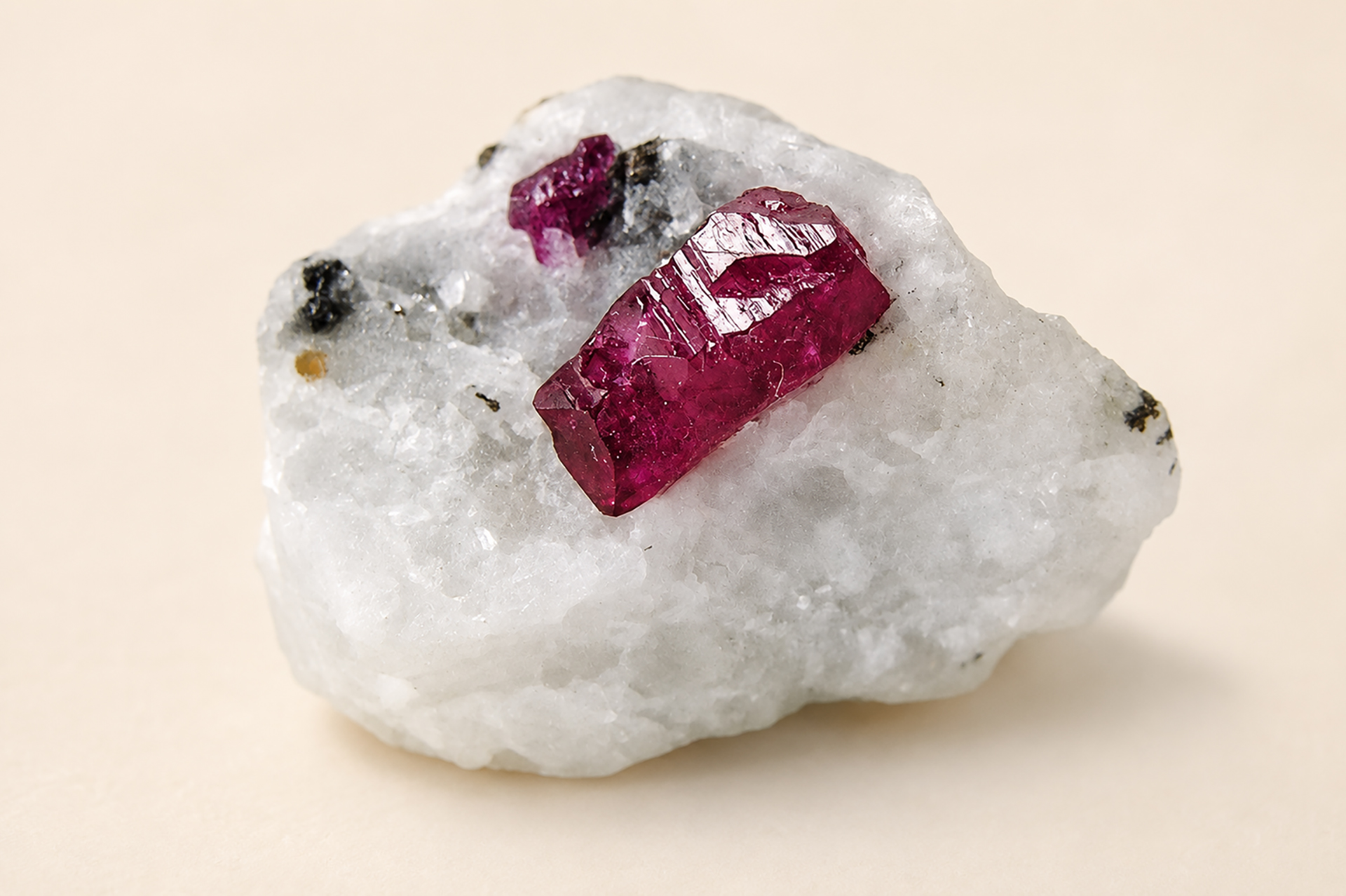
The classic Mogok deposits are today close to exhaustion, and the twenty-first century opened a new chapter where no one expected it. In 2009, near Montepuez in Mozambique’s Cabo Delgado province, a colossal deposit was confirmed — now the largest in the world, worked since 2011 by a venture in which Gemfields participates. Mozambique rubies rival the Burmese in colour, often surpass them in clarity and size — and they arrive with something the old stones frequently lack: a transparent, documented history of origin. The geography of desire is shifting before our eyes; the connoisseur now reads in a certificate not only the deposit but the destiny.
From the Maharajas’ Treasuries to the Auctioneer’s Hammer
The stone of kings has always gathered at the summits of the jeweller’s art — and its modern history can be read in a handful of legendary objects.
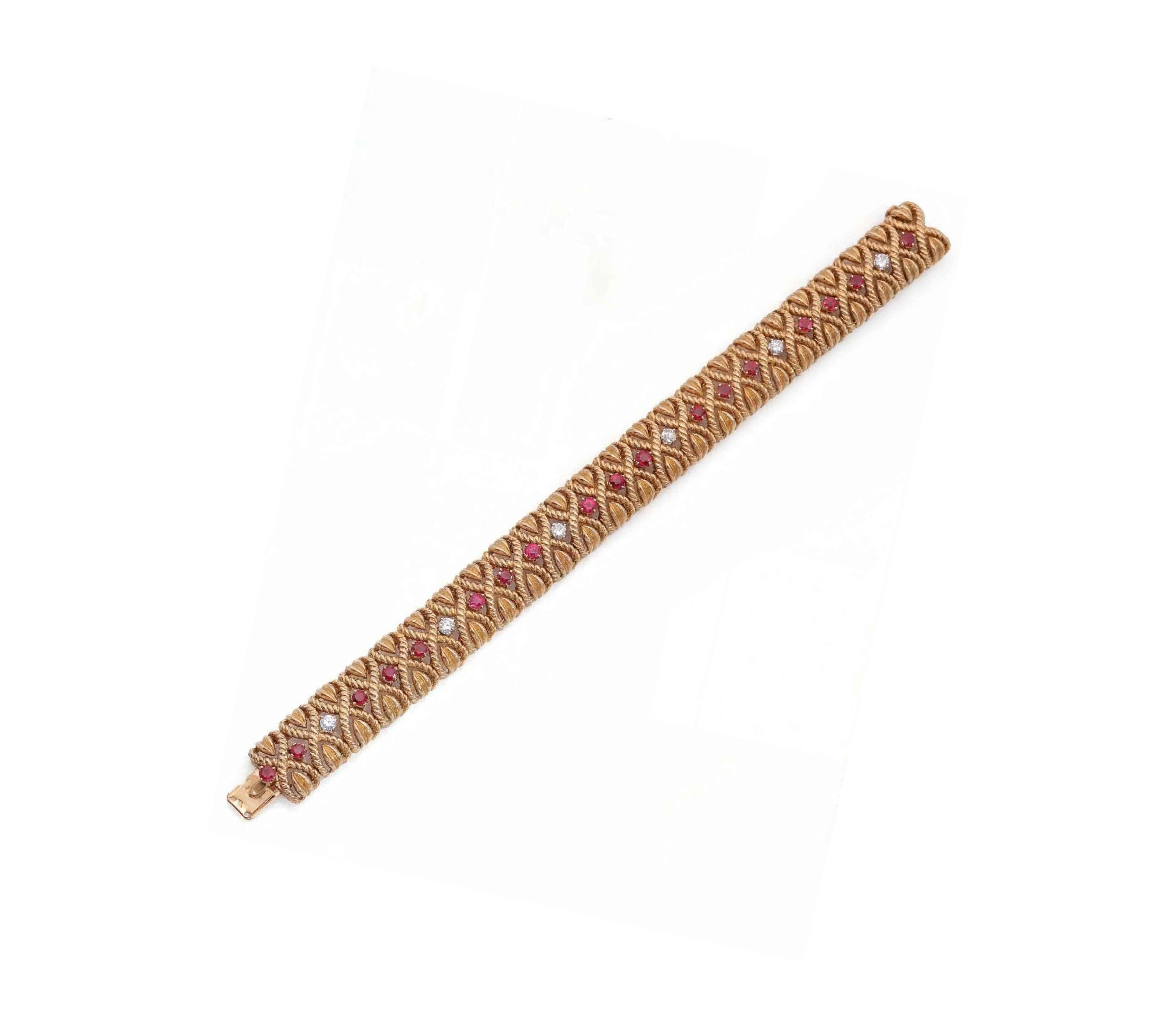
When the Maharaja of Patiala, Bhupinder Singh, entrusted the House of Cartier with transforming his treasury, the result was the Patiala Necklace — commissioned in 1925 and completed by 1928, one of the largest commissions in Cartier’s history: 2,930 diamonds, among them the yellow “De Beers” of 234.65 carats, the largest cushion-cut yellow diamond in the world — and strands of select Burmese rubies. A decade later, in 1937, Cartier created for the Maharaja of Nawanagar a ruby necklace of 116 oval and cushion-cut Burmese stones totalling more than 170 carats, drawn from the mines of Mogok. A long social life awaited this jewel: in 1966 Gloria Guinness wore it to Truman Capote’s legendary Black and White Ball; today it belongs to the Al Thani Collection.
In Hollywood the ruby found royalty of another kind. On Christmas morning of 1968, Richard Burton gave Elizabeth Taylor — perhaps the most discerning private collector of her era — a Van Cleef & Arpels ring with an untreated Burmese ruby of 8.24 carats, hidden, as the story goes, in the toe of a Christmas stocking. “It was the most perfect coloured stone I’d ever seen,” she recalled. When her collection went under the hammer at Christie’s on 13 December 2011, the ring sold for $4,226,500 — four times its estimate, and a then world-record price per carat: $512,925. The sale of the collection as a whole brought $115.9 million.
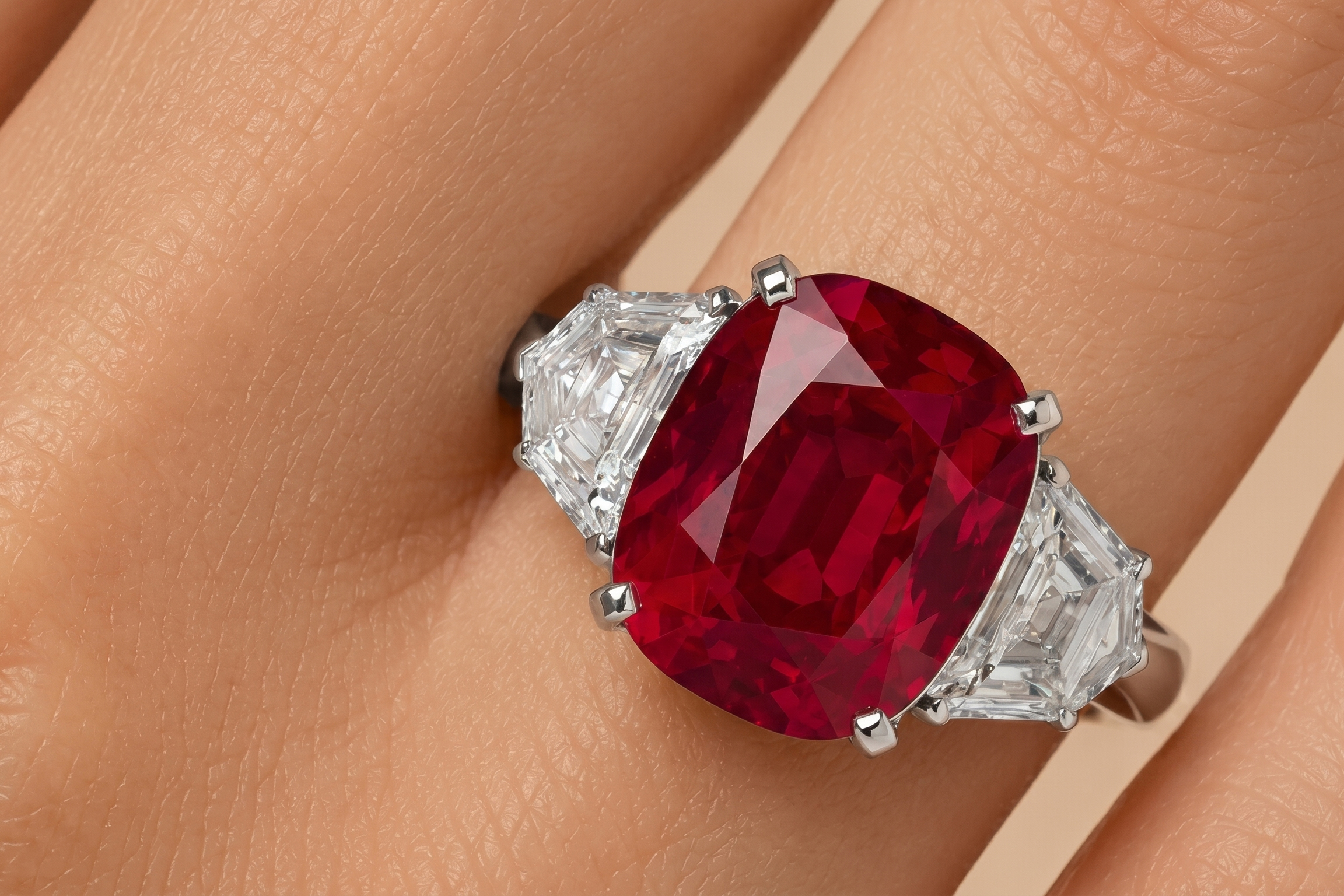
And then came two stones that redrew the boundaries of the possible. In May 2015, at Sotheby’s in Geneva, the Sunrise Ruby — a Burmese pigeon’s-blood stone of 25.59 carats in a Cartier setting, named after verses by the thirteenth-century Sufi poet Rumi — sold for $30.42 million, that is, $1,183,044 per carat: a figure Guinness World Records still lists as unsurpassed on a per-carat basis. Eight years later, on 8 June 2023, at Sotheby’s in New York, the Estrela de Fura — a Mozambique ruby of 55.22 carats, cut from a 101-carat crystal found at Montepuez — went for $34.8 million. It stands as the world-record auction price for a ruby. Together, these two stones tell the whole modern history of the genre: the old Burmese ideal and the young African colossus, the romance of Mogok and the ascent of Montepuez.
Three Questions to Ask a Stone
No stone rewards knowledge quite like the ruby. Two that look alike to the eye can differ in price tenfold or more, and three questions decide the gap — the questions a connoisseur asks of every stone.
The first question is about colour, and the eye answers it before the mind does. The ideal is a red both pure and deep — no brown in it, no heavy darkness — and always alive: the finest stones carry that soft fluorescence that makes a ruby look not lit but kindled.
The second question is about origin, and it is really a question of lineage. For a century the word “Burma” in a laboratory report has rung like a title, carrying with it the rarity, the history, and the romance of Mogok. But times change, and the best stones of Mozambique now answer that old aristocracy with the one argument it cannot rebut: pure beauty.
The third question, ever more often the decisive one, asks what human hands have done to the stone. The vast majority of rubies on the market have been improved by heat — a practice old, honest, and universally accepted. Which is exactly why a stone the furnace has never touched, certified untreated by a laboratory, belongs to another order of value: the gap is measured in multiples, not percentages.
Hence the connoisseur’s first rule: the first instrument is not the loupe but the laboratory report. Any ruby of consequence should arrive with a document from a respected house — the GIA, SSEF, or Gübelin — stating its origin and its treatment. A certificate is where romance meets rigour; in its way, it is the stone’s horoscope — a record of where the stone was born and what has befallen it, written by those who know how to read a fate in its inclusions.
The Sun, Set in Stone
Every time the ruby’s legend was brought before the court of facts, the facts sided with the legend. The tale of an unquenchable flame found its name at last — fluorescence. The Sanskrit title “king of gems” was sealed by the auction records. And the belief that the stone itself chooses whom to crown was borne out by three thousand years of crowns and treasuries. Whether to believe the stars, each reader of this series will decide alone. The ruby is the one party indifferent to the verdict: it burned with a fire of its own long before any theory, and will go on burning long after.
So — which stone is yours? The answer may already be waiting in the next chapter. Almost the whole circle of the zodiac lies ahead, and every sign has its stone, its legend, and its price.