Three Colour Mechanisms, One Stone
Multi-modifier fancy color grades require multiple independent colour mechanisms to operate within a single crystal — a geological co-occurrence scarce enough that GIA designations of this complexity appear infrequently even across large grading datasets. Brownish yellowish orange combines nitrogen-aggregate chemistry, structural lattice deformation, and the specific defect configurations producing orange saturation. Each mechanism is individually uncommon; their convergence in one stone is statistically improbable.
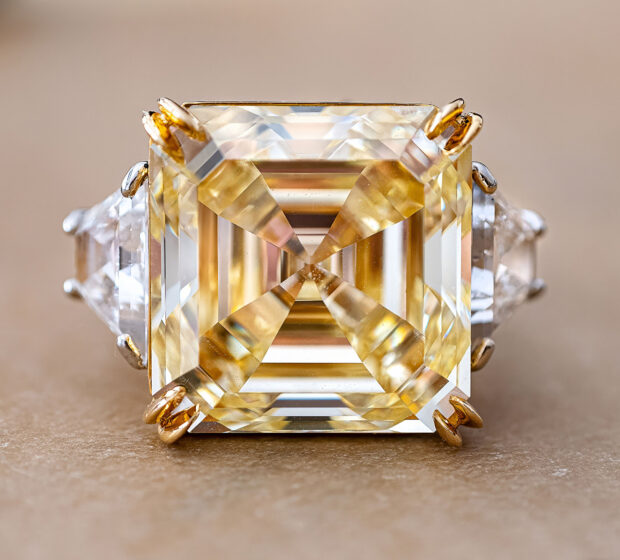
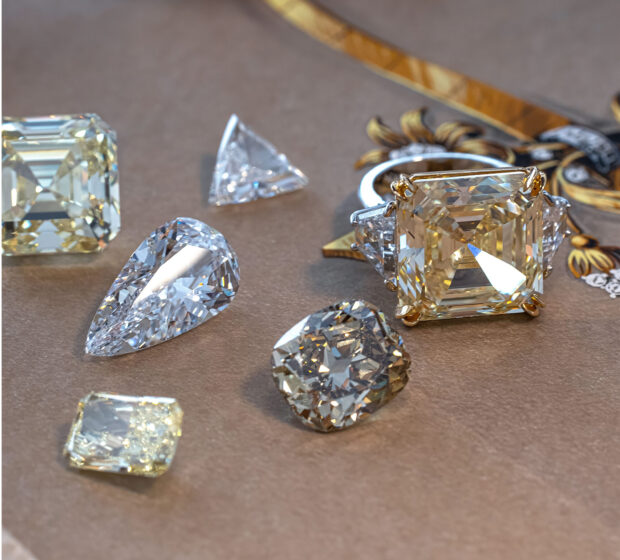
Emerald cut is the natural choice for this colour category. Where brilliant faceting disperses light into discrete flashes, step-cut planes create continuous transparent windows through the stone, making the layered amber-orange-yellow interaction visible as a coherent chromatic whole. This optical coherence is part of what makes premium high value specimens in multi-modifier fancy color grades particularly compelling at collector level.
Authentication of Exceptional Multi-Modifier Fancy Color Diamonds
Each colour mechanism present in this grade can independently be induced through laboratory treatment. GIA Color Origin determination documents natural co-occurrence explicitly — the foundational record for any serious acquisition in this category.
SI1 clarity in emerald cut requires specific consideration: step-cut transparency makes inclusions more apparent than in brilliant cuts of equivalent grade. Experienced collectors weight natural colour certification and estate documentation proportionally higher in this context. For rare loose diamonds of this complexity, the gemological record establishes what the eye cannot determine, and estate quality documentation is the basis of long-term resale value. Material meeting this standard satisfies investment quality criteria applied by auction specialists and institutional buyers.
Heritage and Exclusivity in Rare Fancy Color
Supply of Fancy Deep Brownish Yellowish Orange material at collector grade is constrained by geology, not market cycles. The three-modifier colour origin, deep saturation intensity, and precision emerald cut combine rarity factors that operate independently — each sufficient on its own to define an exceptional stone, their convergence defining a museum-quality one.
Bespoke luxury commissions benefit from acquiring fine collector diamonds in unset condition: full documentation remains accessible, independent verification is straightforward, and the stone’s chromatic character can be considered against specific setting requirements before commitment. Estate collectors in particular value this flexibility, as unmodified condition preserves the provenance continuity that auction specialists and private buyers recognise in museum-quality material. Price appreciation for exceptional rare natural multi-modifier diamonds reflects the growing recognition that colour complexity at this level is irreproducible — timeless material whose exclusivity is written into its geological origin.